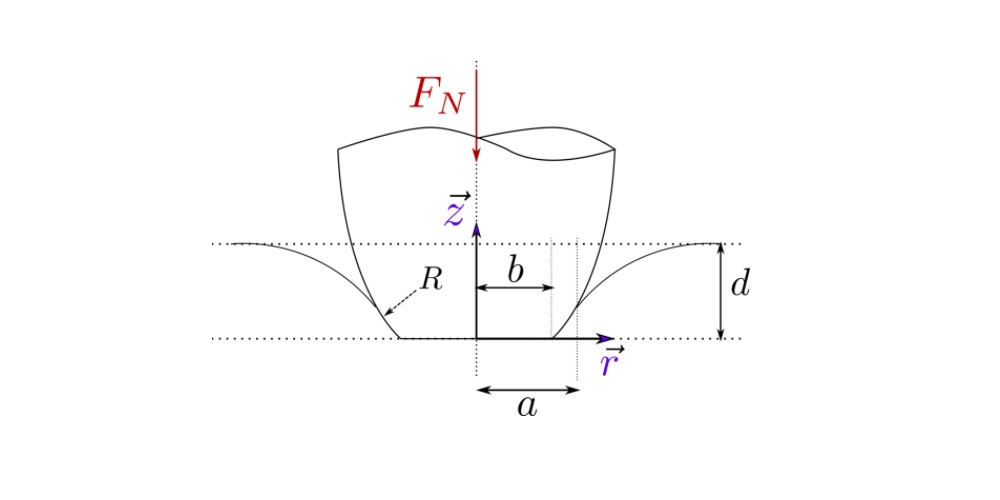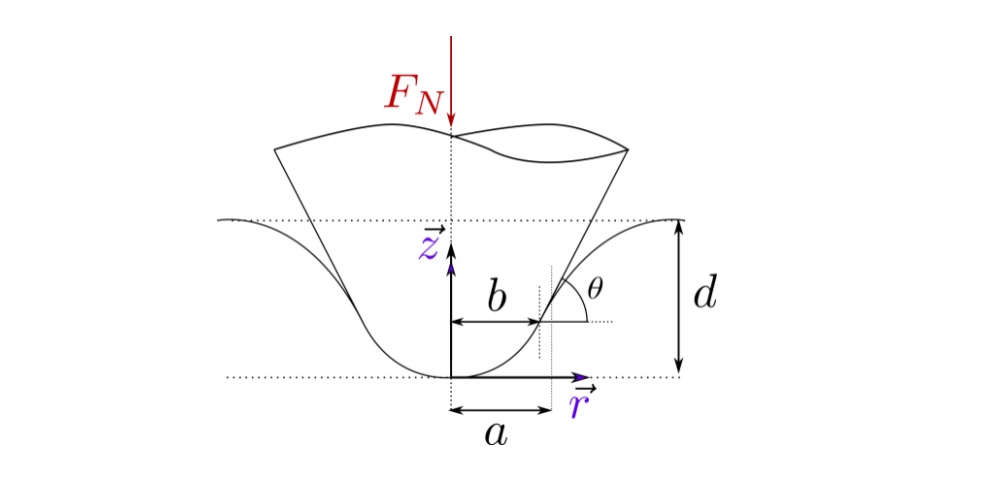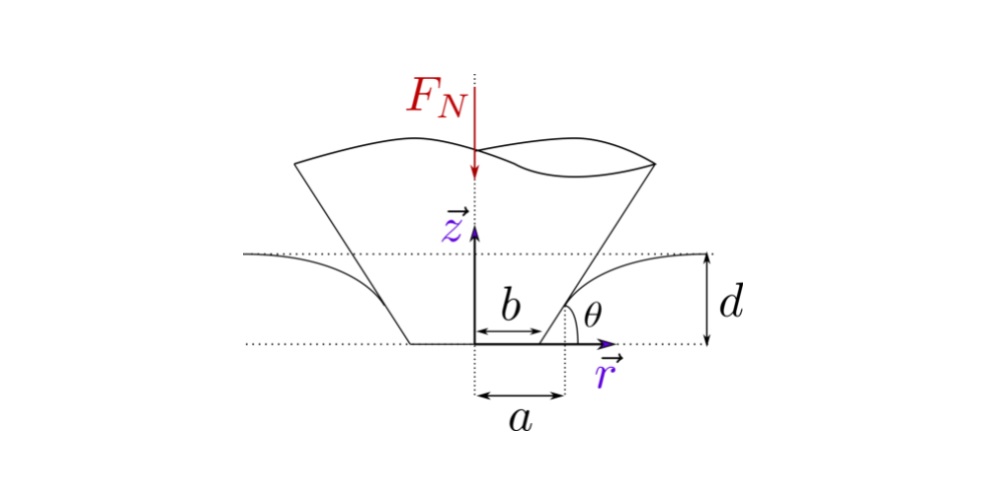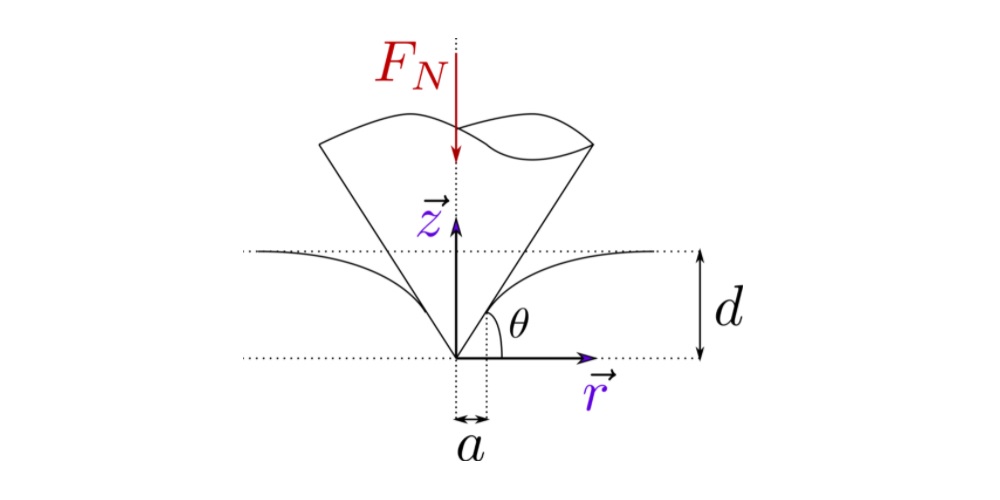







An EHL Film Thickness Calculator allows calculating central and minimum film thicknesses in a full film lubricated line (cylindrical) contact as a function of entrainment speed. The central and minimum film thicknesses are calculated using equations developed by Dowson et al [1,3] and Moes et al [2,4]. The equations used in the calculator are given below the calculator along with the definitions and references. The calculator allows choosing one of the two equations in the calculations.

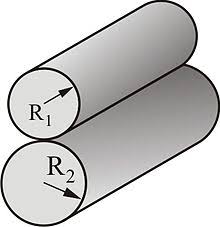
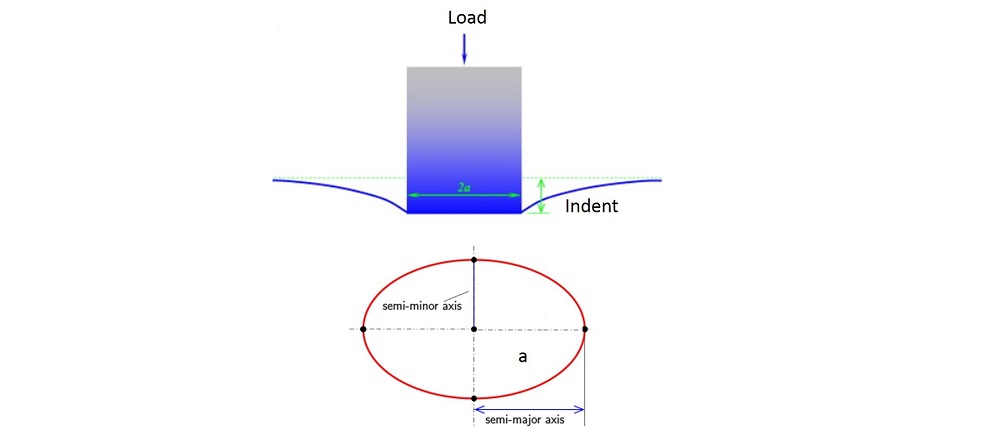
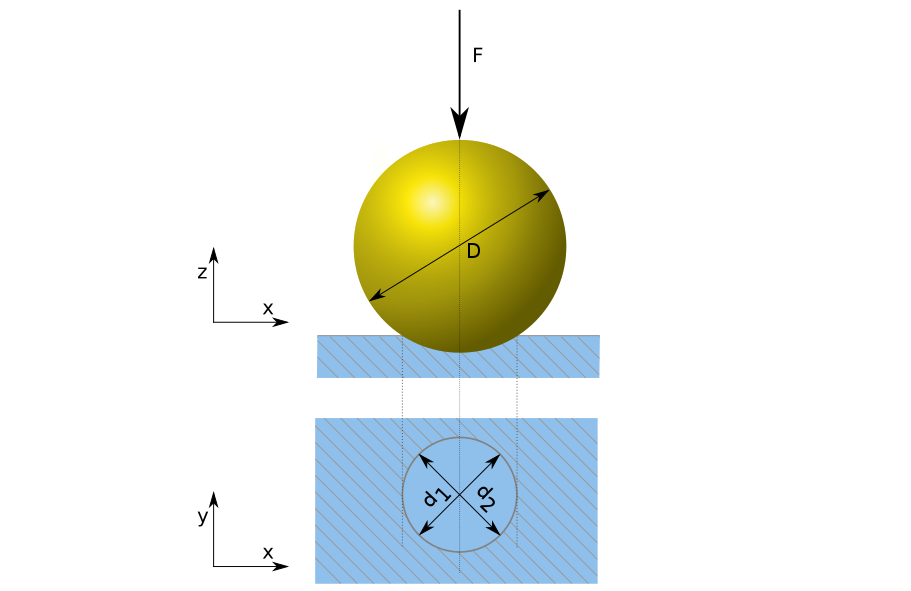
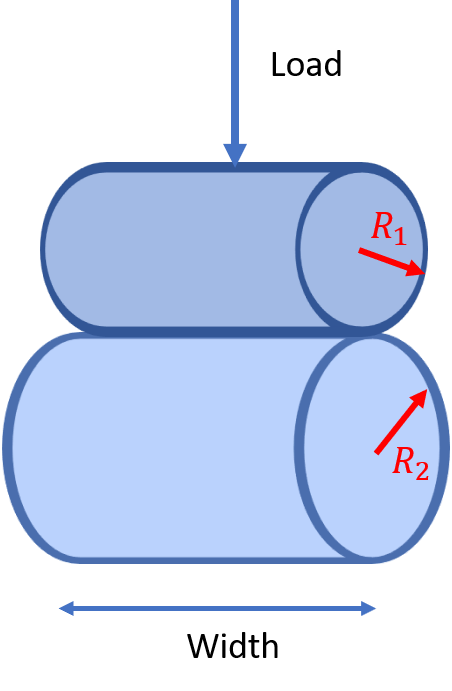
Figure 1. Cylindrical Contact
Central film thickness formulas
Dowson et al formula [1]
Dowson and Toyoda developed a following equation for central film thickness calculations [1]:
(1) 
where
(2) 
Definition of the dimensionless variables are given below.
Moes developed another central film thickness equation [2]:
(3) 
where
(4) 
with
(5) 
Minimum film thickness formulas
Dowson et al formulas
For the calculation of minimum film thickness in a cylindrical contact following Dowson [3], the following equations were used:
(6) 
With
(7) 
Moes et al formulas
According to Moes, the equations for calculation of the minimum film thickness are as follows[4]:
(8) ![\begin{equation*} H_{min} = \left([(0.99\cdot M^{-1/8} L^{3/4} \cdot t)^r + (2.05\cdot M^{-1/5})^r]^{s/r} + (2.45 \cdot M^{-1})^s \right)^{1/s} \end{equation*}](https://quicklatex.com/cache3/30/ql_7875ecdf2336d2f768f0444d9593d230_l3.png "Rendered by QuickLaTeX.com")
where
(9) 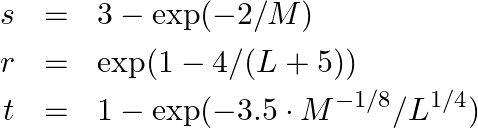
with
(10) 
The calculator input is always the mean entrainment speed. Internally, the Moes equations use twice this input (the sum speed), whereas the Dowson equations use the input directly. With these definitions of U, both Moes thicknesses use the factor  ; no additional factor of 2 is applied during conversion to dimensional thickness.
Hertzian line-contact quantities
The Hertz output uses the same combined transverse radius and elastic modulus as the film-thickness calculation. Here B is the contact length, a is the contact half-width, and the full contact width is 2a. A radius input of 0 represents a flat surface (infinite radius).
(11) 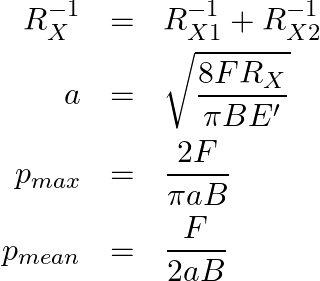
The EHL convention used here is E’ = 2E*, where E* is the conventional Hertz contact modulus. Using E* instead gives the equivalent expression a = sqrt(4 F R_X / (pi B E*)).
Definitions:
Poisson’s ratio  dimensionless,
Young’s modulus of elasticity  , [Pa],
Equivalent elastic constant  , [Pa],
Base oil viscosity (dynamic)  , [Pa
, [Pa  ],
],
Pressure-viscosity coefficient  , [
, [ ],
],
Mean entraining velocity  , [
, [ ] in the equations by Dowson et al. For Moes et al equations, the sum velocity is used:
  , []
, []
Equivalent radii of curvature in X direction  , [
, [ ]
]
Normal applied load  , [N]
, [N]
Material parameter [1],  , dimensionless
Speed parameter [1],  , dimensionless
Load parameter [1],  , dimensionless
Modified load parameter [3],  , dimensionless
Viscosity parameter [3],  , dimensionless
References:
[1] Dowson, D.; Toyoda, S. A central film thickness formula for elastohydrodynamic line contacts. In Proceedings of the 5th Leeds-Lyon Symposium on Tribology, Leeds, UK, September 1978; pp. 60–65.
[2] H. Moes. Lubrication and beyond, University of Twente lecture notes, 2000.
[3] D. Dowson. Elastohydrodynamic and micro-elastohydrodynamic lubrication. WEAR, 190(2), December 1995.
[4] Moes, H. Optimum Similarity Analysis with applications to Elastohydrodynamic Lubrication. Wear 1992, 159, 57–66.