







Macro and Nano-tribology of Carbon nano tubes
Introduction Macro-tribology focuses on the study of friction and wear at a large scale, typically involving macroscopic systems and components. In contrast, nanotribology is concerned with understanding the behaviors and changes in frictional interfaces at the nanoscale, where interactions occur...

Nanoscale Wear in Extreme tribology applications
Introduction Extreme tribology is a branch of tribology that focuses on the behavior of materials under extreme conditions, such as elevated temperatures, extreme pressures, or high sliding speeds. This field investigates friction, wear, and lubrication phenomena in harsh environments and...


Nanoparticles as lubricant additives
Introduction Lubrication refers to interposition of solid, liquid or gaseous material in between surfaces of two material in contact to minimize friction and wear. All commercially available lubricants have additives in their formulation which enhance certain properties of oil like...
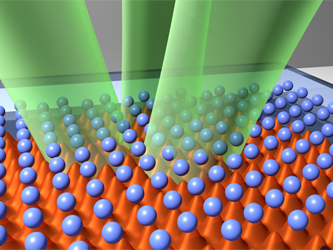
Achieving superlubricity with high temperature
Lubrication between two surfaces depends on their respective co-efficient of frictions, surface finishes and also the type of lubricant used, if there is any. It is known that the temperature at which these surfaces are placed will also play a...


Discontinuous Shear Thickening
If you sometimes wander on youtube, you have probably already seen a video about experiments on cornstarch mixed with water. They were quite popular a few years ago. These videos show the surprising properties of the mixture (also known as...
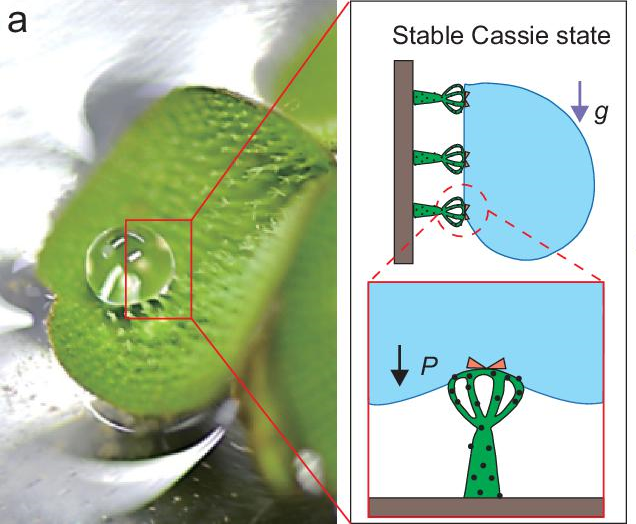
An Engineered Salvinia-like Slippery Surface
The surface properties of materials are often critical because they dictate how they react with their external environment. An important property currently under intense investigation is how surfaces interact with liquids like water. In a wide range of industrial applications,...


Structural Lubricity: A Recent Overview
Tribology is largely concerned with understanding of the (friction) forces acting at the interface between objects moving against each other (Menezes et al., 2013). Over the recent years there has been significant progress in understanding and controlling friction, and in...
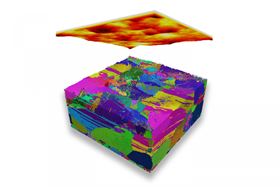
Close Examination of Frictional Wear on an Atomic Scale
Friction and wear have long been a focus of scientists, researchers, engineers, and industries around the world. The common goal is to maximize profits, however, the environmental impact becomes even more important. Wear and friction on machinery and its various...


A New Way to Understand Friction
Friction is a part of everyday life. Most of us do not think about friction at all, except perhaps when we are trying to push something heavy along the floor, cursing the friction that it is making it more difficult....

Superlubricity of carbon nanotubes as a prerequisite for mechanically activated ionic transport
The field of nanofluidics is the study of the behavior, control and manipulation of fluids that are confined in extremely small structures. The dimensions of these minute structures typically range from 1 nanometer to 100 nanometers (1 nm = 10-9...