







Friction Test
Friction Test describes friction test as a practical tribology topic: how surfaces interact, how friction, wear, lubrication, material response, and operating environment influence performance, and what engineers should check when applying the concept in real machines or laboratory tests.
- Core idea: friction test should be interpreted as a system-level contact problem, not as an isolated material property.
- Engineering relevance: load, speed, temperature, surface roughness, chemistry, and lubrication regime can change the observed behavior.
- Good practice: combine measurements with surface inspection and clear reporting of test conditions.
- Failure prevention: use the topic to identify risks early, compare alternatives, and improve reliability.
Table of Contents
What is Friction Test?
Friction Test is part of the wider study of friction, wear, contact mechanics, materials, and lubrication. In practical use, the term is most useful when it is connected to a defined contact pair, surface condition, operating load, motion type, and environment.
For engineers, friction test is not only a definition. It is a way to ask which mechanisms control performance at an interface: elastic or plastic deformation, adhesion, abrasion, fatigue, chemical film formation, lubricant starvation, debris generation, or changes in surface topography.
Why Friction Test matters in tribology
Friction Test matters because small changes at the surface can produce large changes in efficiency, temperature, noise, lifetime, and failure risk. A contact that appears acceptable under one load, speed, or lubricant can behave very differently when the regime shifts from full-film lubrication to mixed or boundary lubrication.
| Question | Why it matters |
|---|---|
| What materials and surfaces are in contact? | Hardness, roughness, coating, oxide layers, and chemistry influence friction and wear. |
| What motion occurs? | Sliding, rolling, reciprocating, impact, and vibration activate different damage mechanisms. |
| What lubrication regime is present? | Boundary, mixed, hydrodynamic, and elastohydrodynamic regimes produce different surface separation and film behavior. |
| What environment is involved? | Temperature, humidity, vacuum, contamination, and reactive species can strongly change tribochemical response. |
Engineering factors to consider
- Contact stress and geometry: estimate nominal and local contact pressure, including asperity-scale effects where relevant.
- Surface topography: measure roughness, waviness, texture direction, and surface defects before and after testing.
- Lubricant selection: consider viscosity, additives, supply method, contamination, and compatibility with materials.
- Thermal conditions: frictional heating can change viscosity, hardness, oxidation rate, and tribofilm formation.
- Running-in: early surface adaptation may control the later steady-state response.
- Debris control: wear particles can become a third body, accelerating abrasion or changing friction.
Measurement and interpretation
When evaluating friction test, report the test configuration clearly: specimen geometry, material grade, surface roughness, lubricant, load, speed, temperature, duration, environment, and repeat count. Tribology results are often system-dependent, so a coefficient of friction, wear scar, or lifetime result should not be treated as a universal property without context.
Useful measurements include friction trace, wear volume or wear rate, surface profilometry, optical or electron microscopy, hardness, lubricant condition, and chemical surface analysis where tribofilms or oxidation are expected.
Detailed background and source material
What is a friction test?
In tribology, measurement of friction consists of the evaluation of forces that occur and oppose a relative motion in a tribological contact. According to ASTM standard G 40, the friction force is “the resisting force tangential to the interface between two bodies when, under the action of external force, one body moves or tends to move relative to the other”. This interface may occur between solids, solids/liquids and also may involve particles.
Since friction depends not only on the applied forces but also on the environment, each application, in general, requires a very specific friction measuring device that replicates the desired conditions. This gives rise to a large variety of devices that are built to measure friction for a specific application. All these devices can be called tribometers. Friction can be measured either directly by measuring the forces in the contact or indirectly. The list of several friction measuring configurations can be found in ASTM standard G 115 list.
What is Tribometer?
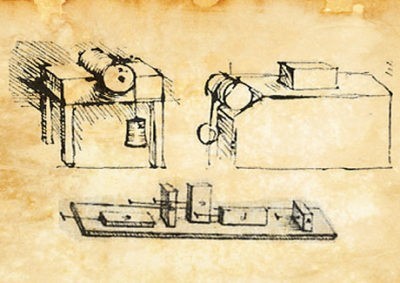
The term ‘tribometre’ was introduced in the 1700s by Goldsmith. The term comes from the Greek word ‘tribos’ meaning ‘rubbing’ and “metron” meaning “measure”. Currently, tribometers can be used to quantify not only friction but also wear of the solids. The first known tribometer device can be attributed to the First Tribologist – Leonrado da Vinci, see Figure 1. His tribometer consists of pulleys and blocks. The simplest device to measure friction is probably an inclined plane with a possibility to measure the angle at which the motion of the block starts, see Figure 2. At the same time, tribometers can be as sophisticated as Atomic Force Microscopes that measures friction using piezoelectrically controlled nano-scopes tips in extremely controlled environments.

Figure 2. Inclined plane friction measurement device
Factors Important in a Friction Test
In order to perform a valid friction measurement test, one must consider the following factors:

- The measuring device should simulate the tribosystem as closely as possible
- The geometry of the test specimens should resemble the system of interest
- Conditions (contact pressure, speed, temperature, humidity, etc) of the test must resemble the ones encountered in the system of interest
- Samples should be cleaned and prepared for the test consistently
- The surface roughness of the test samples should be the same as in the evaluated tribosystem
- How to prepare samples for friction test
Friction forces often depend significantly on the surface characteristics of the tested samples. Consequently, the performance of a valid friction test requires preparation of the surfaces with characteristics representing the surfaces encountered in the evaluated tribosystem. Thus, the surface finish of the test specimens must be representative.
At the same time, the technique used to clean the surfaces prior to the test may influence the results. There is no single, best technique to prepare samples for friction testing. For instance, using solvents like acetone and ethanol for cleaning the metallic surfaces might be reasonable but similar solvents would not work well with polymers. Thus, selection needs to be made based on the material and purpose of testing.
Types of Friction Tests
-
Inclined Plane Method
As illustrated in Figure 2, this is one of the simplest friction measurement devices that exists. This basic technique measures the inclination angle of the plane required for the relative movement of the block to start. Consequently, the static friction force equals to  and the normal force equals to
  and therefore the static friction coefficient is given by
 . This coefficient is called static friction coefficient.
-
Horizontal Plane Friction Test
This test often referred to as “sled test” is able to measure the friction force directly after the start of the movement (static friction force) and kinetic friction force between a slider and a flat surface during the motion. A common variation of the horizontal plane method utilizes back-and-forward movement to recreate the frictional conditions encountered in application with reciprocal motion.
-
Nanofriction measurement methods
Nanometer scale friction tests have been utilized to quantify the frictional forces using a nanometer-sized probes, such as encountered in Atomic Force Microscopes. The forces rising at this scale are of importance in Microelectromechanical systems (MEMS), lithography, nanoimprinting, etc. A very thorough review of the nanofriction test measurements in particular and nanotribology in general can be found in “Tribology on the Small Scale”, by C. Mathew Mate and R. W. Carpick (2019).
-
Standardized test methods
The wide range of applications where friction plays an important role has brought to the life various measurement tests standards. The standards, such as ASTM standard G 115, give the user a general understanding of the parameters that are important and precautions that need to be performed when performing friction tests. New friction standards are being created continuously with the increase in available knowledge.
Besides the standards, some standard tribometers (devices) also exist. These devices may typically perform a test on a component scale. An example of such tool would be a pin on disk test machine, which is available at various tribometer manufacturers, e.g. RTEC Instruments, Bruker, Optimol Instruments, etc.
FAQs
What is Friction Test in simple terms?
Friction Test is a tribology topic used to understand how contacting surfaces behave under load, motion, lubrication, and environmental conditions.
Why is friction test important for engineers?
It helps engineers diagnose friction and wear problems, choose materials or lubricants, design tests, and prevent surface-related failures.

How should friction test be tested?
Testing should reproduce the relevant contact geometry, motion, load, speed, temperature, surface roughness, lubricant, and environment as closely as practical.
What should be reported with friction test results?
Report materials, roughness, lubricant, load, speed, temperature, duration, environment, friction history, wear measurement method, and post-test surface observations.
See also
References and further reading
- Bhushan, B. Introduction to Tribology. Wiley.
- Stachowiak, G. W., and Batchelor, A. W. Engineering Tribology. Butterworth-Heinemann.
- Hamrock, B. J., Schmid, S. R., and Jacobson, B. O. Fundamentals of Fluid Film Lubrication. CRC Press.
- NIST resources for measurement, materials, and surface characterization.
Last updated: May 2026. Reviewed topic: Friction Test, tribological performance, measurement, and failure prevention.
References
- [1] Standard Guide for Measuring and Reporting Friction Coefficients, ASTM Standard G 115
- [2] Tribology on the Small Scale: A Modern Textbook on Friction, Lubrication, and Wear, Second Edition, C. Mathew Mate and Robert W. Carpick, Oxford University Press, 2019.
- [3] Blau P.J. (2013) Friction Measurement. In: Wang Q.J., Chung YW. (eds) Encyclopedia of Tribology. Springer, Boston, MA. https://doi.org/10.1007/978-0-387-92897-5_171
- [4] Chai, J., Zhou, Z., Ye, C. et al. Design and development of a novel sliding friction and wear tester with complex working conditions. Sci Rep 11, 6903 (2021). https://doi.org/10.1038/s41598-021-86451-4
0 Comment