







Rolling Contact Fatigue
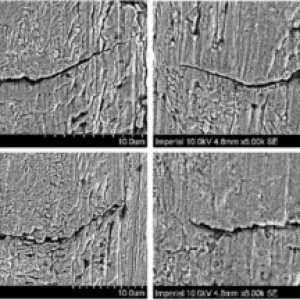
Rolling contact fatigue (RCF) is a fatigue failure mechanism in rolling contacts where repeated Hertzian stresses create cracks near or below the surface. As cracks grow, material can detach as pits, spalls or flakes. RCF is a critical life-limiting process in bearings, gears, cam followers, railway wheel-rail contacts and other machine elements that operate under repeated rolling or rolling-sliding contact.
- Key takeaway: Rolling contact fatigue is driven by cyclic subsurface and near-surface stresses in nonconformal contacts.
- Key takeaway: The main visible damage forms are pitting, spalling and flaking.
- Key takeaway: Surface roughness, lubrication, material cleanliness, residual stress and contact load strongly influence RCF life.
- Key takeaway: Good alignment, clean lubrication and avoiding overload are essential for controlling RCF in bearings and gears.
Table of Contents
- What is rolling contact fatigue?
- Where rolling contact fatigue occurs
- RCF damage modes: pitting, spalling and flaking
- Why RCF differs from classical fatigue
- Main causes and risk factors
- How to reduce rolling contact fatigue
- FAQs
- References
What is rolling contact fatigue?
Rolling-contact fatigue (RCF) is defined as failure or material removal driven by crack propagation caused by a near-surface alternating stress field. In a properly mounted, aligned, lubricated, maintained and non-overloaded bearing, classical bearing life is often limited by RCF rather than by immediate adhesive or abrasive wear.
In rolling contact, two curved bodies touch over a small contact patch. The resulting stress state is governed by Hertz contact theory. Each rolling pass applies a repeated stress cycle to material below the surface. Over many cycles, microcracks can initiate at inclusions, defects, roughness peaks or near-surface plastic zones. Once cracks propagate back to the surface, material can detach and create visible pits or spalls.
RCF is closely related to tribology because friction, lubrication regime, surface roughness, wear debris and lubricant cleanliness all influence crack initiation and growth. For background, see TriboNet’s articles on mixed lubrication, wear particles and surface fatigue.
Where rolling contact fatigue occurs
RCF is commonly observed in machine elements where repeated rolling or rolling-sliding contact carries high load. Typical examples include:
- Rolling element bearings in motors, turbines, gearboxes and wheels.
- Gear teeth, especially near pitch-line rolling-sliding regions.
- Cam and follower contacts in engines and industrial mechanisms.
- Railway wheel-rail contacts, where RCF can create head checks, squats and shelling.
- Traction drives and rollers operating under high contact pressure.
Because RCF often develops gradually, early damage may be detected by vibration monitoring, acoustic emission, oil-debris monitoring, magnetic particle inspection or surface microscopy before catastrophic failure occurs.
RCF damage modes: pitting, spalling and flaking
RCF may appear through subsurface-originated spalling and/or surface-originated pitting. The dominant mechanism depends on surface quality, lubricant cleanliness, material quality, load, sliding, residual stresses and operating environment.
Spalling occurs when microcracks initiate below the surface, often at nonmetallic inclusions or material inhomogeneities, then propagate toward the surface. Smooth surfaces, high material cleanliness demands and limited surface shear are often associated with subsurface-originated spalling.
Pitting is more surface-driven. Surface roughness peaks, dents, scratches or debris impressions act as stress raisers and can initiate cracks at or near the surface. These cracks may grow at a shallow angle, commonly reported around 15–30 degrees to the surface, and then turn back toward the surface, releasing a small pit.
Flaking is a larger-scale form of material detachment. Once pits or cracks coalesce, larger pieces of surface material can break away, increasing vibration, noise and debris generation. The released particles can then accelerate further fatigue and abrasive wear.
Why RCF differs from classical fatigue
RCF differs from classical fatigue because rolling contacts create a highly localized, moving and multiaxial stress field. Several features are especially important:
- The stress state in nonconformal contacts is complex, multiaxial and governed by Hertzian contact theory.
- The loading history at a material point below the surface is nonproportional; stress components do not all rise and fall in the same proportion.
- High hydrostatic stress is present in many nonconformal contacts.
- The stressed volume is small. Typical contact dimensions may be on the order of hundreds of micrometers to about a millimeter.
- Localized plastic deformation and residual stresses can strongly influence crack initiation and RCF damage accumulation.
These conditions explain why simple uniaxial fatigue models are often insufficient. Modern RCF analysis may combine contact mechanics, elastoplastic material models, fracture mechanics, surface roughness modelling, lubricant film prediction and fatigue-life statistics.
Main causes and risk factors
- High contact stress: overload or undersized contact geometry increases Hertzian stress and shortens RCF life.
- Poor lubrication: thin films increase asperity interaction, surface shear and pitting risk.
- Contaminated lubricant: hard particles can dent surfaces and create crack initiation sites.
- Surface roughness and dents: roughness peaks and indentations act as local stress raisers.
- Material inclusions: nonmetallic inclusions can initiate subsurface cracks.
- Misalignment: edge loading concentrates stress and accelerates fatigue.
- Residual stress and heat treatment: beneficial compressive residual stress can improve life, while harmful tensile stress can reduce it.
How to reduce rolling contact fatigue
- Reduce contact stress: improve load distribution, avoid overload and select suitable bearing or gear geometry.
- Improve lubrication: maintain adequate film thickness, viscosity and additive chemistry for the operating regime.
- Keep lubricant clean: use filtration, sealing and contamination control to prevent denting and debris damage.
- Control surface finish: avoid damaging roughness, grinding burns and handling dents.
- Use clean bearing steels: reduce inclusion content and improve microstructural consistency.
- Apply surface treatments: shot peening, case hardening and coatings can improve fatigue resistance when correctly specified.
- Monitor condition: vibration, temperature and oil-debris monitoring can detect early RCF progression.
FAQs
Is rolling contact fatigue the same as wear?
No. RCF is a fatigue crack-growth process caused by repeated rolling-contact stresses. Wear is broader material loss or surface damage caused by sliding, abrasion, adhesion, corrosion or fatigue. RCF can produce wear particles after pits or spalls detach.
What is the difference between pitting and spalling?
Pitting is usually smaller and often surface-initiated. Spalling is larger material detachment and often associated with subsurface crack growth, although real failures can involve mixed mechanisms.
Why does lubricant cleanliness matter for RCF?
Hard contaminant particles can indent the surface. The dents create local stress concentrations and edge effects that accelerate crack initiation and pitting.
Can rolling contact fatigue be eliminated?
It can rarely be eliminated completely in highly loaded rolling contacts, but it can be delayed by correct load selection, clean lubrication, good alignment, suitable materials, optimized surfaces and condition monitoring.
Last updated: May 14, 2026.
References
- Harris, T. A. and Kotzalas, M. N. Rolling Bearing Analysis. CRC Press. Publisher information.
- Johnson, K. L. Contact Mechanics. Cambridge University Press. Cambridge University Press.
- Ioannides, E. and Harris, T. A. A new fatigue life model for rolling bearings. Journal of Tribology, 1985. https://doi.org/10.1115/1.3261038.
- Tallian, T. E. Failure Atlas for Hertz Contact Machine Elements. ASME Press. ASME Digital Collection.
0 Comment