







Reynolds Equation – An Overview
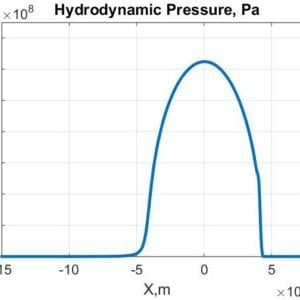
TL;DR: The Reynolds equation is the governing equation for pressure generation in a thin lubricant film between moving surfaces. In tribology it is central to hydrodynamic lubrication and elastohydrodynamic lubrication, because it links lubricant viscosity, surface speed, film thickness and geometry to load-carrying pressure.
- Key takeaway: Reynolds equation is derived from the Navier-Stokes equations using thin-film lubrication assumptions.
- Key takeaway: It predicts lubricant pressure, film thickness trends, friction and load support in bearings and other lubricated contacts.
- Key takeaway: The classical form assumes Newtonian, incompressible, isoviscous, laminar flow with no-slip boundaries.
- Key takeaway: Film thickness is especially important because pressure-flow terms scale with h3.
- Key takeaway: Many practical contacts require generalized Reynolds equations for elastic deformation, cavitation, compressibility, thermal effects, surface texture or non-Newtonian lubricants.
Common use cases: journal bearings, thrust bearings, slider bearings, seals, piston-ring lubrication, textured surfaces and elastohydrodynamic contacts.
What is the Reynolds equation?
The Reynolds equation is a partial differential equation that describes pressure build-up in a thin lubricant film separating two surfaces. It is one of the foundation equations of classical lubrication theory and is used when the lubricant film thickness is small compared with the contact length scale.
Osborne Reynolds introduced the theory in 1886 after interpreting Beauchamp Tower’s bearing-friction experiments. Tower observed that pressure in a lubricated bearing peaks inside the contact rather than simply following the externally applied load. Reynolds explained this by showing that surface motion drags lubricant into a converging gap, generating hydrodynamic pressure that can carry load.

In practical tribology, Reynolds equation is the mathematical bridge between contact geometry, sliding or entrainment speed, lubricant viscosity and the resulting pressure distribution. It is commonly used to estimate load capacity, friction and lubricant film thickness in machine elements where surfaces are separated by a fluid film.
Why does Reynolds equation matter in hydrodynamic lubrication?
Reynolds equation matters because it explains how a lubricant film can support load without solid-solid contact. This is the basic mechanism behind low wear in hydrodynamic bearings and many machine components that operate in full-film lubrication.
| Engineering question | How Reynolds equation helps | Typical design implication |
|---|---|---|
| Will the surfaces separate? | Calculates pressure generated by the lubricant film. | Higher entrainment speed, suitable viscosity and a converging gap improve film formation. |
| Where is the pressure peak? | Solves the pressure distribution across the lubricated contact. | Pressure location affects bearing load capacity, stability and fatigue risk. |
| How sensitive is the contact to film thickness? | Pressure-flow terms include h3, making small thickness changes very influential. | Surface alignment, deflection and roughness cannot be ignored in thin films. |
| Is a classical model enough? | Highlights assumptions that may break down under high load, high shear or surface deformation. | Use generalized or EHL models when pressure-viscosity or elastic deformation is important. |
What is the Reynolds number in lubrication?
The Reynolds number compares inertial forces with viscous forces in a fluid. In thin-film lubrication it is commonly written as:
Re = (inertial forces)/(viscous forces) = ρuh/μ

where Re is Reynolds number, ρ is fluid density, u is characteristic velocity, h is characteristic film thickness and μ is dynamic viscosity. In lubrication, h is usually much smaller than the bearing length or contact width, so viscous effects often dominate and laminar-flow assumptions are usually appropriate.
Reynolds number should not be confused with the Reynolds equation itself. The number helps justify simplifications of the Navier-Stokes equations; the equation then describes the pressure distribution in the lubricant film.
How is Reynolds equation derived from Navier-Stokes?
The full derivation starts from the Navier-Stokes equations and the continuity equation, then simplifies them for a thin lubricant film. A detailed derivation is available in TriboNet’s article on Reynolds equation derivation from Navier-Stokes equations.
The classical derivation assumes:
- Newtonian lubricant with constant viscosity;
- incompressible and laminar flow;
- thin-film geometry, so pressure does not vary significantly across the film thickness;
- negligible body forces and inertia terms;
- no-slip boundary conditions at both surfaces;
- smooth surfaces compared with the nominal film thickness.

What is the classical Reynolds equation?
For an incompressible Newtonian lubricant with constant viscosity, a common two-dimensional form of the Reynolds equation for lubricant pressure is:
∂/∂x[(h3/μ)(∂p/∂x)] + ∂/∂z[(h3/μ)(∂p/∂z)] = 6(U1 + U2)(∂h/∂x) + 12(∂h/∂t)
Here p is lubricant pressure, h is film thickness, μ is dynamic viscosity, x and z are in-plane coordinates, U1 and U2 are surface velocities and t is time.
| Term or variable | Meaning | Practical interpretation |
|---|---|---|
| p | Lubricant pressure | Determines load capacity and local stress in the lubricated contact. |
| h | Film thickness | Small changes strongly affect flow and pressure because of the h3 term. |
| μ | Dynamic viscosity | Higher viscosity usually increases pressure generation but may increase viscous friction. |
| U1, U2 | Surface velocities | Surface motion entrains lubricant into the contact. |
| ∂h/∂x | Wedge term | A converging film creates hydrodynamic pressure. |
| ∂h/∂t | Squeeze-film term | Time-varying gap changes pressure, important in transient contacts. |
What assumptions limit the classical Reynolds equation?
The classical equation is powerful, but its assumptions must match the real contact. It becomes less reliable when pressure changes viscosity, surfaces deform significantly, temperatures vary strongly, flow becomes compressible or cavitation changes the pressure boundary.
| Assumption | When it is reasonable | When to use a generalized model |
|---|---|---|
| Constant viscosity | Moderate pressure and temperature variation. | High pressure-viscosity effects, thermal gradients or shear thinning. |
| Rigid surfaces | Low load or stiff components. | EHL contacts where elastic deformation changes film shape. |
| No slip | Conventional wetting surfaces and ordinary lubricants. | Textured, coated, hydrophobic or engineered-slip surfaces. |
| Incompressible flow | Liquid lubricants at moderate pressures. | Gas bearings, aerostatic films or compressible lubricants. |
| Fully flooded inlet | Sufficient lubricant supply. | Starved lubrication or inlet-limited contacts. |
How is Reynolds equation solved?
Reynolds equation can be solved analytically only for simplified geometries and boundary conditions. Most practical cases require numerical methods such as finite difference, finite element or finite volume methods.
Analytical and semi-analytical solutions are useful for learning and benchmarking. For example, one-dimensional slider or line-contact cases can be solved under simplified cavitation and rigid-surface assumptions. The original article notes that Martin obtained a closed-form solution for minimum film thickness and pressure in a cylinder-plane geometry, while Grubin later introduced an approximate elasto-hydrodynamic approach for line contacts. TriboNet also provides related MATLAB resources for a 1D Reynolds equation analytical solution and Grubin’s approximation.
How do generalized Reynolds equations extend the classical model?
Generalized Reynolds equations relax one or more classical assumptions. In tribology this is important because many real contacts operate at high pressure, high shear rate, thin film thickness and non-uniform temperature.
- Compressible Reynolds equation: used for gas bearings and compressible films.
- Elastohydrodynamic lubrication (EHL): couples pressure generation with elastic deformation and often pressure-dependent viscosity.
- Thermal Reynolds equation: includes temperature-dependent viscosity and heat generation.
- Non-Newtonian Reynolds equation: accounts for shear-thinning or other lubricant rheology effects.
- Slip or texture-modified forms: used for engineered surfaces, micro-textures and high-slip boundary conditions.
- Starved or cavitating models: account for incomplete lubricant supply and vapor/gas-filled regions.
Practical design checklist for applying Reynolds equation
- Define the contact geometry, coordinates and nominal film thickness.
- Confirm whether the lubricant can be treated as Newtonian and incompressible.
- Estimate Reynolds number to check whether inertia can be neglected.
- Choose realistic inlet, outlet and cavitation boundary conditions.
- Include surface speed, squeeze motion and time dependence when relevant.
- Check whether elastic deformation or pressure-viscosity effects require an EHL model.
- Validate predictions against measured film thickness, friction, temperature or bearing performance where possible.
Common pitfalls when using Reynolds equation
- Ignoring cavitation: unrealistic pressure boundary conditions can overpredict load capacity.
- Treating all contacts as rigid: elastic deformation can dominate film shape in highly loaded EHL contacts.
- Using bulk viscosity blindly: contact temperature, pressure and shear rate can change effective lubricant viscosity.
- Forgetting surface roughness: very thin films may enter mixed lubrication, where asperity contact matters.
- Confusing Reynolds number with Reynolds equation: they are related historically and mathematically, but they are not the same thing.
Frequently asked questions about Reynolds equation
What is Reynolds equation in tribology?

Reynolds equation is the thin-film lubrication equation used to calculate pressure in a lubricant film between moving surfaces. It is central to hydrodynamic bearing analysis and many EHL models.
What does Reynolds equation predict?
It predicts lubricant pressure distribution. From that pressure field, engineers can estimate load capacity, friction, film thickness trends and the risk of surface contact.
What is the difference between Reynolds equation and Reynolds number?

Reynolds number is a dimensionless ratio of inertial to viscous forces. Reynolds equation is a differential equation for thin-film pressure. Reynolds number helps justify the assumptions used to simplify Navier-Stokes into Reynolds equation.
What are the main assumptions of the classical Reynolds equation?
The main assumptions are thin-film geometry, laminar flow, Newtonian and incompressible lubricant behavior, constant viscosity, negligible inertia and body forces, rigid smooth surfaces and no-slip boundaries.
Why is film thickness so important in Reynolds equation?
Film thickness appears as h3 in the pressure-flow terms. This means small changes in gap height, surface deflection or roughness can strongly change pressure and load capacity.
Can Reynolds equation model elastohydrodynamic lubrication?
Yes, but it must be coupled with elastic deformation and often pressure-viscosity relationships. This coupled approach is the basis of many elastohydrodynamic lubrication models.
When is a generalized Reynolds equation needed?
A generalized form is needed when classical assumptions fail, such as in gas lubrication, high-pressure EHL contacts, non-Newtonian lubricants, thermal contacts, textured surfaces, slip boundaries or starved lubrication.
How is Reynolds equation solved in real engineering problems?
Most real problems are solved numerically with finite difference, finite element or finite volume methods. Analytical solutions are mainly available for simplified one-dimensional or idealized geometries.
See also
- Hydrodynamic Lubrication
- Hydrodynamic Lubrication Regime
- Elastohydrodynamic Lubrication (EHL)
- Elastohydrodynamic Lubrication Regime
- Generalized Reynolds Equation
- Reynolds Equation Derivation from Navier-Stokes Equations
- Grubin Approximation Reynolds Equation
- Lubricant Viscosity
- Stribeck Curve
- Journal Bearing
References
- Reynolds, O. (1886). “On the Theory of Lubrication and Its Application to Mr. Beauchamp Tower’s Experiments.” Philosophical Transactions of the Royal Society of London, 177, 157–234.
- Szeri, A. Z. (2011). Fluid Film Lubrication. Cambridge University Press.
- Hamrock, B. J., Schmid, S. R., and Jacobson, B. O. (2004). Fundamentals of Fluid Film Lubrication. CRC Press.
- Dowson, D., and Higginson, G. R. (1966). Elasto-Hydrodynamic Lubrication. Pergamon Press.
- Pinkus, O., and Sternlicht, B. (1961). Theory of Hydrodynamic Lubrication. McGraw-Hill.
Trust signal: This article summarizes classical lubrication theory and links to TriboNet’s detailed derivation and generalized Reynolds equation resources for deeper study.
Last updated: 2026-05-06
Reviewed by: TriboNet editorial team
References
- John Philip Matthews et al, Dynamics and early post-tsunami evolution of floating marine debris near Fukushima Daiichi, https://doi.org/10.1038/ngeo2975
What are the basics of Reynolds equation? Where do these equations apply?
If you’re interested in a detailed derivation of the Reynolds equation, please have a look here: https://urn.kb.se/resolve?urn=urn:nbn:se:ltu:diva-72934