






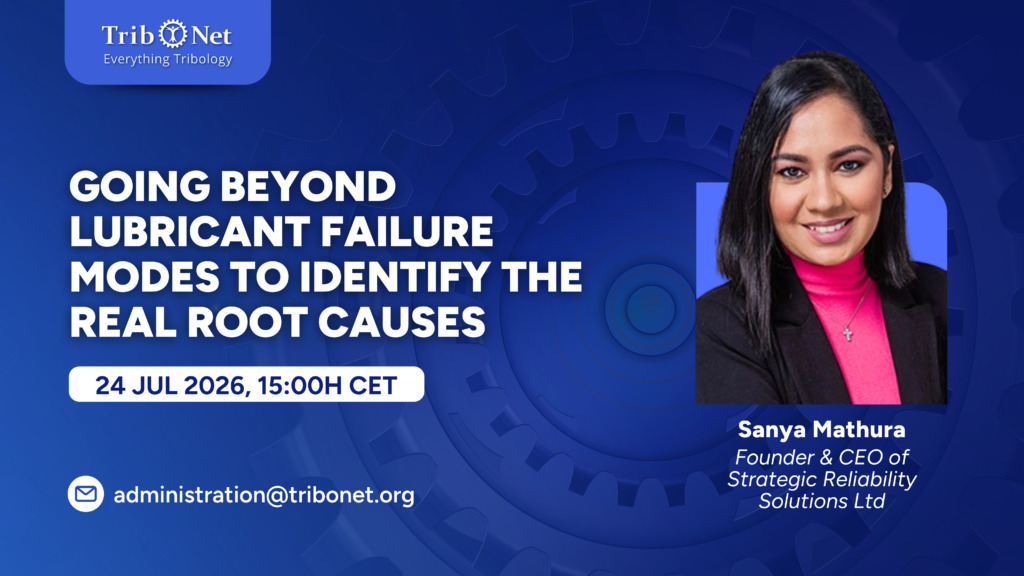
Going Beyond Lubricant Failure Modes to Identify the Real Root Causes
Ready to Download?
1.63 MB file size
Introduction
When people think about lubricants, the first function that usually comes to mind is reducing friction between moving surfaces. While this is certainly one of their most important roles, modern lubricants perform many other critical functions that are essential for maintaining machine reliability and efficiency.
During the webinar, Sanya Mathura explained that lubricants not only reduce friction and wear but also help remove contaminants, dissipate heat, improve equipment efficiency, and protect components from corrosion and premature damage. In hydraulic systems, lubricants even serve as the medium for transmitting power. Depending on the application, one of these functions may be more critical than the others.
Understanding these functions is fundamental because lubricant failure should not simply be defined as degraded or discolored oil. Instead, a lubricant has failed when it can no longer perform one or more of its intended functions effectively. At that point, it is no longer capable of providing adequate protection for the equipment, increasing the risk of wear, overheating, contamination, and ultimately mechanical failure.
Sanya also emphasized that lubricant degradation begins the moment fresh oil enters a machine. Because lubricants are sacrificial by design, their additives are gradually consumed while protecting machine components. As a result, degradation is a natural process rather than an indication that something has gone wrong. The real challenge for maintenance professionals is determining whether the lubricant is degrading at its expected rate or whether abnormal operating conditions are accelerating its deterioration.

Readers who want a broader introduction to lubrication fundamentals may also find Oil Lubrication useful before exploring lubricant degradation mechanisms in greater detail.
Understanding the Different Lubricant Degradation Modes
One of the webinar’s central messages was that not every lubricant failure is caused by oxidation. In practice, several degradation mechanisms can occur, each with different causes, warning signs, and corrective actions. Misidentifying the degradation mode often leads maintenance teams to treat only the symptoms while overlooking the actual source of the problem.
Oxidation is perhaps the best-known degradation mechanism. As antioxidants are gradually depleted, the lubricant begins to oxidize, eventually leading to increased viscosity, sludge formation, varnish deposits, and acid generation. However, oxidation is only one piece of the puzzle.
Sanya explained that thermal degradation occurs under extremely high temperatures—typically exceeding 200°C—where the lubricant breaks down due to excessive heat. Unlike oxidation, thermal degradation commonly produces carbonaceous deposits rather than varnish, requiring a different approach to troubleshooting.

Another important mechanism is microdieseling, which occurs when tiny air bubbles become entrained in the lubricant and collapse under pressure. These microscopic implosions generate localized high temperatures capable of producing soot, varnish, resin, tar deposits, and even cavitation damage on machine surfaces.
The webinar also discussed electrostatic spark discharge, a phenomenon that develops when lubricant flows through very narrow clearances. Friction between oil molecules generates static electricity, increasing the lubricant’s conductivity and contributing to sludge and varnish formation.
In addition, additive depletion can occur independently of oxidation as protective additives are gradually consumed during normal service. Once these additives are exhausted, the lubricant loses many of its protective properties, making equipment more vulnerable to wear and deposit formation.
Finally, contamination remains one of the most significant contributors to lubricant degradation. Water, dirt, metallic wear particles, air, and other foreign materials not only reduce lubricant performance but also accelerate chemical reactions that trigger other degradation mechanisms. In many cases, contamination acts as the catalyst that initiates oxidation or other failure modes rather than being the primary degradation mechanism itself.

Recognizing these differences is essential because each degradation mode requires a different corrective strategy. Simply replacing the lubricant without addressing the underlying degradation mechanism may temporarily improve performance but will rarely prevent the problem from returning.
Engineers interested in contamination-related issues can further explore Water and Particle Contamination in Lubricants: What Changes in Friction and Wear Tests, which explains how contaminants influence lubricant performance and machine wear.
Why Oxidation Is More Complex Than Most People Think
Oxidation is often treated as a single event, but the webinar demonstrated that it is actually a progressive chemical process consisting of several distinct stages. Understanding these stages allows maintenance teams to identify problems long before sludge or varnish become visible.
The process begins with the initiation stage, where catalysts such as heat, oxygen, moisture, or reactive metals generate highly reactive free radicals within the lubricant. These unstable molecules trigger a chain reaction that, if left unchecked, gradually consumes the lubricant’s protective additives.

During the propagation stage, antioxidants act as the lubricant’s first line of defense. Primary antioxidants neutralize free radicals before they can react with other molecules, while secondary antioxidants help eliminate hydroperoxides formed during the oxidation process. As long as sufficient antioxidant reserves remain, the lubricant can continue protecting the machine despite ongoing chemical reactions.
Eventually, antioxidant depletion reaches a point where oxidation accelerates rapidly. This leads to the termination stage, during which oxidation by-products polymerize into larger molecular structures. At this stage, operators begin observing familiar warning signs such as sludge, varnish deposits, increased viscosity, and rising acid numbers.
One of the webinar’s most valuable insights was that maintenance professionals should avoid relying solely on acid number measurements to detect oxidation. By the time acid numbers increase significantly, oxidation has often progressed to an advanced stage. Instead, Sanya recommended monitoring antioxidant depletion much earlier using appropriate laboratory tests, allowing maintenance teams to intervene before damaging deposits develop.
This proactive approach shifts lubricant maintenance from reactive troubleshooting toward predictive reliability, reducing unplanned downtime while extending both lubricant and equipment life.
Many of these concepts align closely with Lubricant Failure Diagnosis: Causes, Tests, and Fixes, which explores how identifying degradation mechanisms early can significantly reduce maintenance costs and equipment downtime.
Looking Beyond a Single Oil Analysis Test
Another important takeaway from the webinar was that no single laboratory test can provide a complete picture of lubricant health. Effective condition monitoring requires combining multiple oil analysis techniques, with each test contributing different information about the lubricant’s condition.
Among the diagnostic methods discussed, Sanya highlighted the Remaining Useful Life Evaluation Routine (RULER) test as one of the most valuable tools for monitoring oxidation. Rather than measuring the consequences of oxidation, the RULER test directly quantifies the remaining concentration of antioxidant additives. Because antioxidant depletion occurs long before sludge or varnish become visible, this test allows maintenance teams to detect oxidation at a much earlier stage.
She also explained the role of Membrane Patch Colorimetry (MPC), which evaluates the lubricant’s tendency to form varnish. Instead of confirming that varnish already exists, MPC estimates the lubricant’s potential to generate varnish deposits, enabling maintenance teams to take preventive action before deposits accumulate on machine components.
Other valuable diagnostic techniques include Fourier Transform Infrared Spectroscopy (FTIR) for identifying oxidation by-products and insoluble contaminants, Acid Number (AN) testing for monitoring acidity changes, and Colorimetric Patch Analysis (CPA) for evaluating deposit formation using a smaller oil sample.
Although Rotating Pressure Vessel Oxidation Test (RPVOT) remains a widely recognized industry standard, Sanya explained why she personally prefers RULER analysis when monitoring oxidation trends. In her experience, RPVOT results may not always provide the repeatability needed for long-term condition trending, whereas antioxidant measurements offer more practical information for predictive maintenance decisions.
Ultimately, the webinar emphasized that oil analysis should never rely on a single indicator. Combining multiple laboratory tests with vibration analysis, operating history, and equipment inspections provides a much more accurate understanding of lubricant condition and machine health. This integrated approach enables maintenance teams to identify degradation early, investigate the true root causes, and implement corrective actions before equipment reliability is compromised.
For readers interested in learning more about lubricant testing techniques, Lubricant Testing: Critical Procedures to Evaluate Friction, Wear & Contamination provides an excellent overview of the most commonly used oil analysis methods and their applications.
0 Comment