







Lubricant Formulation: Critical Insights into Additive Synergy and Base Oil Selection 2026

What is Lubricants Formulation
Lubricant formulation is the scientific process of designing a balanced lubricant composition to effectively reduce friction and wear in motor vehicles and industrial machinery, where mechanical contact and heat generation are unavoidable. Friction is the resisting force that opposes relative motion between two contacting surfaces, while wear refers to the progressive surface damage caused by mechanical interaction, material removal, and chemical-physical effects intensified by frictional heat.
A lubricant is therefore formulated as a carefully balanced mixture of multiple components, and the specific composition or “recipe” followed during blending is known as the lubricant formulation. This formulation primarily consists of base oils and performance additives, whose selection and proportion determine the lubricant’s behavior during service, including its friction control, wear protection, thermal stability, and operational lifespan. To fully understand lubricant formulation, it is also essential to recognize the different types of lubricants and their classifications, as these directly influence formulation strategies and performance requirements.
What are lubricants & how are they classified?
Lubricant is a substance that may be a liquid or powder form; when introduced between two moving parts reduces friction by introducing a slippery film between the two surfaces. Thus improving efficiency and decreasing the wear. Lubricants can be classified into five different categories.
1) Gaseous lubricants

2) Liquid lubricants
3) Solid lubricants
4) Semi-solid lubricants
5) Metal or alloy lubricants

Gaseous lubricants: These have a much lower viscosity and higher compressibility compared to liquid lubricants. Some examples of gases lubricants are air, and it is used in fluid bearings. Technical gases (The most widely used industrial gases include acetylene, argon, carbon dioxide, oxygen, nitrogen, and hydrogen), steam, or liquid metal vapors are also examples of gaseous lubricants.
Gases are used as lubricants in gas-lubricated bearings that operate in the aerodynamic (at high speeds—10,000 to 600,000 r.p.m.) or aerostatic regimes at temperatures from 15 to 800 °C or more, where liquid lubricants would freeze or decompose, in hostile environments (e.g., radiation), where there is a danger of contamination and other difficult or unusual situations.
Liquid lubricants: Liquid lubricants are generally based on one type of base oil. Still, it is possible to use a base oil mixture to meet the performance requirement, for example, water, Mineral oil, Lanolin, vegetable or natural oil, etc.
The majority of lubricants are liquids, and they may be classified according to their origin into two groups:

(1) Mineral oils: Mineral oils are lubricating oils refined from naturally occurring crude oil.
(2) Synthetic oils: Synthetic oils are lubricating oils that are manufactured.
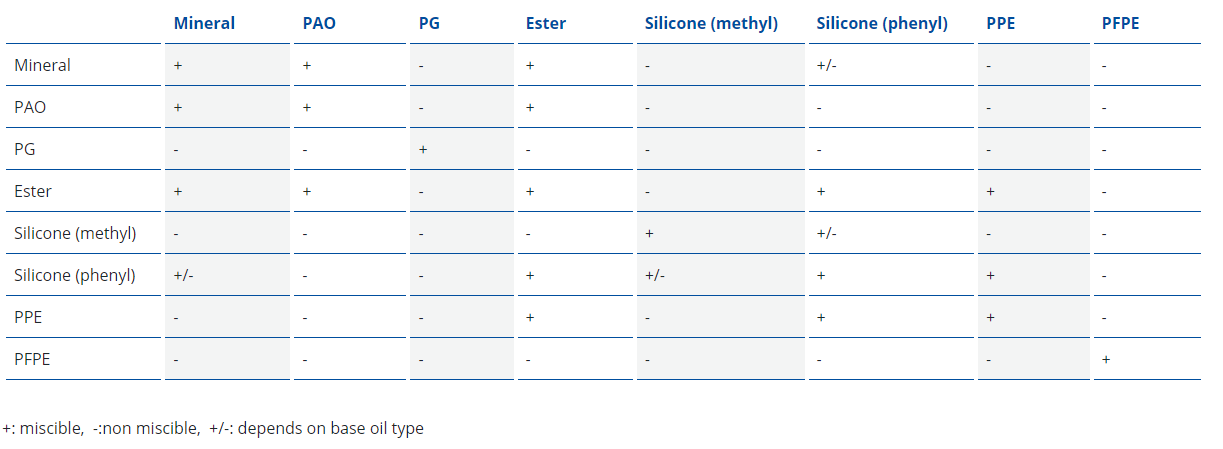
This is very important to know that Lubricating oils are used for lubrication purposes as well, as the same oils are used to make greases. To make any grease, these lubricating oils are the main ingredients & greases contain approx 70% to 80% of oils. As these oils are very important factors for making greases, we should know about the base oil miscibility.
Base Oil Miscibility

Solid lubricants: Graphite, Boron nitride, molybdenum disulfide, and tungsten disulfide are the predominant material used as solid lubricants. They can be used under high-temperature conditions in the form of dry powder. These materials are effective lubricant additives because of their lamellar structure. The lamellar orient parallel to the surface on which they are applied in the direction of motion of the moving surface. For example, graphite, molybdenum disulfide, Boron nitride, Teflon or Polytetrafluoroethylene (PTFE), etc.
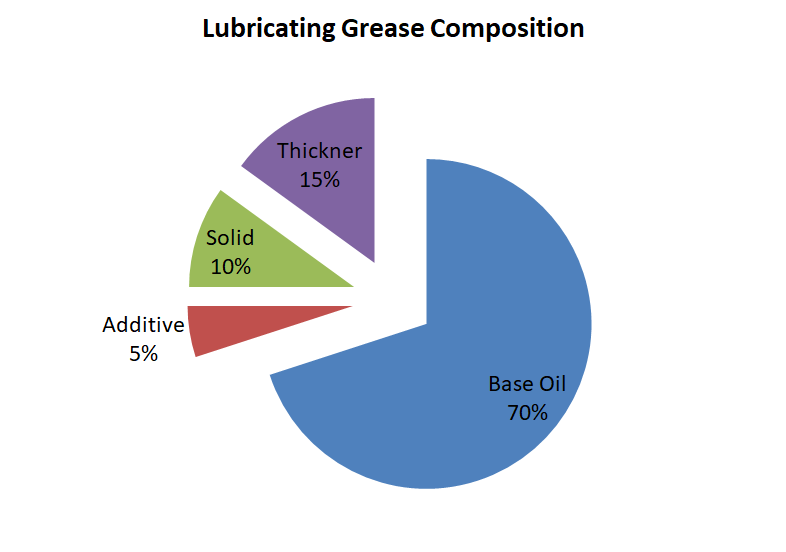
Semi-Solid Lubricants: Semi-solid lubricants are greases. These contain thickening agents like sodium, calcium, Lithium, or aluminum mixed with mineral or synthetic liquid. The composition of greases is generally 70% or synthetic oil, 15% gelling agent like soap, and 10% solid lubricants & 5% of additives such as rust inhibitors, antioxidants, metal deactivators, anti-wear, etc.
Lubricating greases are colloidal systems (dispersions), mostly gels, rarely sols, in which the dispersive (continuous) phase is formed of lubricating oil and the dispersed phase (thickener) is an anisotropic solid that penetrates the liquid phase so that the gel produced acquires properties characteristic of the plastic (solid) state.
Lubricating Grease composition
What is Thickener?
Grease thickeners are substances that form the basis of grease when combined with a suitable base oil and act to increase consistency.
Types of Thickeners
- Soap: Soap-based thickeners are produced via an acid-base reaction known as saponification. The end result is a soap and water mixture. The water is removed and the remaining soap is used as a thickener for grease. The type of soap thickener will depend on which acids and bases are used in saponification. Some Soap thickeners are Fatty Acids, Alkaline Solutions.
- Non Soap: Common non-soap thickeners include polyurea, organophilic clay, fumed silica, fluoropolymers, and others. Polyurea is a generic term that includes diurea, tetraurea, urea-urethane, and many related chemistries. A typical polyurea thickener is the reaction product of a di-isocyanate with mono and/or diamines.
Thickener Miscibility
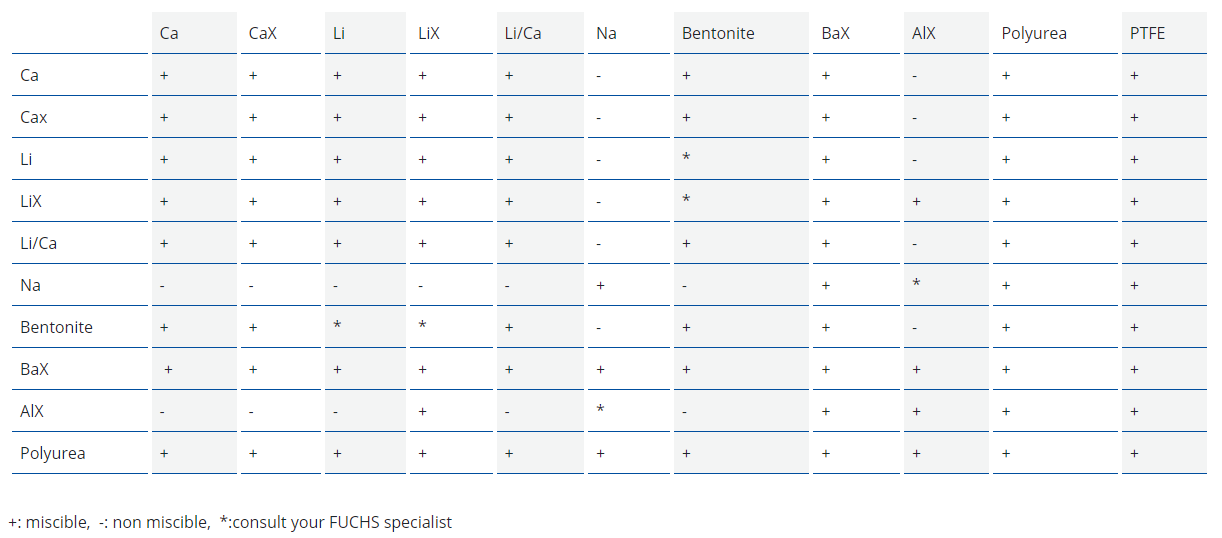
Note: To determine whether two specific lubricating greases are fully miscible, laboratory tests must be carried out with different degrees of mixing (proportions, for example, 20/80, 50/50, 80/20).
The miscibility tests do not serve to guarantee that the performance of the mixture of both greases is the same as that of the separate products, for which the study has to be completed with mechanical-dynamic tests with different degrees of mixing.
Metal or Alloy Lubricants: Metal or alloy lubricants can be employed as lubricants and grease additives for sliding surfaces and bearings. Cadmium and gold are used for plating surfaces which offer good corrosion resistance and improved sliding properties. Lead, tin, zinc alloys, and various other alloys are used in sliding bearings. Metal powder can also be used to lubricate sliding surfaces or as additives to grease.
Conclusions
Each lubricant has a different set of characteristics based on its formulation during manufacturing that determines its consistency, viscosity, ability to prevent friction, reduce wear and tear, protect against rust, corrosion, and oxidation, maintain mobility and stop water and other contaminants from coming into contact with the equipment.
Take all these factors into consideration before deciding which lubricant is better for your application and remember – the right grease for you is the one that meets (and surpasses) all the requirements you have.
Check these related videos:
So good written
Lubricant formulation good article. Interesting details