







JKR Theory: Essential Understanding of Contact Mechanics and Adhesion 2026
Introduction
JKR theory: The phenomenon of neck formation around the contact area of adhesive hemispheres can be understood through an analogy to wetting. In a thought experiment with a soft, rubber-like sphere, when adhesive interactions are introduced, the contact area increases at constant penetration. Alternatively, to keep the contact area constant, the sphere must be pulled back, which is a flat punch displacement. While performing experiments on rubber friction in the Cavendish Laboratory in Cambridge, Roberts clearly observed the formation of a neck around the contact area of adhesive hemispheres.
The flat punch solution shows singularities at the contact edge, with surface displacement following a square root singularity and surface stress following an inverse square root singularity, explaining the extreme behavior at the contact edge. In the local treatment of the adhesive process, the neck height depends on the elastic response and adhesion energy, but not on the punch shape.
In the JKR model, the relevant thermodynamic variable is the contact area, which is coupled to the adhesion energy. In summary, the flat punch term in the JKR model contributes to a peeling action at the contact edge, with the adhesive parameter being the adhesion energy w, which is the energy required to create surfaces.
JKR theory based on tabor parameter
Tabor suggested introducing a parameter to compare the flat punch displacement to the decay length of the interaction potential, denoted as δint (equation (15)). This parameter is represented by λ, where:

λ = δfp\ δint
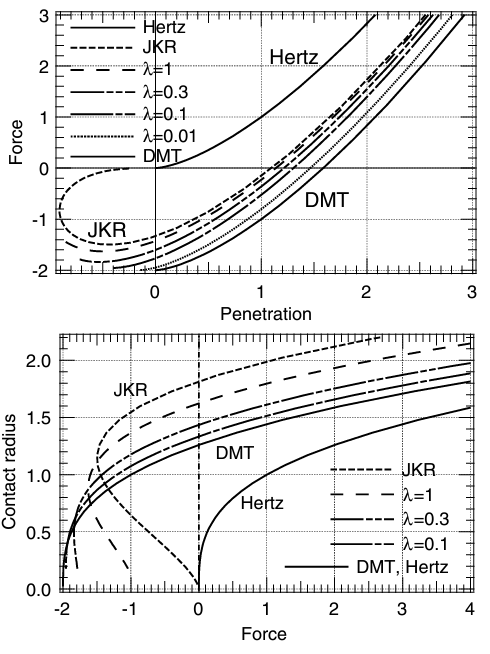
This parameter λ helps quantify the relationship between the displacement at the contact edge and the decay length of the adhesive interaction potential. The JKR case is obtained for large values of λ, while small λ values characterize the DMT regime. In contrast to DMT, the JKR theory applies when the interaction stresses are large and the materials are compliant, meaning they can deform easily under stress.
The contact relations for the Hertz, DMT, and JKR models are based on different assumptions regarding the interaction between two surfaces is shown in Figure-1
Hertz Model: Describes the elastic contact between two bodies without considering adhesion. It provides the relationship between the contact force and the deformation, assuming no adhesive interactions.

DMT Model: Applies when the interaction stresses are small and the materials are stiff. It includes adhesion but assumes that the Hertz deformation profile is not significantly affected by adhesion.
JKR Model: Applies when the interaction stresses are large and the materials are compliant. It accounts for adhesive forces by considering the surface energy and results in a larger contact area than the DMT model.
Figure-1 Contact relations for Hertz, DMT and JKR models. Also shown are double-Hertz models with different values of the Tabor parameter λ
Application and limitations of JKR theory
- The JKR test is used to study adhesive contact, but directly using pullout force and adhesion energy relations to infer adhesion energies is problematic due to the instability at rupture. This instability introduces fluctuations and makes the dynamics of interfacial response affect the pull-out force in complex ways. A more effective approach is to record data in the stable adhesive contact region (before rupture) and analyse it using a contact model.
- The JKR test has led to the development of experimental devices that monitor contact radius as a function of applied load to infer adhesive properties, particularly for characterising surface modification through adhesion.
- In a JKR experiment, a typical curve for contact radius versus load, as shown by Deruelle and coworkers for PDMS lenses on a rigid substrate, reveals that the loading and unloading paths do not overlap. The system is unloaded stepwise, where, after each displacement step, the contact radius gradually decreases, indicating irreversibility and kinetic effects. The contact radius decreases and then stabilises to an equilibrium value.
- These results suggest that velocity-dependent adhesion, rather than thermodynamic adhesion energy, better explains the behaviour. The PDMS lens deformation closely follows JKR theory, allowing for the extraction of an effective adhesion energy that depends on the contact radius velocity, not the radius itself. The equilibrium JKR theory remains adequate here because the system’s bulk behaviour is elastic, with time-dependent and irreversible effects confined to the contact edge.
Reference
0 Comment