







Grease Lubricant: Essential Mechanisms and Selection Guide

TL;DR: A grease lubricant is a semi-solid lubricant made from base oil, thickener and additives. In tribology, grease is used when a machine needs long-lasting lubrication, sealing, corrosion protection and low leakage in bearings, gears, joints and sliding contacts.
- Key takeaway: Grease behaves like an oil reservoir held inside a thickener network.
- Key takeaway: The base oil mainly provides lubrication, while the thickener controls structure, consistency and operating temperature range.
- Key takeaway: Grease selection depends on speed, load, temperature, water exposure, contamination, relubrication interval and compatibility.
- Key takeaway: Grease usually shear-thins: it becomes easier to flow when worked in a contact.
- Key takeaway: Too much grease can increase churning, heat and energy loss; too little grease risks starvation and wear.
Table of Contents
- What is a grease lubricant?
- What is grease made of?
- How does grease microstructure work?
- Why does grease shear-thin?
- How do engineers select grease?
- FAQs
What is a grease lubricant?
A grease lubricant is a lubricating oil that has been thickened into a semi-solid material. It is designed to stay in place while slowly releasing oil into the contact zone. This makes grease useful when liquid oil would leak away, when relubrication is difficult, or when the lubricant must also help block dust, water and other contaminants.
In practical tribology, grease is especially common in rolling element bearings, plain bearings, gears, hinges, electric motors, construction equipment, automotive chassis points and sealed-for-life components. A large share of rolling bearings are grease-lubricated because grease can simplify sealing and maintenance compared with circulating oil systems.
What is grease made of?
Most lubricating greases contain three main components: base oil, thickener and additives. The exact balance controls the grease consistency, oxidation stability, water resistance, load-carrying ability and temperature range.

| Component | Typical role | Why it matters |
|---|---|---|
| Base oil | Provides the lubricating film between surfaces. | Viscosity affects film thickness, friction, start-up torque and temperature behavior. |
| Thickener | Forms a network that holds oil in place. | Controls consistency, dropping point, mechanical stability and water resistance. |
| Additives | Improve performance under specific conditions. | May provide anti-wear, extreme-pressure, antioxidant, corrosion-inhibiting or tackiness properties. |
Common thickener systems include lithium, lithium complex, calcium sulfonate complex, aluminum complex, polyurea and clay-based thickeners. The best choice depends on operating temperature, load, speed, environment and compatibility with the grease already in service.
How does grease microstructure work?
Grease is not simply “thick oil.” Its thickener forms a microscopic network that traps base oil and releases it during operation. This network gives grease its semi-solid consistency and helps it remain inside a bearing or contact.
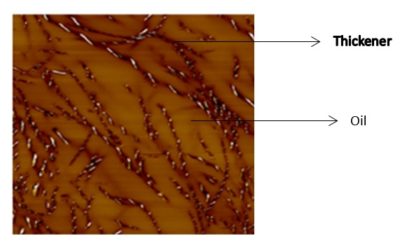
Figure 1: Microstructure of a commercial grease lubricant obtained using atomic force microscopy.
The microstructure controls how grease bleeds oil, resists softening, recovers after shear and handles long service intervals. If the structure breaks down too quickly, the grease may leak, separate oil or fail to feed the contact consistently.
Why does grease shear-thin?
A characteristic feature of grease is shear thinning. At rest, grease behaves like a structured semi-solid. Under shear in a rolling or sliding contact, its apparent viscosity drops and it flows more easily. This helps grease move into the contact while still staying in place when the machine is stopped.

Figure 2: Evolution of apparent viscosity as a function of shear rate for a representative grease lubricant.
Shear thinning is helpful, but excessive working can damage the thickener network. This is why mechanical stability is an important property in bearings, gear couplings and other contacts exposed to repeated deformation.
How do engineers select grease?
Grease selection should start with the contact and operating conditions, not only with brand or thickener type. Engineers usually compare speed, load, temperature, environment and relubrication needs before choosing a grease.
| Selection factor | Question to ask | Grease property to check |
|---|---|---|
| Speed | Will high speed cause churning or heat? | Base oil viscosity, consistency and bearing speed rating. |
| Load | Is boundary or shock loading expected? | Anti-wear and EP additives, film strength and thickener stability. |
| Temperature | Will the grease soften, oxidize or become too stiff? | Dropping point, oxidation stability and low-temperature torque. |
| Water and contamination | Will moisture, dust or process fluids enter the contact? | Water resistance, corrosion protection and sealing behavior. |
| Compatibility | Will it mix safely with the existing grease? | Thickener compatibility and base oil compatibility. |
Grease consistency and NLGI grade
Grease consistency is commonly classified by NLGI grade. A soft grease can flow and pump more easily, while a stiffer grease may stay in place better. The most common bearing greases are around NLGI grade 2, but the best grade depends on the application.
Consistency is often measured using cone penetration methods such as ASTM D217. This measurement helps compare how soft or stiff a grease is before and after working.
Advantages and limitations of grease lubrication
| Advantages | Limitations |
|---|---|
| Stays in place and reduces leakage. | Can be harder to remove heat compared with circulating oil. |
| Helps seal against dirt and water. | Overgreasing can increase churning losses and temperature. |
| Supports long relubrication intervals. | Grease compatibility problems can occur during changeover. |
| Simplifies many sealed-bearing designs. | Oil bleeding and mechanical stability must match the duty cycle. |
Common grease lubrication mistakes
- Overgreasing: too much grease can raise temperature and torque.
- Using the wrong viscosity: base oil viscosity that is too low can reduce film thickness; too high can increase drag.
- Ignoring compatibility: mixing incompatible thickeners may soften, harden or destabilize the grease.
- Missing contamination control: grease can help seal, but it cannot compensate for severe dirt or water ingress forever.
- Relying only on dropping point: high dropping point does not automatically mean good high-temperature service life.
Checklist for choosing a grease lubricant
- Define bearing/contact type, speed, load and motion.
- Estimate operating and start-up temperatures.
- Choose suitable base oil viscosity for film formation.
- Select thickener type for temperature, water resistance and compatibility.
- Check NLGI grade, pumpability and relubrication method.
- Consider anti-wear, EP, antioxidant and corrosion-inhibiting additives.
- Confirm compatibility with existing grease before switching products.
- Set the correct grease quantity and relubrication interval.
FAQs
What is grease lubricant?
Grease lubricant is oil held in a thickener network with additives. It lubricates surfaces while staying in place better than liquid oil.

What are the three main components of grease?
The three main components are base oil, thickener and additives. Base oil provides lubrication, thickener gives structure and additives tune performance.
Why is grease used instead of oil?
Grease is used when the lubricant must stay in the contact, reduce leakage, help seal against contamination or support long maintenance intervals.

What does NLGI grade mean?
NLGI grade describes grease consistency, from very soft to very stiff. It helps engineers compare pumpability and how well grease stays in place.
Can different greases be mixed?
Only if they are compatible. Mixing incompatible thickeners or base oils can change consistency, oil bleeding, mechanical stability and service life.

What causes grease to fail?
Common causes include oxidation, contamination, water washout, oil separation, excessive mechanical working, incompatible mixing, overheating and starvation.
See also
- Lubricant Viscosity
- What are Lubricants?
- Boundary Lubrication
- Hydrodynamic Lubrication
- Elastohydrodynamic Lubrication
- Friction
- Wear
References
- NLGI — National Lubricating Grease Institute.
- ASTM D217 — Standard Test Methods for Cone Penetration of Lubricating Grease.
- Stachowiak, G. W., & Batchelor, A. W. Engineering Tribology. Butterworth-Heinemann.
- Hamrock, B. J., Schmid, S. R., & Jacobson, B. O. Fundamentals of Fluid Film Lubrication. CRC Press.
- Lugt, P. M. Grease Lubrication in Rolling Bearings. Wiley.
Last updated: May 2026. Reviewed topic: grease lubricant composition, microstructure, shear thinning, selection and tribology applications.
0 Comment