







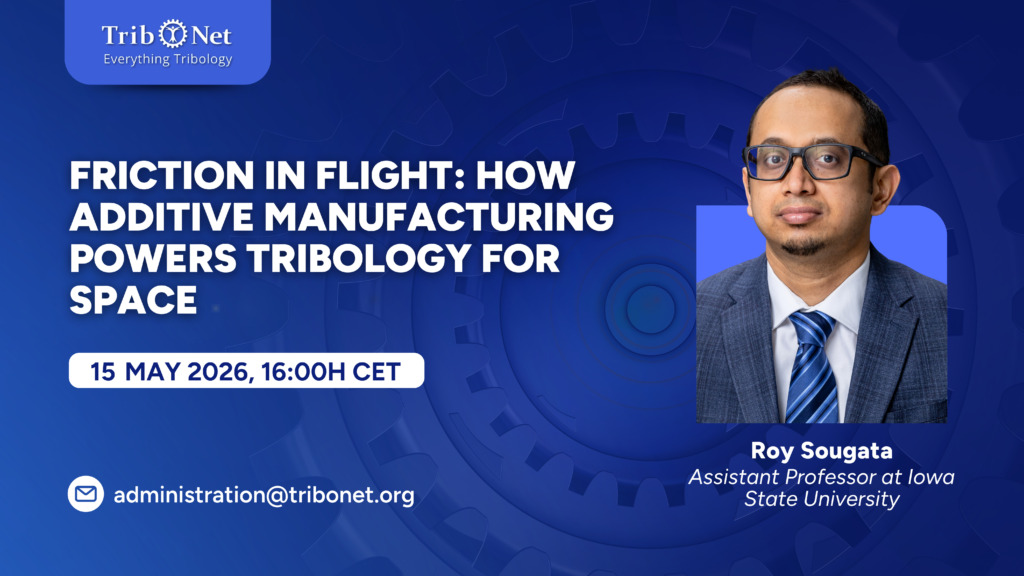
Friction in Flight: How Additive Manufacturing Powers Tribology for Space
Introduction
As humanity prepares for a new era of lunar exploration, engineers and researchers are facing one of the harshest operating environments ever encountered in modern manufacturing. Extreme temperature fluctuations, abrasive lunar dust, high-vacuum conditions, and the absence of atmospheric protection create serious tribological challenges for machines and infrastructure operating on the Moon. During the recent webinar hosted by TriboNet, Dr. Roy Sougata presented groundbreaking research on how additive manufacturing (AM) and advanced material engineering can improve the reliability and wear resistance of lunar components.
The webinar, titled “Friction in Flight: How Additive Manufacturing Powers Tribology for Space,” explored how aluminum-based alloys reinforced with titanium carbide (TiC) can survive demanding lunar conditions while maintaining structural integrity and tribological performance. Supported by Manoj and Xavier Borras, the presentation provided valuable insights into the intersection of additive manufacturing, surface engineering, and space tribology.
Why Additive Manufacturing Matters for Lunar Exploration
The motivation behind Dr. Sougata’s research is closely linked to NASA’s Artemis mission, which aims to establish a long-term human presence on the Moon. Lunar bases, rovers, mining systems, and energy infrastructure will require lightweight yet durable materials capable of operating under severe tribological conditions.
Traditional manufacturing methods often struggle to produce highly customized aerospace parts efficiently. Additive manufacturing, commonly known as 3D printing, enables engineers to produce complex geometries layer by layer while minimizing material waste. As discussed in this TriboNet article about Additive Manufacturing Using Metallic Gels, AM technologies are becoming increasingly important for sustainable and advanced manufacturing applications.

In the webinar, Dr. Sougata focused primarily on L661 aluminum alloy, a material widely used in aerospace engineering because of its lightweight properties and high strength-to-weight ratio. However, standard aluminum alloys are vulnerable to wear and erosion under lunar dust exposure. To address this limitation, the research team reinforced the alloy with titanium carbide particles to improve hardness and wear resistance.
Developing Aluminum-TiC Metal Matrix Composites
The researchers produced four different sample categories for evaluation:
- Conventional rod L661 (T0)
- As-printed L661
- L661 reinforced with 3% TiC
- L661 reinforced with 10% TiC
Using an in-house erosion testing rig, the team simulated lunar dust storm conditions with lunar dust simulants obtained from the University of Central Florida. Samples were exposed to dust particles traveling at 38 m/s under temperatures of approximately 50°C.
One of the most important findings was the effect of TiC reinforcement on the microstructure of printed aluminum parts. The addition of titanium carbide significantly reduced porosity and crack formation, especially in the 3% TiC samples. TiC particles acted as nucleation sites during solidification, encouraging heterogeneous nucleation and producing a more refined microstructure.

However, the study also revealed a key challenge in additive manufacturing: excessive reinforcement can introduce new defects. At 10% TiC concentration, some agglomeration occurred, creating localized weaknesses and inconsistencies within the printed structure.
This balance between reinforcement and manufacturability is a major topic in modern additive manufacturing research. Similar discussions can be found in TriboNet’s article on Additive Manufacturing of Advanced Metallic Materials, which highlights how thermal control and microstructural engineering strongly influence final component performance.
Improved Hardness and Wear Resistance
One of the strongest outcomes from the research was the dramatic increase in hardness achieved through TiC reinforcement. Samples containing 10% TiC demonstrated approximately 40% higher hardness compared to conventional aluminum.
In tribological systems, hardness plays a major role in resisting abrasive wear. Lunar regolith contains sharp, angular particles capable of scratching and eroding surfaces rapidly. Increasing hardness therefore helps extend component lifespan and improve operational reliability.

The erosion wear tests showed that TiC-reinforced samples exhibited lower wear loss and smoother surface finishes after testing. Reduced surface roughness is particularly important because rough surfaces can accelerate friction and wear under repeated contact conditions.
This aligns closely with findings discussed in TriboNet’s guide on Surface Roughness Interpretation for Tribology, which explains how surface texture directly influences friction, lubrication behavior, and wear performance.
Wear Resistance Under Vacuum Conditions
The webinar also explored how additive manufactured components behave in vacuum environments, which is especially relevant for lunar applications where no atmosphere exists to form protective oxide films.
Dr. Sougata compared two additive manufacturing routes:

- Laser Directed Energy Deposition (DED)
- Wire Arc Additive Manufacturing (WAM)
Four sample types were evaluated under both ambient and vacuum conditions:
- Rod L661
- DED-printed L661
- DED with 10% TiC
- WAM with TiC nanoparticles
The results demonstrated that environmental conditions strongly affect tribological behavior. In ambient air, naturally formed oxide layers helped stabilize wear mechanisms and reduce friction. In vacuum environments, however, the absence of oxides increased direct surface interaction and encouraged particle agglomeration.
Interestingly, the WAM samples reinforced with TiC nanoparticles performed exceptionally well. Their equiaxed grain structures and refined microstructures produced lower wear volumes and more stable friction behavior.
The DED samples reinforced with TiC showed higher hardness but experienced increased wear under vacuum due to TiC agglomeration and third-body abrasion effects. This finding emphasized that hardness alone does not guarantee optimal wear resistance; manufacturing route and microstructural stability are equally important.
Scaling Up Large Metal Additive Manufacturing
Another major focus of the webinar involved large-scale additive manufacturing and the challenges associated with scaling production for real lunar infrastructure.
As build height increased in large AM structures, the researchers observed significant changes in porosity distribution and mechanical properties. The bottom regions of builds contained higher porosity due to rapid cooling and insufficient substrate heating, which trapped hydrogen and promoted defect formation.
Higher regions of the build benefited from accumulated thermal energy generated during successive layer deposition. This improved material consolidation and reduced defect density.
Mechanical properties varied considerably throughout the build:
- Bottom regions showed higher hardness and yield strength due to finer grains and intermetallic phases.
- However, tensile strength was lower at the bottom because defects reduced ductility.
- Upper regions displayed improved tensile performance because of reduced porosity.
These findings highlight one of the key challenges in additive manufacturing for aerospace applications: maintaining consistent mechanical properties across large structures.
Surface Engineering for Future Lunar Components
To further enhance performance, the research team is now investigating advanced surface engineering methods including:
- Ultrasonic Impact Processing (UIP)
- Laser Shock Peening (LSP)
UIP produced up to a 20% increase in hardness and refined grain structures by nearly five times. Both methods also improved residual stress distributions, potentially enhancing fatigue resistance and long-term reliability.
Surface engineering is becoming increasingly important in aerospace tribology because even small improvements in surface condition can dramatically affect operational lifespan. The role of surface condition, texture, and roughness is also extensively discussed in TriboNet’s Surface Roughness Interpretation Guide.
Audience Questions and Technical Insights
The webinar concluded with an engaging technical discussion involving Dr. Sima Alidot, Will Gray, Melissa, and Amanab.
Dr. Sougata explained that the aluminum-TiC wire used in WAM processing was custom manufactured in collaboration with Metelli using proprietary wire drawing techniques capable of distributing TiC nanoparticles throughout the wire matrix.
When asked about alternative reinforcements, he noted that materials such as tungsten disulfide could potentially provide even lower friction coefficients. However, project funding limitations from NASA constrained the study to titanium carbide systems.
Questions regarding tribological testing parameters clarified that vacuum wear tests were conducted under a 15 N load using steel counterface balls. Dr. Sougata also addressed questions about residual stress measurements associated with laser shock peening and ultrasonic impact processing, noting that additional investigations are ongoing.
The Future of Tribology in Space Exploration
The webinar demonstrated how additive manufacturing is rapidly evolving from a prototyping tool into a critical technology for future space infrastructure. Lightweight aluminum composites reinforced with ceramic particles could help engineers build more reliable lunar vehicles, habitats, and mechanical systems capable of surviving harsh extraterrestrial environments.
The research presented by Dr. Roy Sougata provides an important step toward solving these challenges. By combining additive manufacturing, nanoparticle reinforcement, and advanced surface engineering, researchers are creating materials that may one day support permanent human activity on the Moon.
The webinar recording is expected to be published on the TriboNet website pending final approval from Dr. Sougata. Researchers and engineers interested in collaboration opportunities related to additive manufacturing and tribology are encouraged to contact Dr. Roy directly for future research discussions.
interesting!