







Lubricants Market Size Worth USD 200.16 Billion by 2034 | CAGR: 3.5%

An industry news titled “Lubricants Market Size Worth USD 200.16 Billion by 2034 | CAGR: 3.5%” is relevant to your esteemed website “https://www.polarismarketresearch.com/industry-analysis/lubricants-market” This email is a suggestion to publish this news (content attached in word format or can be picked from the link mentioned below) on your website with an objective to share the information with your audience.
Press Release @ https://www.polarismarketresearch.com/press-releases/global-lubricants-market

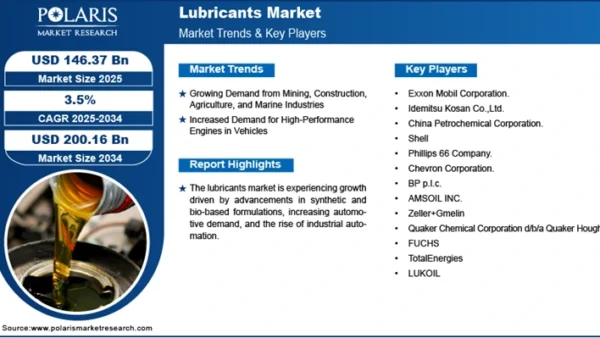
The global lubricants market is experiencing unprecedented momentum, with industry valuations reaching USD 141.48 billion in 2024 and projections indicating substantial growth to USD 200.16 billion by 2034. This impressive trajectory, marked by a compound annual growth rate (CAGR) of 3.5%, underscores the critical role lubricants play across automotive, industrial, marine, and aerospace sectors as businesses worldwide prioritize operational efficiency and equipment longevity.
Market Dynamics Reshaping the Lubricants Industry

The lubricants industry stands at a transformative crossroads where traditional petroleum-based products meet cutting-edge synthetic and bio-based alternatives. As machinery becomes increasingly sophisticated and environmental regulations tighten, manufacturers are innovating to deliver high-performance solutions that reduce friction, minimize wear, and enhance equipment lifespan while meeting stringent sustainability standards.
Key Growth Drivers Accelerating Market Expansion

Surge in Industrial Applications
Heavy industries including mining, construction, agriculture, and marine operations are primary catalysts for lubricants market growth. These sectors demand specialized, high-performance lubricants capable of withstanding extreme pressures and temperatures. Recent product launches exemplify this trend Chevron’s introduction of Rykon grease in February 2024, specifically engineered for heavy-duty applications with calcium sulfonate complex formulations, demonstrates the industry’s commitment to developing solutions that enhance equipment longevity while reducing operational costs.

The diversification of industrial applications has created unprecedented opportunities for lubricant manufacturers. From excavators and dozers in construction to tractors and harvesters in agriculture, equipment operators increasingly recognize that premium lubricants represent investments in productivity rather than mere maintenance expenses.
Automotive Sector Dominance
The automotive segment commanded the largest market share in 2024, driven by global vehicle production increases and rising consumer awareness about proper maintenance. Modern vehicles equipped with turbocharged engines, direct fuel injection systems, and advanced powertrains require specialized lubricants that deliver superior performance under demanding conditions.
Castrol India’s June 2024 launch of enhanced Castrol EDGE variants including formulations specifically designed for hybrid engines, European OEMs, and high-performance SUVs illustrates how manufacturers are responding to evolving automotive technologies. These innovations provide up to 30% improved performance while meeting the latest original equipment manufacturer (OEM) specifications.
Synthetic Oil Segment: The Future of Lubrication Technology
While mineral oils currently dominate market share, synthetic oils are positioned for explosive growth through 2034. Superior thermal stability, exceptional oxidation resistance, and enhanced engine protection under extreme conditions make synthetic lubricants increasingly attractive to industrial and automotive users alike.
The extended drain intervals and reduced environmental impact of synthetic formulations align perfectly with both cost-conscious operations and sustainability-focused corporate policies. Industry analysts predict that as manufacturing costs decrease and awareness grows, synthetic oils will capture progressively larger market segments across all applications.
Regional Market Dynamics and Opportunities
Asia Pacific: The Current Market Leader
Asia Pacific dominated the global lubricants market in 2024, propelled by rapid industrialization, urbanization, and robust manufacturing sector expansion. China and India serve as primary growth engines, with massive infrastructure projects and increasing vehicle ownership creating sustained demand for both industrial and automotive lubricants.
The February 2024 partnership between Seqens and KK India Petroleum Specialties Pvt. Ltd. highlights the strategic importance of this region. This collaboration to distribute lubricant additives across India, Bangladesh, Sri Lanka, and Nepal provides comprehensive support for lubricant formulation and troubleshooting, positioning local manufacturers to meet growing regional demand.
North America: Fastest Growing Regional Market
North America is projected to achieve the highest growth rate during the forecast period, driven by industrial automation advancements and surging demand for high-performance lubricants. The region’s strong automotive industry, coupled with increasing adoption of electric and hybrid vehicles requiring specialized lubricants, creates unique market opportunities.
Investments in infrastructure development and the presence of major industry players including ExxonMobil, which expanded its Unconventional business through the May 2024 acquisition of Pioneer Natural Resources further strengthen North America’s growth trajectory.
Sustainability and Innovation: Shaping Tomorrow’s Lubricants
Environmental consciousness is revolutionizing lubricant development, with bio-based oils emerging as viable alternatives to traditional petroleum derivatives. Kraton’s February 2024 introduction of SylvaSolve, a bio-based oil line derived from renewable sources, exemplifies this shift toward sustainable solutions for coatings, adhesives, sealants, and personal care applications.
Regulatory pressures and corporate sustainability commitments are accelerating this transition. Manufacturers investing in eco-friendly formulations position themselves advantageously as industries worldwide prioritize environmental responsibility alongside operational efficiency.
Competitive Landscape and Market Leaders
The global lubricants market features intense competition among established giants and innovative challengers. ExxonMobil Corporation, Shell, Chevron Corporation, TotalEnergies, BP, and FUCHS lead the industry through extensive research and development capabilities, robust distribution networks, and strategic acquisitions.
FUCHS’s November 2024 acquisition of Swiss industrial lubricants producer STRUB & Co. AG demonstrates how market leaders pursue geographic expansion and product portfolio diversification. Similarly, Shell’s December 2024 launch of Helix Ultra API SQ-ready products, designed specifically for turbocharged gasoline direct injection (TGDI) engines, showcases the industry’s commitment to addressing emerging automotive technologies.
Request for a sample copy of this research report @ https://www.polarismarketresearch.com/industry-analysis/lubricants-market/request-for-sample
Future Outlook and Strategic Opportunities
The lubricants market’s evolution presents compelling opportunities for manufacturers, distributors, and end-users. As advanced engine technologies proliferate and sustainability becomes non-negotiable, companies that innovate developing high-performance, environmentally responsible products will capture the greatest market share.
The convergence of electrification in automotive sectors, automation in industrial applications, and environmental stewardship across all industries creates a dynamic landscape where traditional boundaries dissolve and new opportunities emerge. Forward-thinking organizations that recognize these trends and position themselves accordingly will thrive in this expanding market.
Read More: https://www.polarismarketresearch.com/
Contact Us
Prajwal Agale
Sr Researcher
Phone: +1 929-297-9727
Polaris Market Research and Consulting
Email– [email protected]
0 Comment