







Breakdown Voltage Myths in Electric Vehicle Bearings
Introduction
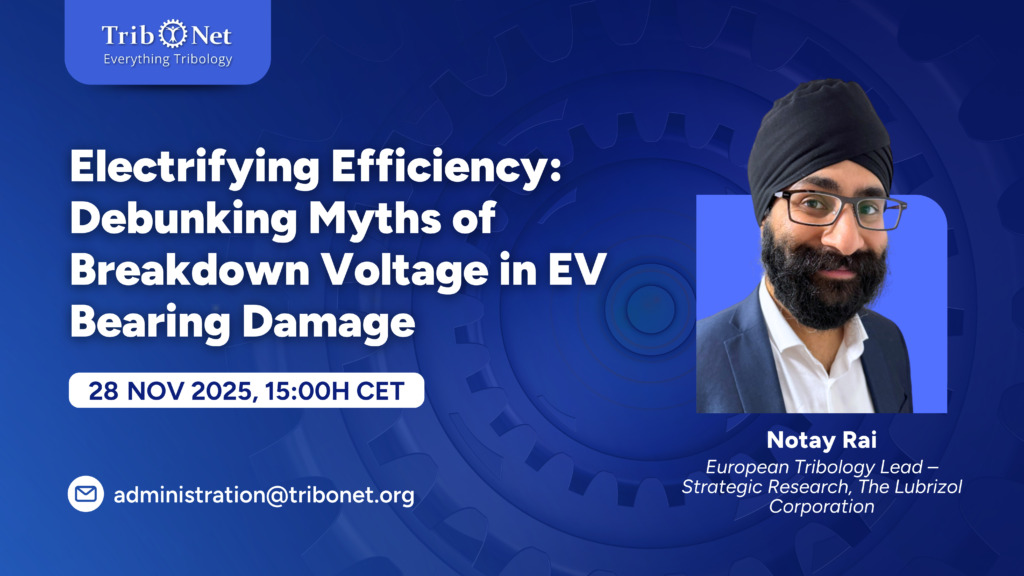
Electric vehicles are becoming more common, but their motors face unique problems that don’t appear in traditional cars. One of these problems is electrically induced bearing damage (EABD), which happens when stray electrical currents pass through the bearings and slowly damage them. In a recent TriboNet webinar, Dr. Notay Rai explained how these electrical currents form, how they affect bearings, and why the electrical breakdown voltage of lubricants plays an important role in preventing this damage. His explanation shows that something as simple as a lubricant’s viscosity and film thickness can make a big difference in keeping Electric Vehicle motors running smoothly.
Electrically Induced Bearing Damage (EABD): Why It Happens
One of the core issues explained in the webinar is the presence of stray electrical currents in EV drivetrains. These currents originate from the variable frequency drive (VFD) used to convert battery DC to AC power. While the VFD is essential for controlling motor speed and torque, it can create electrical imbalances that allow high-frequency currents to pass through the motor shaft and, eventually, through the bearings.

When these currents cross from one bearing surface to another, they may discharge through the lubricant film. This creates electrical arcs, which gradually etch the bearing raceways and cause a distinct pattern known as electrical fluting.
To understand how lubrication regimes affect film formation and breakdown, TriboNet provides a detailed, accessible explanation of lubrication fundamentals here: What Is Lubrication?
Electrical Breakdown Voltage — Why It Matters
A critical part of Dr. Rai’s research revolves around dielectric breakdown voltage, which determines the point at which an electric arc can jump across the lubricant film.
Breakdown voltage is a key property because once an electrical arc forms inside a bearing, even a well-lubricated contact becomes electrically compromised. Repeated discharge events generate localized damage that accumulates over time, leading to premature failure.

This links closely with the science behind lubrication regimes such as boundary, mixed, and hydrodynamic lubrication — described clearly in TriboNet’s article on lubrication regimes: Lubrication Regimes Explained
Film Thickness vs. Conductivity — The Surprising Truth
One of the most important findings presented by Dr. Rai is that lubricant film thickness, not electrical conductivity, has the strongest influence on breakdown voltage.
Key insights from the experiments:
- – Thicker films = significantly higher breakdown voltage
- – Viscosity strongly determines film thickness
- – Viscosity is temperature-dependent
- – Conductivity (often modified by additives) has much less impact than assumed

This challenges traditional assumptions in lubricant formulation. Many engineers long believed that conductivity was the primary factor affecting breakdown, but Dr. Rai’s work demonstrates that viscosity stability is far more important.
For deeper context on how viscosity and pressure build up film thickness in rolling bearings, see TriboNet’s explanation of Elastohydrodynamic Lubrication (EHL).
How EV Lubrication Differs from Conventional Systems
EV powertrains operate differently from internal combustion engines (ICEs), with much higher motor speeds and unique electrical environments. These differences lead to thinner films and higher risks of electrical discharge.

A great resource on how lubrication behavior changes in EVs is this article that specifically analyzes the Stribeck Curve in Electric Vehicles. This page explains how EV systems tend to operate in the mixed lubrication regime, where film thickness is more sensitive to viscosity changes — aligning with Dr. Rai’s findings.
Tribological Challenges Ahead
Dr. Rai highlighted several key challenges facing EV lubrication research:
1. Efficiency vs. Durability Trade-Off
EVs often rely on lower viscosity oils to reduce friction and improve efficiency. But thinner oils create thinner films, lowering breakdown voltage and increasing electrical damage risk.
2. Lack of Electrical Breakdown Standards
No established testing standards exist for lubricant dielectric breakdown in tribological contacts. Industry-wide protocols will likely become necessary as EV technology matures.
3. Higher Operating Temperatures
EV motors run hot, and viscosity drops with heat. This thinning effect can push lubricants into regimes where breakdown voltage becomes critically low.
Practical Implications for Lubricant Formulators and EV Engineers
Lubricant Developers Should Focus On:
- – Maintaining viscosity at a wide temperature range
- – Formulating for film stability, not just conductivity
- – Ensuring shear-stable base oils for high-speed EV bearings
EV Designers Should:
- – Account for electrical discharge risks in bearing selection
- – Optimize cooling systems to prevent viscosity loss
- – Consider the use of insulating bearing coatings or hybrid designs
Maintenance Engineers Should:
- – Monitor oil condition and temperature behavior
- – Be cautious with ultra-low viscosity efficiency oils
- – Understand the signs of early electrical fluting
Conclusion
Dr. Notay Rai’s TriboNet webinar provides critical insight into how electrical breakdown voltage, lubricant viscosity, and film thickness interact to determine Electric Vehicle bearing durability. His findings overturn older assumptions about conductivity and highlight the need for new standards and design practices for electric mobility.
As Electric Vehicle adoption grows, ensuring bearing reliability under electrical load will be essential. With the help of ongoing research and educational platforms like TriboNet, the tribology community is well-equipped to address these evolving engineering challenges.
Keywords
Electric Vehicle bearings, electrical breakdown voltage, EABD, Electric Vehicle lubricants, electrical fluting, lubricant film thickness, viscosity, tribology webinar, TriboNet research, VFD motor lubrication
0 Comment