








Findable AI-Ready (FAIR) Data in Tribology
Introduction
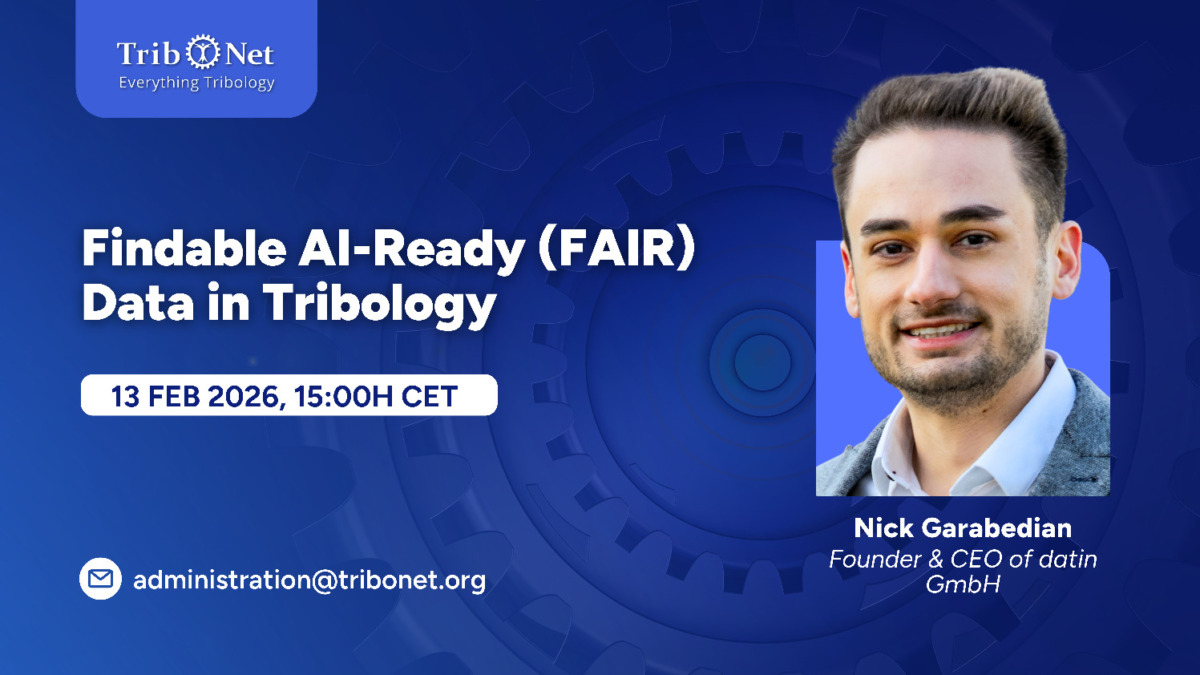
Artificial intelligence is reshaping industries worldwide, yet its full potential in tribology remains largely unrealized. In a recent webinar hosted by TriboNet, Nick Garabedian, CEO of Datin GmbH, shared a compelling vision for scaling AI in scientific research through structured data systems, knowledge graphs, and FAIR data principles.
The session explored a critical question: Why has AI not yet revolutionized engineering disciplines like tribology? According to Garabedian, the answer lies not in algorithmic limitations—but in data infrastructure.

For context, tribology—the science of friction, lubrication, and wear—is inherently interdisciplinary. As outlined in TriboNet’s comprehensive overview of Tribology Fundamentals, the field connects materials science, mechanical engineering, surface chemistry, and physics. Without structured integration across these domains, AI systems struggle to produce meaningful, scientifically grounded insights.
From Nano-Scale Research to AI-Driven Engineering
Garabedian’s journey began after earning a PhD in nano and material psychology, where he examined complex material systems at microscopic scales. During his research, he recognized that AI had enormous potential to analyze such systems—but only if supported by contextualized, interoperable data.
Today, as CEO of Datin GmbH, he focuses on building infrastructure that enables AI to function at scale within engineering and scientific environments. Rather than simply applying machine learning models to datasets, his company aims to develop systems that structure and connect scientific knowledge itself.

This challenge is particularly evident in tribology. Topics such as Friction Mechanisms and Lubrication Regimes cannot be analyzed in isolation. They involve multiple variables—materials, load conditions, surface roughness, temperature, and chemical interactions—that must be understood as interconnected systems.
The Current Limitations of AI in Scientific Research
Despite impressive advancements, AI models today largely rely on statistical correlations. They identify patterns but often lack the structured reasoning required for complex scientific domains.

In tribology, understanding wear behavior might require linking:
- Material microstructure
- Surface treatment processes
- Lubricant chemistry
- Contact pressure
- Environmental conditions
Without structured relationships between these parameters, AI outputs may appear convincing but lack scientific robustness. Dr. Garabedian emphasized that AI must evolve from pattern recognition tools into systems capable of contextual reasoning. To achieve this, engineering data must be organized in a way that reflects real-world scientific relationships.
Knowledge Graphs: Providing Context and Structure
One of the core solutions proposed during the webinar was the implementation of knowledge graphs. A knowledge graph is a structured network that connects entities and defines relationships between them. Instead of treating datasets as disconnected files, knowledge graphs model how different variables influence each other.

In tribology, this could mean connecting:
- Specific alloys to hardness values and wear rates
- Surface coatings to friction coefficient outcomes
- Lubricant additives to performance under boundary lubrication conditions
- Test standards to experimental methodologies
By embedding these relationships into AI systems, researchers can move from superficial data analysis to deeper scientific inference. Knowledge graphs effectively provide the “scientific grounding” that modern AI systems often lack. They enable machines to understand context—not just correlation.
FAIR Data: The Foundation for Interoperable Research
A central theme of Dr. Garabedian’s presentation was FAIR data—Findable, Accessible, Interoperable, and Reusable. Scientific data today is often siloed in private databases, inconsistent formats, or disconnected institutional repositories. This fragmentation limits collaboration and slows innovation.
FAIR principles ensure that data can:
- Be easily discovered
- Be accessed under clear conditions
- Integrate across platforms
- Be reused for new research
In tribology, FAIR data would allow experimental results from one laboratory to integrate seamlessly with simulation models from another. It would enable cross-referencing wear data, lubricant performance metrics, and material characterization findings without manual restructuring.
Automating FAIR Data for Scalable AI
A practical concern raised during the webinar was researcher workload. Scientists already manage experiments, analysis, documentation, and publication. Adding manual FAIR data formatting would be burdensome. Datin GmbH’s vision addresses this challenge through automation. By embedding FAIR compliance directly into research software tools, data structuring occurs seamlessly in the background.
This approach enables:
- Automatic metadata tagging
- Standardized formatting at data creation
- Direct integration into knowledge graphs
Automation removes friction from data management—allowing tribologists to focus on scientific discovery rather than administrative tasks.
The Future of AI in Tribology
The webinar concluded with a clear message: AI will only reach its full potential in engineering when supported by structured, interoperable data ecosystems.
TriboNet, as a global platform dedicated to advancing tribology, plays a critical role in promoting knowledge sharing and technical education. As the community increasingly embraces FAIR principles and knowledge graph frameworks, tribology could become a leading example of AI-enabled scientific transformation.
Dr. Garabedian’s presentation underscored that scalable AI is not simply about better algorithms—it is about better infrastructure. By combining knowledge graphs, FAIR data automation, and collaborative platforms like TriboNet, the engineering community can unlock faster discovery, reduced redundancy, and stronger commercialization pathways.
0 Comment