







Beyond Conventional Tribology: Why Electrical Current Matters in Lubricant Testing
Electrification is transforming tribology
The rapid growth of electric mobility is changing the operating conditions of lubricated contacts. In electric drive systems, lubricants are no longer exposed solely to mechanical loads—they must also withstand electrical stress. Despite this shift, many conventional laboratory tests still evaluate lubricant performance without considering the influence of electrical current.
This creates a significant knowledge gap. Two lubricants may perform almost identically under standard tribological conditions, yet behave completely differently once electrical current passes through the contact. As electrified powertrains become the industry standard, tribological testing must evolve to reflect real operating conditions.
A new perspective on lubricant evaluation
At Optimol Instruments, our investigations using the SRV®5 Tribometer equipped with an integrated Electrical Contact Resistance (ECR) sensor clearly demonstrate that electrical current can fundamentally alter lubricant behaviour.
The SRV®5 allows controlled AC and DC currents to be applied directly through the tribological contact while friction, wear and Electrical Contact Resistance are recorded simultaneously. This integrated approach reveals mechanisms that remain invisible during conventional testing. No external current source or additional measurement equipment is required.
Experimental approach
Five lubricant formulations, including one ZDDP-containing oil and four zinc-free formulations—were tested under identical operating conditions (200 N, 80 °C, 50 Hz, 2 hours). Each lubricant was evaluated under three electrical conditions: no current, 200 mA DC and 200 mA AC, corresponding to an estimated current density of approximately 1 MA/m².
What the results reveal
Although the coefficient of friction remained largely unchanged, wear behaviour differed significantly depending on both current type and additive chemistry.
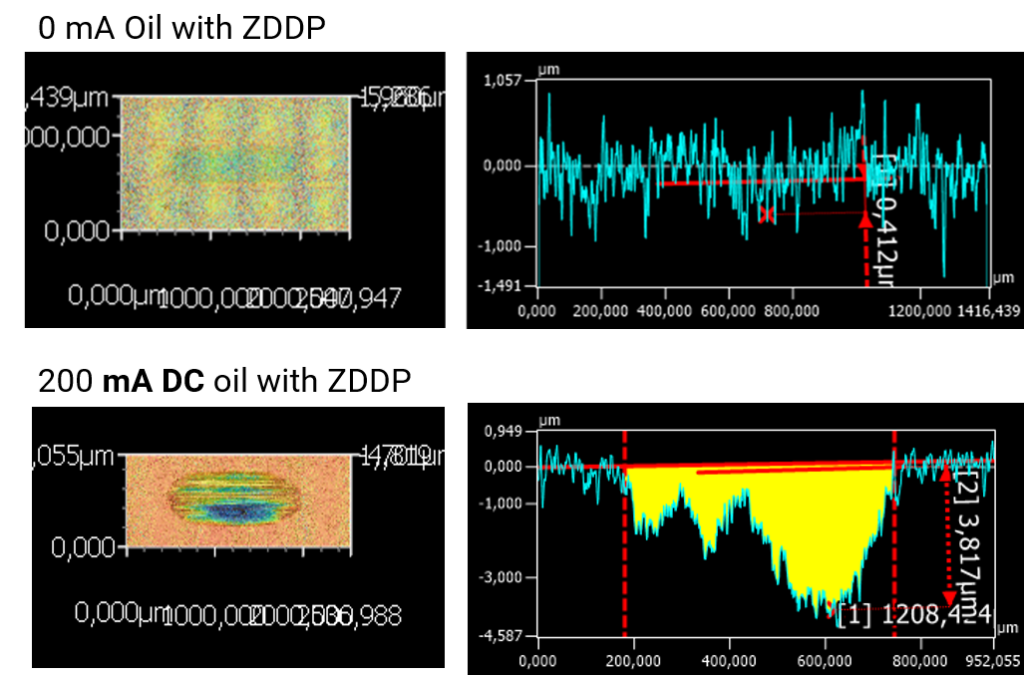
• The ZDDP formulation exhibited substantially higher wear under DC current than under 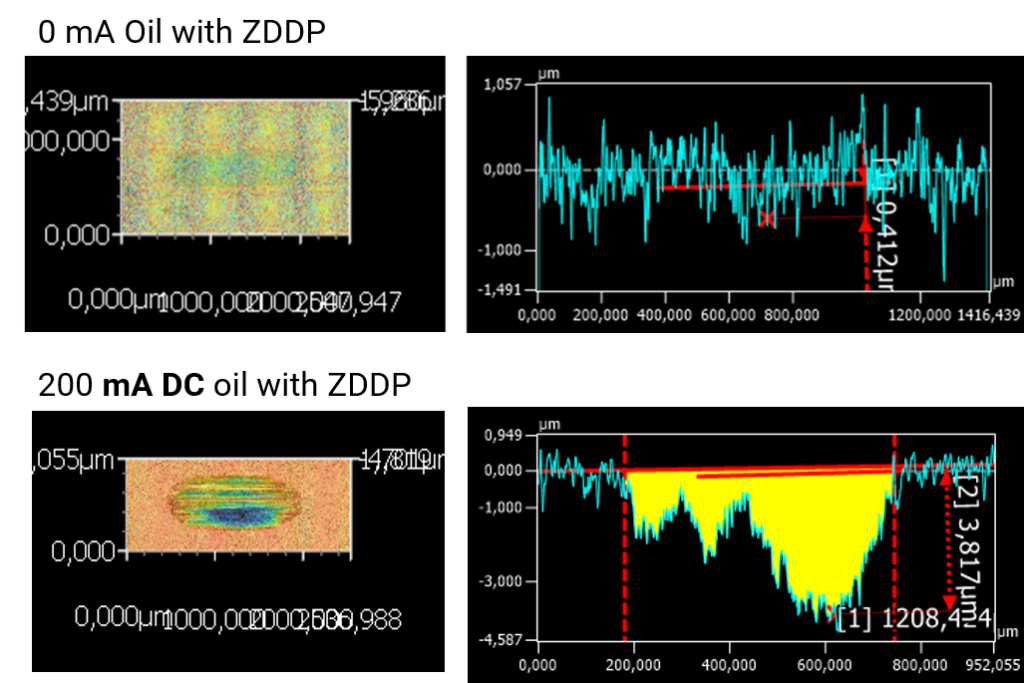 AC or no-current conditions, confirming observations reported in the scientific literature.
Figure 1: Microscopy images for oil with ZDDP
• Additive A remained remarkably stable under all electrical conditions.
• Additive B showed a moderate increase in wear under AC current.
• Additive C performed better under AC current, exhibiting reduced wear.
• Additive D displayed increased wear under both AC and DC current.
These results clearly demonstrate that electrical current can completely change the performance ranking of lubricant formulations. A lubricant that performs well under purely mechanical conditions may not necessarily be the best choice for electrified applications.
The Optimol Instruments solution
The SRV®5 with integrated ECR technology combines friction, wear and electrical contact resistance measurements within one fully integrated test system. It enables lubricant developers to investigate the interaction between mechanical and electrical loads efficiently and reproducibly.
At Optimol Instruments, we support customers worldwide with application-oriented tribological testing that accelerates lubricant development and provides deeper insight into lubricant performance under realistic operating conditions.
One Instrument. One Test. Complete Insight.
Dr. Ameneh Schneider
Senior Expert Tribology | Optimol Instruments
www.optimol-instruments.de
0 Comment