








TriboNet Weekly: Global Tribology, Lubrication & Surface Engineering Intelligence — Oct. 26–31, 2026
Key Takeaways
- Middle Eastern Group III base-oil imports fell to their second-lowest monthly level in more than six years, maintaining pressure on premium lubricant formulations.
- SK Enmove’s geographically diversified production network gained strategic importance and delivered record quarterly operating profit amid elevated base-oil spreads.
- India raised base-oil production to a five-month high, although strong exports and continued domestic demand maintained its dependence on imports.
- Singapore redirected a greater proportion of its base-oil exports toward India, China and Southeast Asia.
- Weak lubricant demand and high raw-material costs squeezed producers and blenders, with Castrol India’s quarterly operating margin falling to its lowest level in more than a decade.
- FUCHS announced investments that will increase its ownership and operating presence across Southern and East Africa.
- Research highlights included programmable frictional metainterfaces, grease-starvation visualization, cartilage-targeted biolubricants, nano-MQL machining, adaptive tribochemical lubrication and low-wear electrical-contact materials.
1. Middle Eastern Group III Imports Remain Severely Constrained
Global imports of premium Group III base oils from Qatar, the UAE and Bahrain fell to less than 7,000 tonnes in August, according to trade data reported on 27 October. This was down from more than 22,000 tonnes in July and represented the second-lowest monthly volume in more than six years. baseoilnews.com
Middle Eastern products reportedly represented less than 3% of premium base-oil shipments during the four months to August, compared with approximately 41% in 2024 and 39% in 2025.

The impact was not uniform across regions:
- The United States remained highly dependent on imported Group III base stocks.
- Europe retained some domestic and regional alternatives.
- Asia could draw on South Korean, Indian, Chinese and Singaporean production.
- Replacement cargoes increasingly travelled longer distances, adding freight, inventory and qualification costs.
Shipments to Europe and the United States resumed only sporadically during September, leaving buyers increasingly reliant on South Korean supply and additional material from India and China.
Why Tribologists Should Care
Group III base oils are widely used in:

- SAE 0W-20, 0W-16 and other low-viscosity engine oils
- High-performance passenger-car motor oils
- Heavy-duty engine oils
- Automatic-transmission and driveline fluids
- Industrial lubricants requiring high oxidation stability
- Long-drain lubricant formulations
Replacing one Group III base oil with another is not necessarily a simple drop-in substitution. Supplier products can differ in:
- Viscosity index
- Noack volatility
- Low-temperature response
- Oxidation stability
- Additive solvency
- Sulfur and aromatic content
- Elastomer compatibility
- Friction-modifier response
Finished formulations carrying API, ACEA or OEM approvals may require additional testing before an alternative base stock can be introduced.
Source: Global Group III Imports from the Middle East Fall Further in August


2. SK Enmove Benefits from Group III Supply Disruption
SK Enmove’s European and international operations gained strategic importance as buyers sought alternatives to disrupted Middle Eastern Group III supply.
The company’s European presence includes Iberian Lube Base Oils Company—iLBOC—in Cartagena, Spain. The facility is reportedly owned 70% by SK Enmove and 30% by Repsol Petróleo. Its combined Group II and Group III production capacity is approximately 19,300 barrels per day. JobbersWorld
However, installed capacity should not be interpreted as immediately available Group III supply. Actual availability depends on:

- Operating rate
- Feedstock availability
- Existing supply contracts
- Grade distribution
- Maintenance schedules
- Product qualification requirements
Record Quarterly Profit
SK Enmove reported third-quarter operating profit of approximately KRW 1.091 trillion, its highest quarterly result. The result exceeded its previous record annual operating profit of KRW 1.071 trillion, achieved in 2022. Elevated base-oil spreads associated with global supply disruption were identified as the principal contributor. Aju Press
SK Innovation, the parent company, reported consolidated third-quarter operating profit of KRW 3.704 trillion.
Tribology Impact
SK Enmove’s result demonstrates the strategic value of geographically diverse premium-base-oil production. However, lubricant manufacturers still need to determine whether available grades can be used without compromising:
- Low-temperature viscosity
- Volatility
- Deposit control
- Wear protection
- Seal compatibility
- Fuel-economy performance
- Existing product approvals
Sources:
- SK Enmove’s European Base-Oil Operations Gain Importance
- SK Innovation Q3 Profit Hits Record on Oil and Lubricant Margins

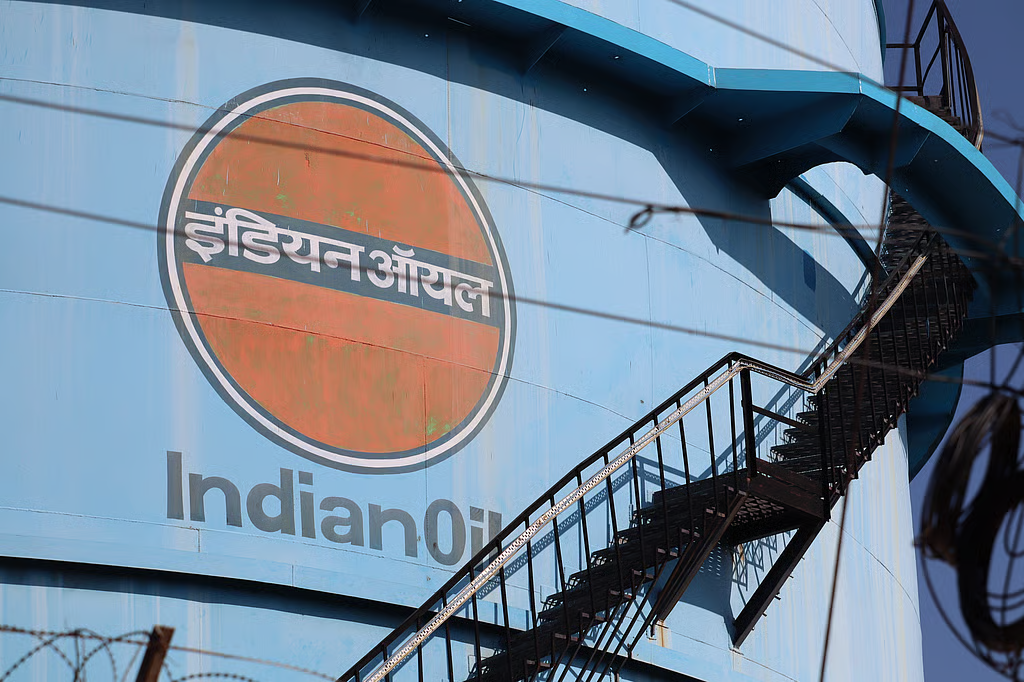
3. India’s Base-Oil Production Reaches a Five-Month High
India produced approximately 151,000 tonnes of base oils in September, up from 140,000 tonnes in August. Output increased 22% year-on-year, marking a tenth consecutive annual increase and the third-highest monthly total on record. baseoilnews.com
Despite the increase, domestic supply remained insufficient to satisfy demand. India continued to attract cargoes from across Asia.
Key Market Figures
| Indicator | Reported value |
|---|---|
| September base-oil output | 151,000 tonnes |
| August base-oil output | 140,000 tonnes |
| Year-on-year production increase | 22% |
| September Asian exports to India | More than 145,000 tonnes |
| August Indian base-oil exports | More than 42,000 tonnes |
| August supply deficit | More than 150,000 tonnes |
More than half of India’s record August exports reportedly went to the United States, where buyers were seeking alternatives to lost Middle Eastern Group III supply.
September brought a partial reversal. Asian exports to India rose to a six-month high, while preliminary data indicated that India’s exports declined from the August peak.
Why Tribologists Should Care
Higher domestic production may improve supply security, but it does not guarantee that every viscosity grade or formulation-quality base stock will be available locally.
Base-oil supply decisions are driven by:
- Product yield and refinery configuration
- Domestic versus export price
- Grade demand
- Freight economics
- Contractual commitments
- Lubricant approval requirements
For Indian blenders, local sourcing can reduce transport risk and lead time, but new sources must still undergo formulation and performance qualification.
Source: India’s September Base Oils Output Rises to Five-Month High
4. Singapore Redirects More Base-Oil Cargoes Toward Asia
Singapore’s base-oil exports increased to more than 175,000 tonnes during the four weeks ending 28 October, up from less than 125,000 tonnes during the four weeks ending 21 October.
The total remained below September’s unusually high 203,000 tonnes but was close to the 178,000 tonnes shipped in August. baseoilnews.com
The destination mix changed significantly:
- Exports to India exceeded 39,000 tonnes—the highest since mid-May.
- Exports to China exceeded 25,000 tonnes—the highest since late July.
- China, India and Southeast Asia accounted for more than 70% of exports.
- The United States and Europe received only 6%, down from 33% in September.
- A cargo of approximately 11,000 tonnes to the United States was the first in a month.
Market Interpretation
The shift suggests that Singaporean supply was moving back toward regional buyers after the earlier surge of shipments to Western markets.
Indian buying likely included inventory replenishment after months of constrained supply rather than only increased end-use consumption.
Tribology Impact
Regional supply redistribution can influence lubricant formulations through:
- Base-stock source changes
- Different additive-treat requirements
- Batch-to-batch viscosity variation
- Product reformulation
- Temporary consolidation of viscosity grades
- Longer qualification timelines for approved lubricants
The technical risk is greatest for highly optimized products where small changes in base-stock composition affect friction, oxidation or low-temperature properties.
Source: Singapore’s Base Oils Exports Rebound in Month to 28 October

5. Weak Demand Limits Producers’ Ability to Recover Costs
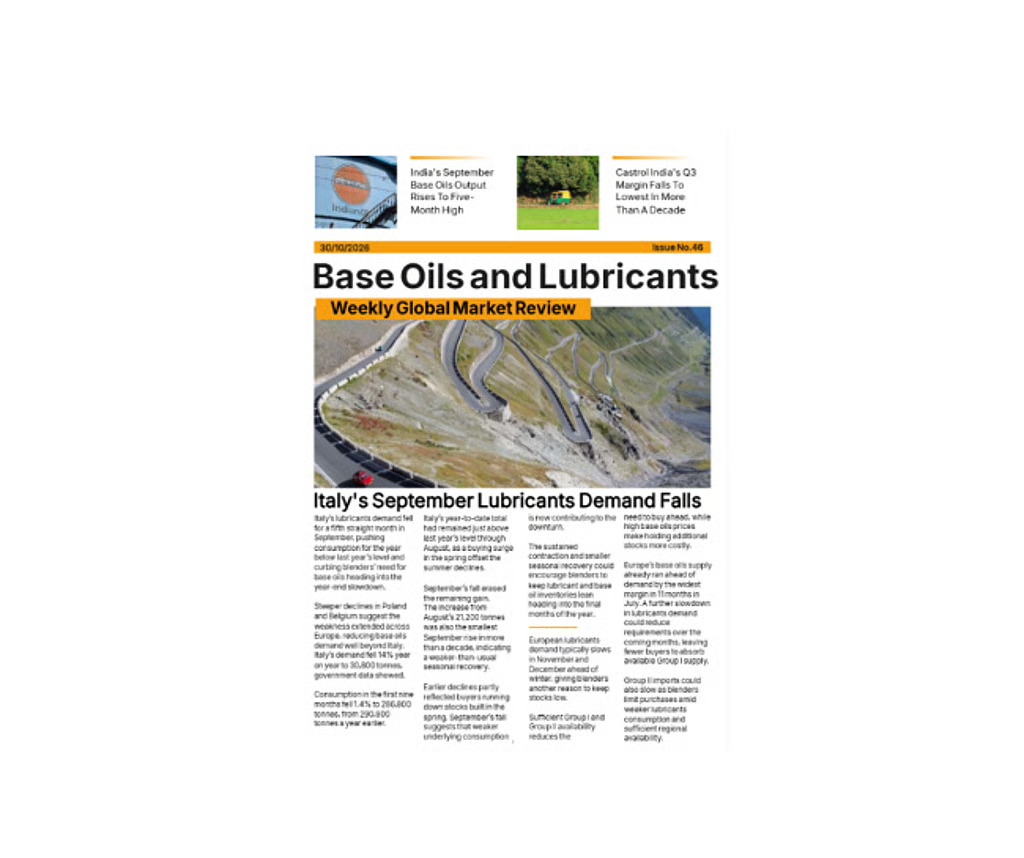
The weekly global market review published on 30 October described a difficult balance between increasing production costs and weak lubricant demand.
Producers required higher prices to restore squeezed margins, but buyers were reluctant to replenish inventories while supply remained sufficient across most markets. Refiners also faced weak base-oil margins relative to diesel production. baseoilnews.com
Key developments included:
- Maintenance at several production facilities
- Fewer long-haul cargoes from Asia
- Lean buyer inventories
- Weak lubricant demand
- High feedstock and raw-material costs
- Stronger Group III margins because of constrained supply
- Weak Group I and Group II producer margins
Italy’s Lubricant Demand Declines
Italian lubricant consumption fell for a fifth consecutive month in September.
Demand declined 14% year-on-year to approximately 30,800 tonnes. Consumption during the first nine months of 2026 fell 1.4% to 286,800 tonnes, compared with 290,900 tonnes during the equivalent 2025 period. baseoilnews.com
Declining demand was also reported in other European markets, including Poland and Belgium.
Why Tribologists Should Care
Weak market demand may encourage lubricant suppliers and end users to:
- Reduce inventories
- Consolidate product portfolios
- Delay lubricant changes
- Extend drain intervals
- Increase the use of alternative base stocks
- Reduce the number of application-specific products
These actions can be commercially reasonable, but extending lubricant service requires condition-based evidence.
Relevant monitoring parameters include:
- Kinematic viscosity
- Acid and base numbers
- Oxidation and nitration
- Additive depletion
- Water concentration
- Particle count
- Wear-metal concentration
- Ferrous debris
- Varnish potential
- Remaining useful life
Sources:
- Weekly Global Base-Oil and Lubricant Market Review — 30 October 2026
- Italy’s September Lubricants Demand Extends Slide
6. Castrol India’s Margin Falls as Raw-Material Costs Rise
Castrol India’s third-quarter operating margin reportedly fell to its lowest level in more than a decade as raw-material costs increased faster than sales.
Profit before tax declined 21% year-on-year to approximately ₹2.43 billion. The reported margin narrowed to 14.0% from 25.4% in the second quarter. baseoilnews.com
Reported Indicators
| Indicator | Change |
| Revenue | +27% year-on-year |
| Total costs | +41% year-on-year |
| Raw-material costs | +71% year-on-year |
| Profit before tax | −21% year-on-year |
| Reported margin | 14.0% |
| Previous-quarter margin | 25.4% |
Raw materials reportedly accounted for 72% of total costs, compared with 67% during the previous quarter and less than 60% in 2025.
Castrol India indicated that it was increasing local sourcing, supplier diversification and reformulation to manage costs.
Tribology Impact
Reformulation can help control cost and improve supply resilience, but it must preserve:
- OEM and industry approvals
- Wear protection
- Oxidation resistance
- Deposit control
- Low-temperature performance
- Volatility
- Seal compatibility
- Frictional performance
- Drain interval
Cost optimization should therefore be supported by formulation testing rather than viscosity matching alone.
Source: Castrol India’s Q3 Margin Falls to Lowest in More Than a Decade

7. FUCHS Expands Its African Lubricant Operations
FUCHS announced a series of investments intended to expand its direct operations in Southern and East Africa.
The company signed agreements to:
- Acquire 100% ownership of former joint ventures in Zimbabwe
- Acquire 100% ownership of operations in Zambia
- Acquire 100% ownership of operations in Mozambique
- Establish a controlling share in a new Kenyan joint venture
- Increase its Tanzanian holding to a controlling stake
The transactions are expected to close in early 2027. The companies involved employ approximately 170 people and generate around €50 million in annual sales. FUCHS LUBRICANTS CO. (United States)
FUCHS identified mining, infrastructure, manufacturing, urbanization and increased vehicle ownership as long-term drivers of African lubricant demand.
Why Tribologists Should Care
Closer regional operations can improve:
- Product availability
- Technical support
- Oil-analysis services
- Application-specific formulation
- Customer training
- Mining and heavy-equipment lubrication
- Response to local operating environments
African equipment can operate under severe combinations of dust, heat, water contamination, variable fuel quality and inconsistent maintenance. Lubricant selection should therefore account for local duty cycles rather than relying only on generic OEM viscosity recommendations.
Primary source: FUCHS Expands Presence in Africa Through Strategic Investments
8. Research Watch: Papers Published During the Week
8.1 Inverse Design of Programmable Frictional Metainterfaces
Paper: Inverse Design of Metainterfaces Towards Static Friction Control: Beyond the Hertzian Limit
Published: 26 October 2026
Journal: Tribology Letters
Researchers combined a differentiable contact-mechanics model, neural network and quadratic optimizer to design engineered asperity geometries that produce targeted static-friction responses.
Conventional rough contacts frequently exhibit an approximately linear relationship between real contact area and normal load. The proposed metainterfaces use non-standard asperity geometries to generate nonlinear macroscopic contact laws. Predictions were validated using boundary-element simulations. Springer Nature Link
Why It Matters
Programmable friction could benefit:
- Soft robotic grippers
- Haptic interfaces
- Precision positioning
- Adaptive brakes and clutches
- Medical devices
- Reconfigurable fixtures
The method moves surface design from trial-and-error texturing toward inverse design: specifying the desired frictional law first and calculating a compatible topography.
Paper: https://doi.org/10.1007/s11249-026-02210-4

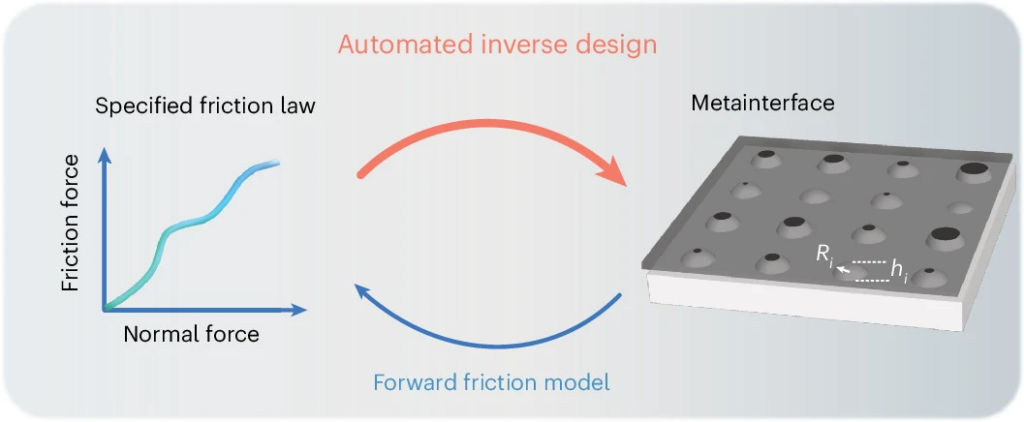
8.2 Automated Metainterfaces with Tailored Friction Laws
Paper: Automated Inverse Design of Metainterfaces with Tailored Friction Laws
Published: 30 October 2026
Journal: Nature Physics
This study developed an automated approach for identifying asperity-based surface topographies capable of producing selected macroscopic friction laws.
Previous metainterfaces were often designed using intuition and limited geometric families. The automated framework expands the searchable design space and allows targeted friction–load behavior to be encoded into surface structure. Nature Physics
Why It Matters
The study indicates that friction can be treated as an engineerable system response rather than a fixed property of a material pair.
Practical translation will require consideration of:
- Manufacturing tolerances
- Asperity damage
- Surface contamination
- Plastic deformation
- Environmental humidity
- Wear-induced topographical evolution
- Scale-up from unit cells to components
Paper: https://doi.org/10.1038/s41567-026-03503-0
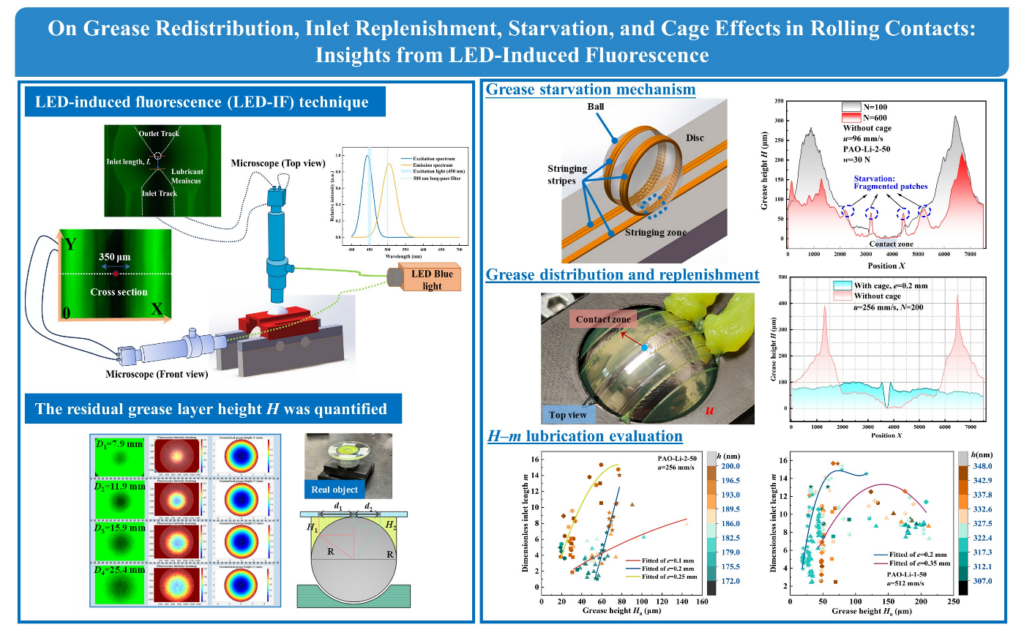
8.3 Direct Visualization of Grease Redistribution and Starvation
Paper: On Grease Redistribution, Inlet Replenishment, Starvation, and Cage Effects in Rolling Contacts: Insights from LED-Induced Fluorescence
Available online: 26 October 2026
Journal: Friction
The researchers used LED-induced fluorescence to directly observe grease distribution at the inlet of a ball-on-disc rolling contact.
They quantified residual grease-layer height and related it to dimensionless meniscus length to construct a lubrication-supply map. Grease was primarily supplied through a stringing mechanism. Progressive fragmentation prevented string reformation, restricted replenishment and eventually promoted starvation. sciopen.com
Cage clearance also influenced lubricant redistribution:
- Appropriate clearance improved grease entrainment.
- Excessively small clearance reduced replenishment.
- Excessively large clearance also reduced replenishment.
- The optimum depended on grease type and operating conditions.
Why It Matters
Bearing film thickness cannot be predicted from grease consistency or residual quantity alone. Spatial distribution, entrainment speed, cage geometry and replenishment dynamics are also important.
The method could improve understanding of:
- Bearing run-in
- Grease churning
- Starvation onset
- Relubrication intervals
- Cage design
- Low-torque bearing systems
Paper: https://doi.org/10.26599/FRICT.2026.9441325
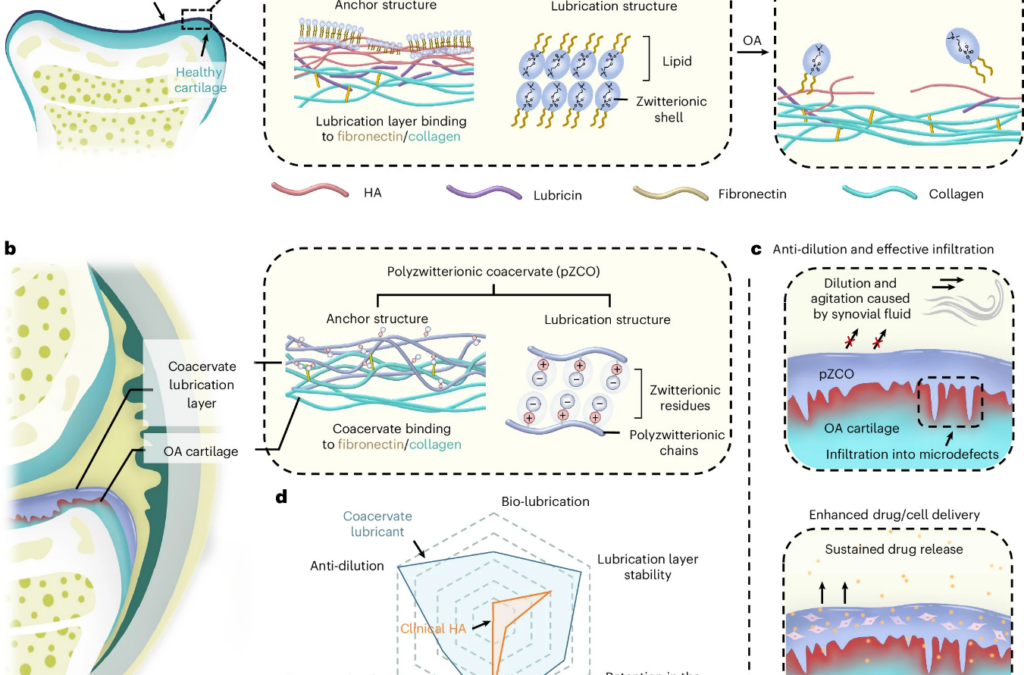
8.4 Cartilage-Binding Biolubricant Combines Friction Reduction and Drug Delivery
Paper: Cartilage-Binding Coacervate with Therapeutic Payload Delivery and Biomimetic Lubrication Alleviates Osteoarthritis by Reducing Joint Friction and Inflammation
Published: 27 October 2026
Journal: Nature Biomedical Engineering
The study developed a cartilage-binding coacervate intended to provide both biomimetic lubrication and localized therapeutic delivery.
The design was inspired by the natural cartilage boundary-lubrication system, in which hyaluronic acid, lubricin and phospholipids contribute to low friction and surface protection.
The reported system was designed to:
- Bind to cartilage
- Retain therapeutic agents locally
- Reduce joint friction
- Limit inflammatory activity
- Protect cartilage from further degeneration Nature Biomedical Engineering
Why It Matters
Many osteoarthritis treatments address pain or inflammation without restoring the damaged lubrication environment. A combined tribological and biological therapy may interrupt the cycle in which matrix degradation increases friction, mechanical stress and inflammatory signalling.
Future translation will require evidence on:
- Retention under repeated joint loading
- Long-term lubrication
- Degradation products
- Dose control
- Immune response
- Repeated administration
- Performance in human synovial fluid
- Comparison with existing viscosupplements
Paper: https://doi.org/10.1038/s41551-026-01819-z

8.5 ROS-Responsive Hybrid Biolubricant for Osteoarthritis
Paper: Injectable and Reactive Oxygen Species-Responsive Nanogel–Microgel Hybrid Biolubricants for Osteoarthritis Therapy by Immunometabolic Reprogramming
Published: 28 October 2026
Journal: Journal of Nanobiotechnology
The researchers developed an injectable nanogel–microgel hybrid intended to respond to elevated reactive oxygen species in osteoarthritic joints.
The platform combines lubrication, cartilage protection and modulation of the inflammatory microenvironment. Springer Nature Link
Why It Matters
This work reflects a broader movement from passive viscosupplementation toward responsive biolubricants that react to disease-associated chemistry.
Tribological evaluation should establish whether therapeutic benefits persist under:
- Repeated reciprocating motion
- Physiological contact pressure
- Protein-rich synovial fluid
- Enzymatic degradation
- Long-duration loading
- Dilution and clearance from the joint
Paper: https://doi.org/10.1186/s12951-026-05177-5

8.6 Nano-MQL Machining Combined with Machine Learning
Paper: Integrated Experimental and Machine Learning Analysis of Nano-MQL Assisted Turning of AA7075-T6
Published: 26 October 2026
Journal: Scientific Reports
The study compared dry machining, minimum-quantity lubrication and nanoparticle-enhanced MQL during turning of AA7075-T6 aluminium alloy.
The analysis considered outcomes including:
- Tool wear
- Surface roughness
- Cutting temperature
- Machining forces
- Lubrication condition
- Process prediction using machine-learning models Scientific Reports
Why It Matters
Nano-MQL attempts to combine the low fluid consumption of MQL with the heat-transfer and interfacial properties of nanoparticles.
However, industrial adoption requires assessment of:
- Nanoparticle stability
- Nozzle blockage
- Worker exposure
- Aerosol formation
- Tool and workpiece contamination
- Waste handling
- Reproducibility
- Lifecycle environmental impact
Machine learning can optimize parameters, but the models must remain valid outside the exact materials and operating ranges used during training.
Paper: https://doi.org/10.1038/s41598-026-73437-3
8.7 Friction-Activated Tribo-Click Lubrication
Paper: Adaptive Lubrication and Antiwear Enabled by Synergy Between Friction-Induced In Situ Tribo-Click Reaction and Gel Confinement of Reaction Products
Published: 30 October 2026
Journal: Advanced Functional Materials
The study introduced a lubricant platform in which friction initiates an interfacial click reaction. A gel network confines the reaction products near the rubbing interface, helping form and retain a protective lubricating layer. Wiley Online Library
Why It Matters
Conventional additives may be consumed continuously throughout the lubricant volume. A mechanically activated system could concentrate protective chemistry where and when it is needed.
Potential advantages include:
- Load-responsive tribofilm formation
- Reduced additive loss
- Self-adaptive wear protection
- Longer interfacial protection
- Improved retention of reaction products
Long-term work should determine whether the reaction remains repeatable and whether accumulated products affect viscosity, debris transport or surface fatigue.
Paper: https://doi.org/10.1002/adfm.79384
8.8 Low-Wear Silver Composites for Electrical Contacts
Paper: Multiphase Synergy and Friction-Induced Low-Wear Mechanisms in Silver-Based Composites
Published: 28 October 2026
Journal: Advanced Engineering Materials
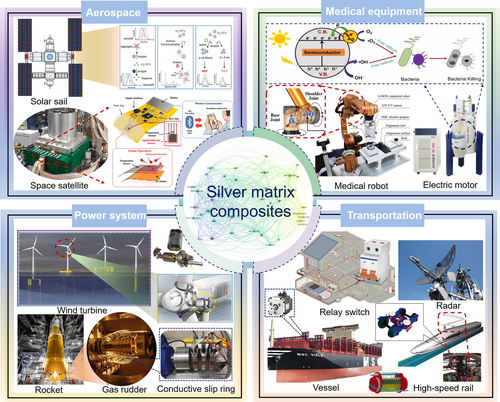
The review examined how silver matrices, solid lubricants and reinforcing phases interact in sliding electrical contacts.
Pure silver provides high electrical and thermal conductivity but has limited hardness and wear resistance. Multiphase composites can improve performance through:
- Stress redistribution
- Load-bearing reinforcement
- Solid lubrication
- Stable third-body formation
- Tribofilm development
- Tribo-oxidation control
- Gradient nanocrystallization
- Surface amorphization Wiley Online Library
Why It Matters
Electrical-contact materials must balance properties that can conflict:
- Low electrical resistance
- Low friction
- High wear resistance
- Arc-erosion resistance
- Thermal stability
- Low transfer tendency
Optimizing only hardness or conductivity is therefore insufficient.
Paper: https://doi.org/10.1002/adem.71372
9. Technology Outlook
| Technology area | Development | Opportunity | Principal limitation |
| Group III sourcing | Greater reliance on South Korean, Indian and Chinese supply | Improved regional diversification | Qualification and approval requirements |
| Frictional metainterfaces | Inverse-designed asperity topographies | Programmable grip and haptics | Manufacturing tolerances and wear |
| Grease visualization | Direct observation using fluorescence | Improved bearing and cage design | Laboratory geometry may not reproduce full bearings |
| Cartilage biolubricants | Lubrication combined with targeted therapy | Joint protection and localized drug delivery | Retention and long-term biocompatibility |
| Nano-MQL | Nanoparticle-enhanced low-volume lubrication | Lower fluid consumption and tool wear | Aerosol exposure and dispersion stability |
| Tribo-click chemistry | Friction-activated protective reactions | On-demand tribofilm formation | Reaction durability and product accumulation |
| Electrical-contact composites | Multiphase silver systems | Lower wear with retained conductivity | Complex interactions among phases |
| Machine-learning optimization | Data-driven design and process prediction | Faster screening and parameter selection | Limited extrapolation beyond training data |
10. Final Outlook
The week of 26–31 October highlighted a divergence within the lubricant market.
Group III supply remained constrained, supporting exceptionally strong margins for producers such as SK Enmove. In contrast, many Group I and Group II producers faced weak demand and limited ability to recover higher costs. Castrol India’s margin compression demonstrated how base-oil and raw-material inflation was transferring pressure from refiners to finished-lubricant manufacturers.
Regional production became increasingly important. India raised output, Singapore redirected cargoes toward Asian buyers, and SK Enmove benefited from production outside the Middle East. FUCHS’s African investments similarly showed the growing value of operating closer to local customers and industrial markets.
The research published during the week was unusually diverse but connected by a common principle: tribological response can increasingly be designed rather than merely measured. This appeared in programmable asperity structures, friction-triggered chemistry, responsive joint lubricants, visualized grease supply and machine-learning-assisted machining.
The continuing challenge is translation. Laboratory performance must survive realistic manufacturing variability, contamination, environmental exposure, repeated loading, material ageing and long-term wear.
References
- Base Oil News. “Global Group III Imports from the Middle East Fall Further in August,” 27 October 2026.
https://www.baseoilnews.com/amp/story/europe-mideast-gulf-africa/mideast-gulf/global-group-iii-imports-from-middle-east-fall-further-in-august - JobbersWorld. “SK Enmove’s European Base-Oil Operations Gain Importance Amid Group III Supply Disruptions,” 26 October 2026.
https://jobbersworld.com/2026/10/26/sk-enmoves-european-base-oil-operations-gain-importance-amid-group-iii-supply-disruptions/ - Aju Press. “SK Innovation Q3 Profit Hits Record on Oil, Lubricant Margins,” 29 October 2026.
https://www.ajupress.com/view/20261029110900071 - Base Oil News. “India’s September Base Oils Output Rises to Five-Month High,” 28 October 2026.
https://www.baseoilnews.com/asia/india/indias-september-base-oils-output-rises-to-five-month-high - Base Oil News. “Singapore’s Base Oils Exports Rebound in Month to 28 October,” 29 October 2026.
https://www.baseoilnews.com/amp/story/asia/singapore/singapores-base-oils-exports-rebound-in-month-to-28-october-2026 - Base Oil News. “Base Oils and Lubricants: Weekly Global Market Review — 30 October 2026.”
https://www.baseoilnews.com/weekly-review/base-oils-and-lubricants-weekly-global-market-review/base-oils-and-lubricants-weekly-global-market-review-30-oct-26 - Base Oil News. “Italy’s September Lubricants Demand Extends Slide,” 27 October 2026.
https://www.baseoilnews.com/europe-mideast-gulf-africa/italy/italys-september-lubricants-demand-extends-slide - Base Oil News. “Castrol India’s Q3 Margin Falls to Lowest in More Than a Decade,” 28 October 2026.
https://www.baseoilnews.com/company-news/castrol-indias-q3-margin-falls-to-lowest-in-more-than-a-decade - FUCHS SE. “FUCHS Expands Presence in Africa Through Strategic Investments,” 28 October 2026.
https://www.fuchs.com/us/en/company/news/press-releases/view/10397-FUCHS-expands-presence-in-Africa-through-strategic-investments/ - Bilotto, J., Singhal, A., Garcia-Suarez, J., et al. “Inverse Design of Metainterfaces Towards Static Friction Control: Beyond the Hertzian Limit.” Tribology Letters, 74, 128 (2026). DOI: 10.1007/s11249-026-02210-4.
https://doi.org/10.1007/s11249-026-02210-4 - Fu, L., Gabriel Kashala, D., Dalmas, D., et al. “Automated Inverse Design of Metainterfaces with Tailored Friction Laws.” Nature Physics (2026). DOI: 10.1038/s41567-026-03503-0.
https://doi.org/10.1038/s41567-026-03503-0 - Liu, Y., Pape, F., Liu, M., et al. “On Grease Redistribution, Inlet Replenishment, Starvation, and Cage Effects in Rolling Contacts: Insights from LED-Induced Fluorescence.” Friction (2026). DOI: 10.26599/FRICT.2026.9441325.
https://doi.org/10.26599/FRICT.2026.9441325 - Chen, S., Jiang, T., Qiu, X., et al. “Cartilage-Binding Coacervate with Therapeutic Payload Delivery and Biomimetic Lubrication Alleviates Osteoarthritis by Reducing Joint Friction and Inflammation.” Nature Biomedical Engineering (2026). DOI: 10.1038/s41551-026-01819-z.
https://doi.org/10.1038/s41551-026-01819-z - Zhang, Y., Chu, Y., Tang, Y., et al. “Injectable and Reactive Oxygen Species-Responsive Nanogel–Microgel Hybrid Biolubricants for Osteoarthritis Therapy by Immunometabolic Reprogramming.” Journal of Nanobiotechnology (2026). DOI: 10.1186/s12951-026-05177-5.
https://doi.org/10.1186/s12951-026-05177-5 - Binali, R., Ayrancı, E., Kuntoğlu, M., et al. “Integrated Experimental and Machine Learning Analysis of Nano-MQL Assisted Turning of AA7075-T6.” Scientific Reports (2026). DOI: 10.1038/s41598-026-73437-3.
https://doi.org/10.1038/s41598-026-73437-3 - Liu, W., Bao, L., et al. “Adaptive Lubrication and Antiwear Enabled by Synergy Between Friction-Induced In Situ Tribo-Click Reaction and Gel Confinement of Reaction Products.” Advanced Functional Materials (2026). DOI: 10.1002/adfm.79384.
https://doi.org/10.1002/adfm.79384 - Zhu, et al. “Multiphase Synergy and Friction-Induced Low-Wear Mechanisms in Silver-Based Composites.” Advanced Engineering Materials (2026). DOI: 10.1002/adem.71372.
https://doi.org/10.1002/adem.71372
0 Comment