







In-situ vision tool wear monitoring using Artificial Intelligence

Introduction
Industries like aerospace, nuclear, automotive, and naval operates in environments where the consequences of component failure can be catastrophic, leading to loss of life, environmental harm, or significant financial costs. Because of these risks, safety standards are extremely strict, and there is an urgent need for components to meet high reliability and performance criteria. In these industries, the failure of even a small part could result in significant operational disruptions or pose serious hazards. Precision manufacturing plays a key role in ensuring that parts meet these stringent requirements by producing components with exact dimensions and tight tolerances. This means that every part is crafted with a high degree of accuracy, ensuring it functions exactly as intended, even in extreme conditions like high pressure, temperature fluctuations, or high-stress environments. By achieving this level of precision, the risk of failure is greatly reduced, ensuring that machinery and systems in these industries operate reliably over time.
Why is tool wear monitoring required?
Implementing Tool Condition Monitoring (TCM) ensures that essential components, such as aero-engine Low Pressure Turbine casings, are produced with high precision and quality standards. During the manufacturing process on a vertical lathe, a human inspector regularly pauses the work to visually check tool wear, ensuring that it remains within acceptable limits. If the tool wear is found to be unacceptable, it could lead to damage to the workpiece or insufficient material removal. In such cases, this could result in excessive force being applied to the next tool, potentially causing it to fail or cause further damage. Therefore, inspecting the workpiece in these situations is crucial to prevent compounding issues and ensure the continued quality and safety of the manufacturing process.
How can ANN help in monitoring?
- Versatility of ANN: ANN offer a wide range of options for users to obtain the most accurate findings regarding machining results, making them highly versatile for different applications.
- Preferred AI Method: Compared to other AI techniques, ANN is the most preferred due to its flexible, fast learning capabilities, and its ability to function without requiring expert intervention.
- Handling Large Data: ANN, inspired by human learning models, can manage vast amounts of data, which would otherwise require significant human effort and time, making it ideal for handling surplus sensorial data from cutting area sensors in TCM.
- High Accuracy in Machining: ANN has proven to be highly accurate in estimating machining parameters for processes like turning, milling, grinding, and drilling, offering reliable results for various manufacturing tasks.
- Data Requirements for ANN: ANNs require large datasets to be divided into training and test classes for effective learning. Without sufficient data, challenges like low accuracy, failure detection issues, and insufficient model learning may arise.
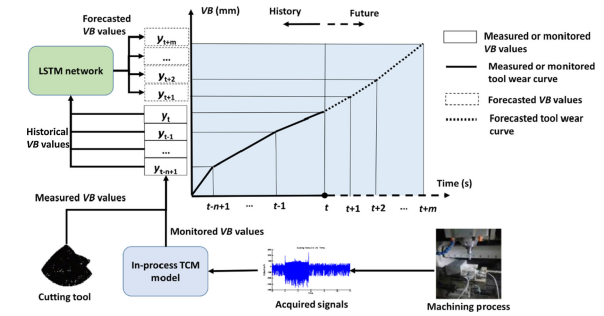
Figure – 1 In-process TCF approach [2]
Conclusion
ANNs are highly effective for modelling complex behaviors and relationships, making them ideal for tasks that require handling intricate patterns and dynamic data. They come in various typologies, providing flexibility to address a wide range of challenges across industries. However, ANNs can be computationally intensive, requiring long training times, especially for large datasets and complex models. Additionally, they involve numerous parameters that need expert optimization for achieving optimal performance. While ANNs are powerful, they are often considered “black boxes” due to the difficulty in interpreting their decision-making processes. Despite these challenges, ANNs are widely used in industrial applications and are regarded as a standard in artificial intelligence for solving real-world problems.
Reference

0 Comment