








Thin Film Deposition of Tribological Coatings
Article provided by Caitlin Ryan.
Thin film tribological coatings are important for reducing friction, minimising wear, and increasing the lifespan of mechanical components in a variety of industries. These coatings can be applied using different deposition techniques which each offer their own advantages based on cost, scalability, and material shape.
Creating the optimal coating depends on several factors, and extends beyond the coating process and into the drying dynamics that occur as well. This article explains the key thin film deposition methods that are used to create tribological coatings, applications of each, and the overall factors that must be considered to achieve optimal coating performance.
Choosing a Deposition Method
Choosing the most appropriate deposition technique for tribological coatings depends on several considerations.

Firstly, the desired thickness of the tribological coating must be considered. Different coating methods can create thin layers of different thicknesses, from the nanometre to micrometre range. Additionally, how uniform the thin film is will depend on what technique is used. Some methods offer greater control over important factors such as the fluid properties, making it easier to get consistently uniform coatings.
The next thing to think about is the scale of the application – is the work being carried out in a lab or on an industrial scale? Is a single item being coated, or is it part of a roll-to-roll continuous process? Some coating methods are not suitable for scaling up to an industrial level, or can only be used for batch processing.
The shape of the object that is being coated is another important consideration. Some coating techniques, such as dip coating, can be used to coat complex shapes such as tubes whereas others, such as spin coating, are limited to coating small, flat surfaces only.
Quite often, environmental and sustainability considerations must also be factored in when choosing a technique. For example, some coating methods waste a high amount coating solution which may be an issue if the solution is costly or environmentally harmful. As well as this, different coating methods apply coatings at different speeds and with varying levels of complexity. This impacts overall energy consumption, which can be a key consideration during the scaling up process.
Thin Film Tribological Coating Techniques
There are several thin film deposition techniques that are currently used in industry to produce uniform tribological coatings for a range of applications. The most common of these are spin coating, dip coating, and slot die coating. Each of these techniques has its own advantages and limitations, as well as a range of parameters that must be adjusted to achieve an optimal, uniform coating.
Other common thin film deposition methods, such as doctor blade coating and bar coatings, are not frequently used in industry for tribological coatings specifically and are therefore not discussed.
Spin Coating
Spin coating works by depositing a solution onto the substrate that you wish to coat, then rotating it at a high speed. The constant acceleration creates centrifugal force which, in combination with viscous drag and surface tension effects, causes the solution to spread evenly across the substrate. The rate that the substrate is rotated at is what determines the thickness of the film – a faster rotation results in a thinner film.
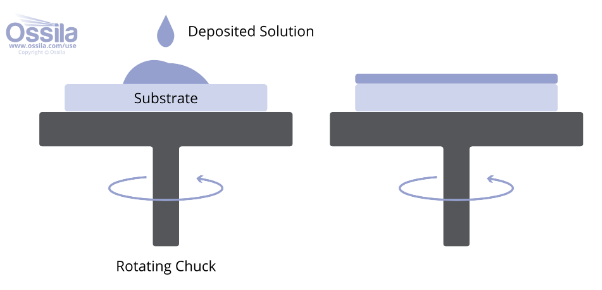

Spin coating is a simple technique that works very well to create uniform coatings on a small scale. Due to the nature of the process, it does not scale very well and so it is limited to batch processing of small components, typically within the research and development period of competent development.
Though limited to small, flat surfaces, there are several applications of spin coating for tribological thin films:
- Hard disk drives (HDDs): Spin coating can be used to apply ultra-thin layers of perfluoropolyether (PFPE) lubricant onto HDDs to reduce the friction between the read/write head and the disk surface.
- Micro-electromechanical systems (MEMS): The performance of MEMS can be improved by spin coating thin layers onto the surface, such as self-assembled monolayers and silicon dioxide layers. These layers reduce static friction by creating low-energy surfaces that minimise adhesion forces.
- Optical coatings: Sol-gel derived coatings can be spin coated onto optical surfaces such as lenses and displays to protect them from scratches and environmental degradation.
Dip Coating
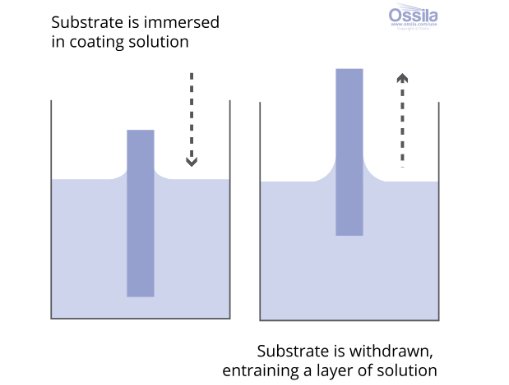
Dip coating works as the name suggests. A substrate is immersed in a coating solution and as it is withdrawn, a thin layer of the coating solution forms on the substrate. Once the solvent within the coating solution is evaporated from the substrate’s surface, a dry thin film will remain.

The thickness of the thin film is hardest to control with dip coating, and it is based on several factors including withdrawal speed, air flow, viscosity, and evaporation rate.Despite this, dip coating is very commonly used to deposit thin tribological coatings across a range of industries:
- Biomedical implants: Biomedical implants such as titanium alloy joint replacements can be dip coated with polymers including ultra-high molecular weight polyethylene (UHMWPE). In doing so, load bearing and wear resistance are increased, leading to better patient outcomes.
- Automotive engine components: Dip coating is often used for engine components such as pistons and shafts because the immersion-based technique means that entire complex geometries can be coated in one process. E-coating, a form of dip coating that also includes an electric field, is sometimes used to apply even layers of anti-corrosion films to components.
Slot Die Coating
In slot die coating, a solution flows through a ‘head’ at a determined rate and directly onto a substrate, which moves relative to the head. The thickness of the deposited film is determined by how much solution is placed onto the substrate. Other factors, such as the solution flow rate and substrate movement speed, must be optimised to improve how uniform the thin film deposition is.
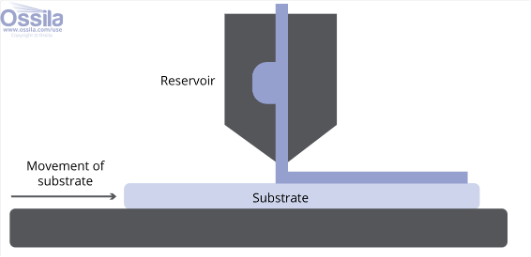
Slot die coating scales very easily and is the most commonly seen thin film deposition technique within the large-scale manufacturing industry. A big benefit over dip coating is that the solution is directly coated onto the substrate, which means there is very little waste.It is, however, the most complex coating technique and a lot of optimisation work is required to ensure that tribological coatings are consistent, stable, and uniform.

As previously mentioned, slot die coating is often used to create tribological thin films on an industrial scale:
- Turbine blades: Slot die coating is compatible with roll-to-roll processes meaning it can be used to create large-area tribological coatings for parts such as turbine blades.
- Energy applications: Slot die coating is used to create protective components on battery electrodes and fuel cell membranes to increase durability. The advantage of this technique is that, once optimised, tribological coatings are consistently defect-free which is particularly important for energy applications.
- Industrial machinery: Precise thickness lubricant films can be deposited onto industrial machinery using slot die coating to reduce friction and wear during operation.
Drying and Film Uniformity
The drying stage is a very important aspect of the deposition of the tribological thin film process. The way that a coating is dried can impact the morphology, uniformity, and therefore its subsequent performance. For that reason, the suitable drying method for both the coating type and technique must be determined to prevent defects from occurring.
The formation of thin films is heavily influenced by the evaporation of the solvent within the coating solution. Once a substrate has been coated and the solvent begins to evaporate, the solid materials in the wet coating become increasingly concentrated until the final dry layer is formed. Therefore, the evaporation process determines how the solid materials organise to create the finished dry layer.
The drying method used is an important consideration, as different techniques can change the final morphology of the film without changing the coating’s chemical composition. Commonly, thin film tribological coatings are thermally dried for example in a furnace or on a hotplate. A higher temperature results in a faster evaporation rate and a reduced drying time.
Drying of Dip Coated Thin Films
The dynamics that occur during the drying of a dip coated thin film depend on the speed that it is withdrawn from the coating solution.
When the withdrawal speed is fast enough, the drying dynamics are dominated by the constant rate period in which solvent evaporation happens uniformly across the surfaces of the wet film. The only exception is at the edge of the coated substrate, where a drying front occurs. In this scenario, the final film thickness is dependent on the initial wet film thickness.
If the withdrawal speed is slow, the drying dynamics become dominated by the drying front period instead. At the drying front, there is a greater surface-to-area volume which causes evaporation to occur much faster, leading to the formation of a wet film with a higher concentration of solid particles. A combination of surface-tension driven effects and capillary forces results in a thickening of the deposited film.
Drying of Spin Coated Thin Films
The rate of evaporation is typically fastest in a spin coated wet film compared to a dip coated or slot die coated wet film. This is because the spinning environment causes the surrounding atmosphere to be less vapour-saturated, which drives more rapid evaporation. For that reason, the rate of evaporation can be slowed down by spin coating in an environment that is vapour saturated.
Additionally, the speed of rotation has an impact on the evaporation rate. Spinning faster results in faster evaporation, but will also create a thinner tribological coating meaning some optimisation between the two is required.
Different evaporation rates can sometimes lead to complex behaviours occurring. For example, if the evaporation rate is too high, it can lead to the formation of a top layer that has a higher concentration. This so-called ‘crust’ can prevent evaporation from within the coating, trapping solvent there. Often, this leads to defects arising such as wrinkling in the final film.
Drying of Slot Die Coated Thin Films
Slot die coating is the most frequently used thin film deposition method in industry, but the drying phase can cause several complications if not properly optimised. This is because the surface tension and viscoelastic properties of the coating solution can cause the coating to expand or recede whilst it is still wet. Naturally, this causes the coating to dry differently than the way it was applied, resulting in variations in the thickness and width than expected.
As well as this, the increased surface area at the edge causes the edge of the coating to dry faster than the centre. This creates capillary forces that result in a flow of coating to move towards the edge of the film where the concentration of solids increases. This is known as the ‘coffee ring’ effect as the edge of the film ends up being thicker, leading to a pattern that looks like the ring left behind by a mug of coffee.

Slot die coating is also fairly unique in that there is a delay between the application of the first and last regions of the coating, due it passing underneath the coating head. This results in a drying front, which is the point where the wet and dry coating meet. The rate that this front moves across the surface as it dries can be an issue if it moves at a different speed to the solution deposition. The drying conditions need to be optimised to ensure that the movement of the drying front is consistent, and to prevent defects such as cracks and pinholes.
0 Comment