







TriboNet Weekly: Global Tribology, Lubrication & Surface Engineering Intelligence June 08-20, 2026

Weeks: 08 June – 20 June 2026
⚡ Top 5 Signals This Period
- Base-oil markets split sharply by grade: global base-oil supply hit a five-year high in March, but demand rose faster, pushing the market into its first deficit in more than five years; the tightest stress remained in Group III / III+, not in the overall base-oil pool. Tribology impact: OEM-grade synthetic lubricant programs remain exposed even where Group I/II availability looks healthier.
- Russia cut June crude exports while raising refinery runs, with western-port crude loadings expected to fall to ~1.7 million bpd from 2.5 million bpd in May and refinery throughput rising by 250,000–400,000 bpd. Tribology impact: more crude retained for fuels can tighten export-oriented feedstock availability and keep lubricant/base-oil planning volatile across Europe and Asia.
- Wind-turbine bearing tribology produced one of the strongest performance jumps of the month: a new DLC-grease composite system delivered 97.5% wear reduction, survived 288,000 cycles, and operated at 2.19–3.47 GPa contact stress. Tribology impact: this is a meaningful route for offshore wind bearing life extension rather than another generic “monitoring” story.
- Starved-lubrication surface engineering moved into focus: new DLC work published 16 June showed that coating architecture and transfer-layer behavior remain decisive when oil supply is marginal. Tribology impact: highly relevant for EV gearboxes, aerospace actuators, and industrial assets operating under low-oil or interrupted-lube conditions.
- Bio-based nano-additive lubrication advanced materially: borophene nanosheets in castor oil cut average friction from 0.059 to 0.034 (42% reduction) at only 0.1 wt% loading, while lowering steel counterface roughness Ra from 0.826 to 0.326 μm. Tribology impact: one of the clearest June signals for sustainable high-performance lubricant formulation.
Executive Summary
The period 8–20 June 2026 did not bring a single dominant conference storyline; instead, it exposed a more important operating reality for tribology teams:

the lubricant market is no longer moving as “one market,” and tribology performance is becoming a supply-risk mitigation tool.
Three themes mattered most this period:
- feedstock fragmentation rather than blanket shortage,
- surface/lubricant systems designed for severe duty rather than generic efficiency claims,
- high-performance bio-lubrication moving closer to credible engineering use cases.
The practical implication is that tribology teams now need to manage two parallel risks:
- lubricant availability / formulation risk (especially premium synthetics), and
- mechanical survivability under compromised lubrication.
1. Oil, Refining & Base-Oil Intelligence

1.1 Base Oils: The Story Is Now Grade Fragmentation, Not “Shortage vs no shortage”
The clearest market signal during this period came from the 12 June global base-oils review:
| Metric | Signal |
| Global base-oil supply | 5-year high in March |
| Global market balance | First deficit in >5 years |
| China output | Still well above normal despite easing from 4-year high |
| US Group III imports | Supported by South Korea, but Qatar pause widened premium-grade gap |
| Singapore exports | 9-year low |
What changed: the market increasingly behaved as separate Group I / II / III / III+ / PAO markets, not one lubricant feedstock market. Europe and Asia showed healthier broad supply than headlines implied, but premium synthetic grades remained tight and expensive.
Tribology impact

This matters because the most tribology-sensitive applications are often the least substitutable:
- 0W/5W automotive synthetics
- EV fluids
- high-temperature industrial synthetics
- premium hydraulic and turbine lubricants
Engineering implication
Plants should not track only “base oil availability”; they should track approved formulation exposure by viscosity grade and OEM spec. The risk is not merely running out of oil — it is losing access to the right oil chemistry.


1.2 Russia Reduced Crude Exports to Raise Refinery Runs
Reuters reported on 8 June that Russia was set to cut crude exports from western ports to ~1.7 million bpd in June, down from 2.5 million bpd in May, while raising refinery runs by 250,000–400,000 bpd to address domestic fuel shortages.
Why this matters for tribology
This is not just a crude-market headline. Higher domestic refinery throughput and lower export crude availability can affect:
- vacuum gasoil and base-oil feedstock economics
- regional refinery operating priorities
- marine and industrial lubricant pricing in Europe / Black Sea / Mediterranean-linked trade flows
- spot availability of premium feedstocks
Tribology takeaway
The operational risk is not uniform lubricant inflation; it is regional and grade-specific volatility. Maintenance teams should expect lubricant pricing and lead times to remain unstable even when headline crude prices ease.

1.3 Crude Volatility Eased by 20 June — But Lubricant Relief Is Not 1:1
By 20 June, Brent was set for a weekly fall of ~8%, trading around US$80.38/bbl, as ceasefire developments in Lebanon and partial Gulf export normalization improved market sentiment.
Tribology impact
Lower Brent helps sentiment, but it does not automatically normalize premium lubricant economics because:
- Group III tightness is a specialty supply-chain problem, not only a crude-price problem.
- refinery outages / turnaround schedules still matter,
- OEM approvals constrain substitution,
- shipping and inventory normalization lag crude futures.
Bottom line
For tribology users, Brent down ≠ lubricant risk gone.
2. Lubrication Technology & Tribology Research
2.1 Wind Turbine Bearings: DLC-Grease Composite Delivered One of June’s Strongest Practical Results
A June Tribology International paper reported a DLC-grease composite lubricating system for wind turbine bearings with the following performance:
| Parameter | Result |
| Contact stress tested | 2.19–3.47 GPa |
| Wear reduction | 97.5% |
| Wear rate | 1.10 × 10⁻⁸ mm³·N⁻¹·m⁻¹ |
| Test life demonstrated | 288,000 cycles |
Why this matters
This is a materially different signal from the usual “wind reliability remains important” narrative. The paper points toward a specific tribosystem architecture—coating + grease + interface design—that can operate under very high contact stress with dramatically reduced wear.
Tribology impact
If validated at scale, this has direct relevance for:
- main-shaft and gearbox bearing durability
- grease interval extension
- offshore maintenance-cost reduction
- lower risk under transient load spikes
Commercial relevance
Wind O&M economics improve when the solution reduces wear at the interface, not just when it improves monitoring.
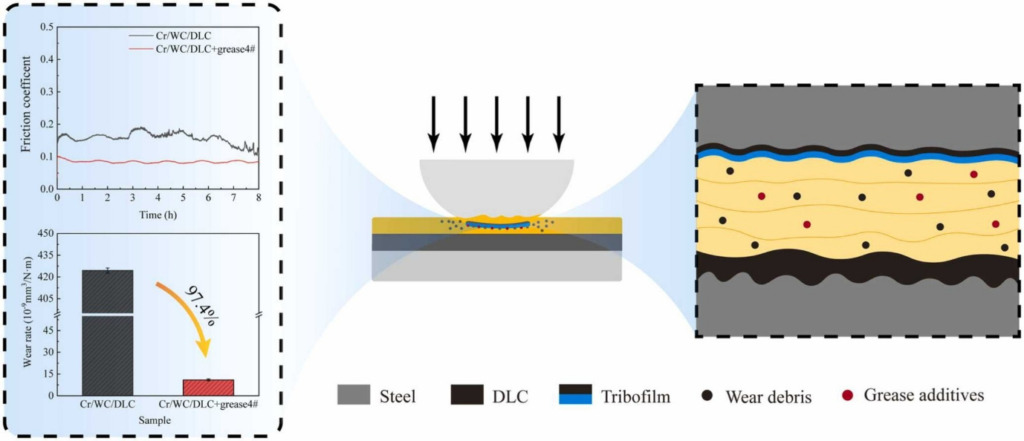
Link: https://www.sciencedirect.com/science/article/pii/S0301679X26000885?
2.2 Starved-Lubrication DLC Performance Is a Bigger Industrial Story Than It Looks
A Tribology Letters paper published 16 June examined DLC coatings under starved lubrication—an operating condition highly relevant to real machines where lubricant replenishment is imperfect.
Why this matters
A large share of real-world wear problems occur not under ideal fully flooded lubrication, but under:
- delayed grease replenishment,
- start-stop operation,
- low-flow oil supply,
- thermal thinning,
- contamination-driven film collapse.
Tribology impact
The value of this work is that it shifts attention from “low-friction DLC in ideal tests” to how coatings behave when lubrication is marginal, which is where many assets actually fail.
Sectors affected
- industrial gearboxes
- EV reduction gears
- actuators and compressors
- aerospace auxiliary systems
- wind pitch/yaw systems
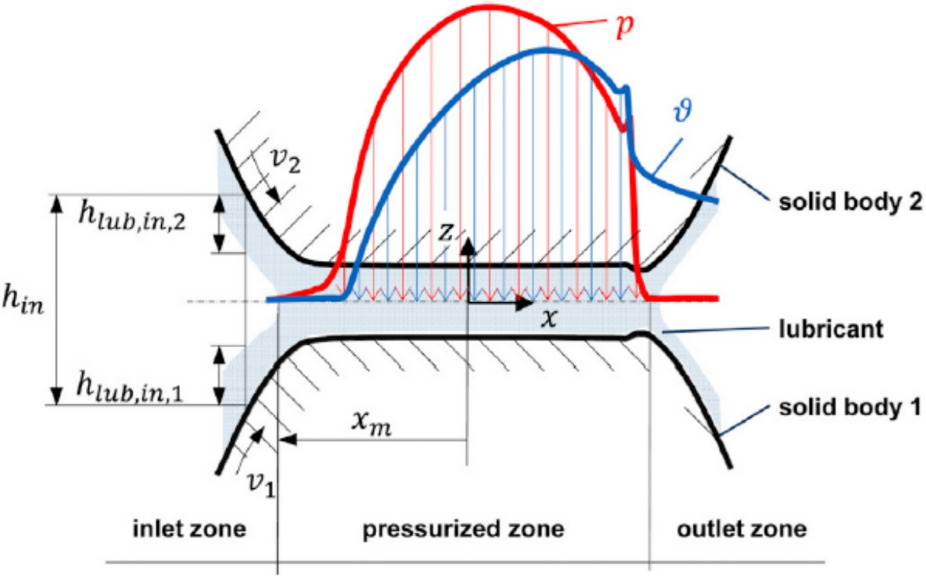
Link: https://link.springer.com/article/10.1007/s11249-026-02165-6?
2.3 Water-Lubricated Bearings: Secondary Lubricant Injection Offers a Severe-Duty Fix
A June Tribology International paper showed that adding a trace secondary lubricant to water-lubricated bearings can materially reduce friction under low-speed / heavy-load conditions.
What is important here
Water-lubricated systems are attractive for sustainability and marine applications, but they often struggle when:
- speed is low,
- load is high,
- boundary lubrication dominates,
- start-up friction spikes occur.
The study found that even a small secondary lubricant dose can trigger a second friction drop once the additive reaches the contact zone.
Tribology impact
This matters for:
- marine stern-tube / pump / bearing systems
- water-lubricated industrial bearings
- low-emission rotating equipment
Engineering takeaway
Instead of abandoning water-lubricated systems when duty cycles become severe, designers may have a hybrid lubrication route: keep water as the primary medium but deploy controlled secondary lubricant injection for critical transients.
3. Surface Engineering & Coatings
3.1 High-Temperature Coatings: Ag-Doped Mo Matrix System Reached Negative Wear Rate
A June Tribology International pre-proof reported an Ag-doped MoNiAl coating with:
| Parameter | Result |
| Temperature | 600°C |
| Friction coefficient | 0.24 |
| Wear rate | −1.9 × 10⁻⁵ mm³·N⁻¹·m⁻¹ |
Why this is notable
A negative wear rate indicates material transfer / tribolayer behavior that more than compensates for material loss under the test conditions. For high-temperature tribology, that is a very strong result.
Tribology impact
This is relevant to:
- aerospace hot-section auxiliary components
- thermal process equipment
- high-temperature valves and sliding contacts
- future hydrogen / combustion-adjacent hardware where thermal loads remain severe
Strategic takeaway
Surface engineering is increasingly delivering application-specific tribological resilience, not just generic hardness.
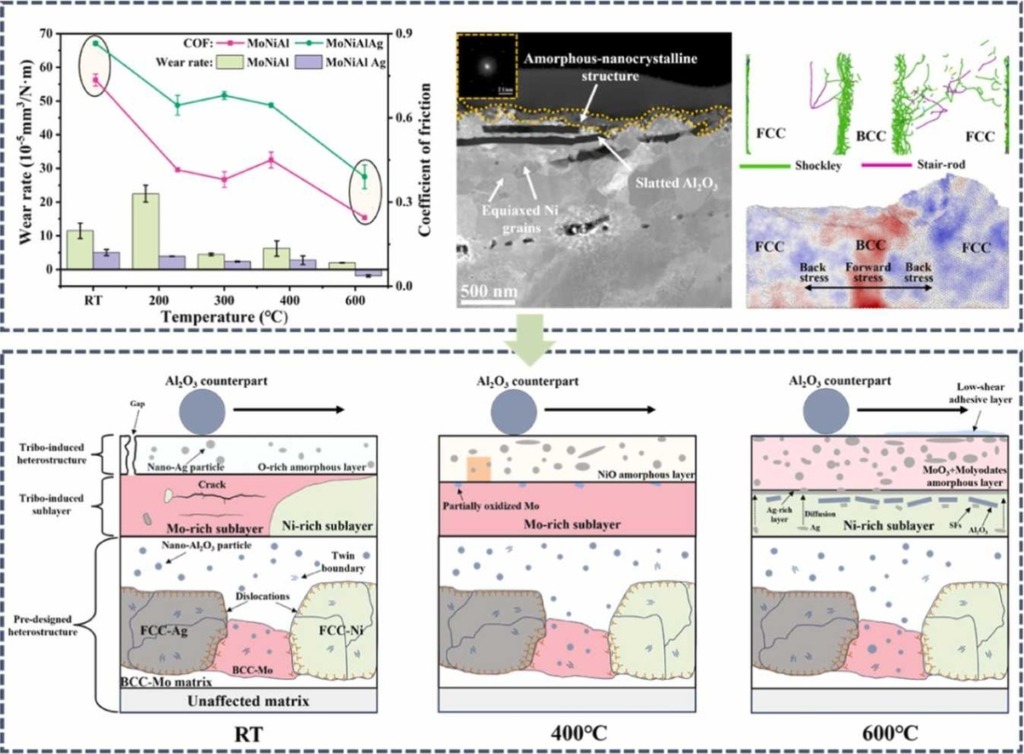
Link: https://www.sciencedirect.com/science/article/pii/S0301679X26006031?
4. Sustainable Lubrication & Bio-Based Additives
4.1 Borophene Emerged as a High-Performance Bio-Lubricant Additive
A June paper in ACS Applied Engineering Materials tested borophene nanosheets in castor oil and reported:
| Parameter | Base Oil | With Borophene |
| Average coefficient of friction | 0.059 | 0.034 |
| Friction change | — | 42% lower |
| Loading | — | 0.1 wt% |
| Surface roughness Ra | 0.826 μm | 0.326 μm |
| Surface roughness Rq | 1.01 μm | 0.405 μm |
Why this matters
This is one of the more concrete June examples of a bio-based lubricant system improving tribological performance materially without heavy additive loading.
Tribology impact
Potential downstream relevance includes:
- metalworking fluids
- light industrial lubricants
- environmentally sensitive applications
- specialty biodegradable greases / oils
What to watch
The key next question is oxidation stability and cost-scalability, not whether the friction result is interesting. For commercial use, the additive must survive storage, contamination, temperature cycling, and long-duration service.
5. What Changed vs the Previous Weekly Reports
To avoid repeating earlier issues, the June 8–20 period is best understood through five genuinely new angles:
| New angle this period | Why it matters |
| Grade fragmentation in base oils | Tribology risk now depends on which base oil family your lubricant requires |
| Russia export-to-refining shift | Refining utilization changes can ripple into feedstock and lubricant economics |
| DLC-grease wind bearing system | Specific, quantifiable route to wind bearing life extension |
| Starved-lubrication coating performance | More realistic view of how coatings behave in actual field failures |
| Borophene in castor oil | Bio-based lubrication moved from concept to measurable high-performance gains |
Weekly / Fortnight Snapshot
A. Market & Feedstock
| Segment | 08–20 June Direction | Tribology meaning |
| Crude oil | Volatile, then softer by 20 Jun | Some feedstock relief, but not enough to normalize premium lubes |
| Base oils overall | Better supplied than headlines imply | Don’t confuse broad supply with spec-grade availability |
| Group III / III+ | Still tight | Risk remains highest for synthetics / OEM-approved fluids |
| Russia crude exports | Lower | Regional feedstock / refining flows remain unstable |
B. Technology & R&D
| Segment | June signal | Practical implication |
| Wind tribology | 97.5% wear reduction via DLC-grease composite | Strong candidate for heavy-duty bearing durability |
| Starved lubrication coatings | Fresh June evidence | Relevant to real low-lube industrial failure modes |
| Water-lubricated bearings | Secondary-lube assist validated | Hybrid route for low-speed / high-load duty |
| Bio-lubricant additives | Borophene cut friction 42% | Sustainable lubricant R&D gaining real performance credibility |
| High-temp coatings | Ag-doped Mo system showed negative wear rate | Strong high-temperature surface-engineering signal |
Engineering Insight of the Period
Tribology teams now need to manage specification risk, not just lubricant consumption risk.
The old maintenance question was:
“Do we have enough lubricant?”
The June 8–20 question is:
“Do we have access to the exact approved chemistry and can the machine survive if lubrication quality degrades?”
That changes priorities. The most resilient operators over the next quarter will be the ones who pair:
- grade-level lubricant risk tracking
- condition monitoring
- coating / surface upgrades
- severe-duty tribosystem design
- approved substitution strategies where possible
References
- Base Oil News – Global Market Review, 12 June 2026
https://www.baseoilnews.com/amp/story/weekly-review/base-oils-and-lubricants-weekly-global-market-review/base-oils-and-lubricants-weekly-market-review-12-june-2026 - Reuters / Kitco – Russia to reduce June oil exports amid higher refinery runs
https://www.kitco.com/news/off-the-wire/2026-06-08/russia-reduce-june-oil-exports-amid-higher-refinery-runs-and-lower - Reuters syndicated – Brent set for 8% weekly fall, 20 June 2026
https://www.brecorder.com/news/40426452
https://www.thedailystar.net/business/global-economy/news/brent-set-8-weekly-fall-4203731 - Tribology International – DLC-grease composite lubricating materials with ultra-low wear and ultra-high load capacity for wind turbine bearings
https://www.sciencedirect.com/science/article/pii/S0301679X26000885 - Tribology Letters – Tribological Performance of DLC Coatings Under Starved Lubrication
https://link.springer.com/article/10.1007/s11249-026-02165-6 - Tribology International – Enhanced lubrication in water-lubricated bearings under low-speeds and heavy-loads via secondary lubricant
https://www.sciencedirect.com/science/article/pii/S0301679X2600068X - Tribology International – Ultra-Low Wear in Ag-Doped Mo matrix Coating Enabled by the Synergy of Designed and Tribo-Induced Heterostructures
https://www.sciencedirect.com/science/article/pii/S0301679X26006031 - ACS Applied Engineering Materials – Unveiling the Tribological Potential of Borophene Nanosheets as a High-Performance Lubricant Additive
https://pubs.acs.org/doi/10.1021/acsaenm.6c00540
0 Comment