








TriboNet Weekly: Global Tribology, Lubrication & Surface Engineering Intelligence — Nov. 2–7, 2026

Key Takeaways
- Stonepeak completed its acquisition of a 65% controlling interest in Castrol, while bp retained a 35% minority stake.
- European Group II base-oil supply fell below 130,000 tonnes in August, its lowest level in 28 months, although lower demand and imports moderated the impact.
- Group III base stocks remained the major supply exception: continued tightness supported record quarterly base-oil profits at S-Oil.
- FUCHS reported record third-quarter EBIT after using faster pricing and supply continuity to offset higher base-oil costs.
- Asian base-oil cargoes continued moving toward the United States and Europe, while cautious year-end purchasing increased the risk of surplus in non-Group III grades.
- New research addressed hybrid cryogenic lubrication, self-replenishing solid lubrication, ultrasonic friction control during bolt tightening, thermo-rheological mixed lubrication and wear-resistant aluminium composites.
- STLE announced a virtual symposium focused on future transportation propulsion and the fluids required for electrification.
1. Stonepeak Completes Acquisition of Castrol
Stonepeak completed the acquisition of a 65% controlling interest in Castrol from bp on 2 November. Bp retained a 35% minority interest.
The new Castrol board is chaired by Ben van Beurden, former chief executive of Shell and current chairman of Clariant. Castrol stated that the ownership structure would provide greater financial and operational flexibility for its next growth phase. Castrol Australia

Castrol operates across:
- Passenger-car motor oils
- Commercial-vehicle lubricants
- Industrial oils and greases
- Metalworking fluids
- Marine and energy-sector lubricants
- Electric-vehicle fluids
- Data-centre and battery thermal-management fluids
Implications for Castrol India
The transaction also transferred indirect control of Castrol India to Stonepeak’s acquisition entity. Castrol Limited remained the registered promoter holding approximately 51% of Castrol India, but control of the ownership chain moved from bp to the Stonepeak-backed entity. Autocar Professional
Why Tribologists Should Care

Ownership changes at a major lubricant company can alter:
- Research and development priorities
- Capital allocation
- Regional manufacturing
- Additive and base-stock sourcing
- Product-portfolio strategy
- EV-fluid development
- Industrial technical services
- Investment in thermal-management products
The immediate announcement did not indicate changes to existing formulations, product specifications or customer arrangements. Therefore, any conclusion that the transaction will cause short-term technical changes would be speculative.
Primary source: Stonepeak Acquires 65% Stake in Castrol


2. European Group II Supply Falls to a 28-Month Low
European Group II base-oil supply fell below 130,000 tonnes in August, down from more than 240,000 tonnes in July. This was the lowest regional availability since April 2024. baseoilnews.com
The reduction was largely associated with lower output in the Netherlands:
| Indicator | July 2026 | August 2026 |
| European Group II supply | More than 240,000 t | Less than 130,000 t |
| Netherlands output | 99,000 t | 54,000 t |
| U.S. imports | — | Less than 60,000 t |
A power disruption in the Rotterdam port area coincided with the fall in Dutch production. The Netherlands and the United States normally account for more than 90% of European Group II availability, making the regional market sensitive to disruption at either source.

Despite the sharp fall, prices declined in September. This suggests that weaker demand and increased imports from the United States and Singapore were sufficient to cover immediate requirements.
Tribology Impact
Group II base stocks are widely used in:
- Heavy-duty diesel engine oils
- Passenger-car motor oils
- Hydraulic fluids
- Gear and circulating oils
- Compressor oils
- Turbine oils
- Industrial lubricants requiring improved oxidation stability
Alternative Group II sources may share the same API classification but differ in volatility, viscosity index, oxidation response and additive solvency. Substitution can affect:
- Air release
- Foam behavior
- Demulsibility
- Seal response
- Deposit formation
- Antiwear performance
- Low-temperature viscosity
Blenders should therefore evaluate the finished formulation—not only compare base-oil viscosity.
Source: Europe’s August Group II Supply Falls to Two-Year Low

3. Group III Tightness Drives Record S-Oil Base-Oil Profit
S-Oil reported record base-oil operating profit for a second consecutive quarter.
Operating profit from its base-oil business increased 56% quarter-on-quarter to KRW 742.7 billion—approximately US$555 million—and was more than five times the year-earlier result. Sales increased 119% year-on-year to a record KRW 1.54 trillion. baseoilnews.com
The operating margin reached approximately 48%, compared with 37% in the second quarter and its highest level in more than 15 years.
Principal Drivers
- Disruption to Middle Eastern Group III production and exports
- Greater European and U.S. dependence on South Korean supply
- Group III prices rising faster than feedstock costs
- Plants operating close to full capacity
- Limited immediate availability of equivalent replacement grades
S-Oil expected Group III supply to remain tight into 2027 but had limited capacity to increase production further.
Why Tribologists Should Care
Persistent Group III tightness affects high-performance lubricants where base-oil substitution is technically difficult. Examples include:
- Low-viscosity engine oils
- Long-drain oils
- Fuel-economy formulations
- Automatic-transmission fluids
- Electrified-drivetrain fluids
- Lubricants carrying OEM approvals
The record margins reflect scarcity, but they also indicate that formulators may continue facing elevated acquisition costs and limited sourcing flexibility.
Source: S-Oil’s Q3 Base Oils Profit Surges to Record High

4. FUCHS Uses Faster Pricing to Offset Base-Oil Costs
FUCHS reported record third-quarter EBIT of €149 million, up 27% from €117 million in the corresponding 2025 quarter.
For the first nine months of 2026:
| Indicator | 9M 2025 | 9M 2026 | Change |
| Revenue | €2.700 bn | €3.126 bn | +16% |
| EBIT | €326 m | €409 m | +25% |
| Free cash flow before acquisitions | €181 m | €92 m | −49% |
The company raised its full-year EBIT forecast to approximately €500 million and projected annual revenue of around €4.1 billion. FUCHS LUBRICANTS CO. (United States)
FUCHS attributed its performance to pricing, volume growth earlier in the year and contributions from all geographic regions. However, higher raw-material costs increased working-capital requirements and reduced free cash flow.
Market Significance
The result contrasts with lubricant companies that experienced margin compression because costs increased faster than selling prices.
The difference illustrates the importance of:
- Rapid price adjustment
- Product mix
- Raw-material procurement
- Inventory management
- Customer retention
- Reliable product supply
- Specialty rather than commodity positioning
Tribology Impact
Commercial pressure can influence formulation decisions. A supplier with stronger margins may have more capacity to maintain:
- Application engineering
- Field support
- Product qualification
- Condition-monitoring services
- Specialty-fluid research
- Regional supply resilience
However, increased revenue or EBIT does not independently demonstrate improved lubricant performance.
Sources:
- FUCHS Reports Strong First Nine Months of 2026
- FUCHS Q3 Profit Hits Record as Faster Pricing Offsets Costs
5. Non-Group III Supply Builds as Buyers Remain Cautious
The global market review published on 6 November described improving refinery margins but weakening seasonal demand.
Base-oil prices had not fallen as rapidly as crude-oil prices, widening refinery margins and reducing the immediate incentive to cut production. At the same time, buyers were maintaining lean inventories because of price volatility and the usual year-end slowdown. baseoilnews.com
The resulting market was divided:
- Group III remained tight.
- Group I and Group II supply was becoming more comfortable.
- Asian production remained relatively firm.
- Cargoes from South Korea and Singapore continued moving toward Western markets.
- The U.S. surplus had increased.
- Buyers reduced inventories rather than committing to large purchases.
Global Cargo Flows
Base Oil News reported the following movements during the week:
- A large Singapore cargo was heading to Spain.
- A previous Singapore cargo was destined for the United States.
- Multiple South Korean cargoes were heading to the U.S. Gulf Coast.
- A South Korean cargo was travelling to Brazil.
- Indian cargoes were moving to Brazil and the United States.
- Renewed loadings from Spain suggested that maintenance was nearing completion.
- Saudi cargoes were being considered for Nigeria and Germany. Week to 6 November
Tribology Impact
More physical supply does not immediately resolve formulation constraints because the available cargo must match:
- Required viscosity grade
- Base-oil group
- Volatility limits
- Additive solubility
- Product approvals
- Regional regulatory requirements
- Existing formulation specifications
A broad market surplus can therefore coexist with shortages of a particular approved grade.
Sources:
- Base Oils and Lubricants: Weekly Global Market Review — 6 November 2026
- Global Base-Oil Cargo Flows: Week to 6 November

6. STLE Highlights Future Transportation Propulsion
STLE announced a virtual symposium on future transportation propulsion on 5 November.
The event focuses on the scientific and engineering challenges associated with e-mobility, future propulsion systems and their fluid requirements. STLE
Relevant tribological topics include:
- EV gear lubricants
- Electrified bearings
- Electrical-discharge damage
- Copper compatibility
- Thermal-management fluids
- Low-viscosity driveline lubricants
- Hydrogen and alternative-fuel engines
- Hybrid powertrains
- Materials compatibility
- Lubricant ageing under electrical stress
Why Tribologists Should Care
Future transportation fluids must perform multiple functions simultaneously:
- Reduce friction and wear
- Remove heat
- Protect electrical materials
- Control conductivity
- Resist oxidation
- Remain compatible with polymers and elastomers
- Minimize churning losses
- Prevent corrosion and deposits
This requires combined electrical, thermal, chemical and mechanical testing rather than reliance on conventional gear or bearing tests alone.
Source: STLE
7. Research Watch: Papers Published During the Week
7.1 Hybrid Cryogenic–MQL Machining of Monel 400
Paper: Sustainable Machining of Monel 400 Using Hybrid Cryogenic Lubrication and Multiobjective Optimization
Published: 3 November 2026
Journal: Scientific Reports
The study compared four machining environments:
- Dry cutting
- Minimum-quantity lubrication
- Cryogenic liquid-nitrogen cooling
- Hybrid cryogenic–minimum-quantity lubrication
Hybrid Cryo-MQL combined the cooling capacity of liquid nitrogen with the lubricating action of biodegradable sunflower oil.
Compared with dry machining, Cryo-MQL reportedly reduced:
- Surface roughness by 48%
- Specific cutting energy by 29.17%
- Machining cost by 10.64%
A combined MOPSO–TOPSIS optimization approach was used to identify balanced machining conditions. Validation errors were 4.61% for surface roughness, 3.06% for specific cutting energy and 2.79% for cost. nature.com
Why It Matters
Monel 400 is difficult to machine because of work hardening, low thermal conductivity and high tool–chip adhesion. Cryo-MQL addresses both thermal and tribological limitations.
However, reduced cutting energy does not automatically establish a lower carbon footprint. Nitrogen production, purification, transport and storage must be included in lifecycle assessment.
Paper: https://doi.org/10.1038/s41598-026-79274-8

7.2 Self-Replenishing MOF-Based Dry Lubrication
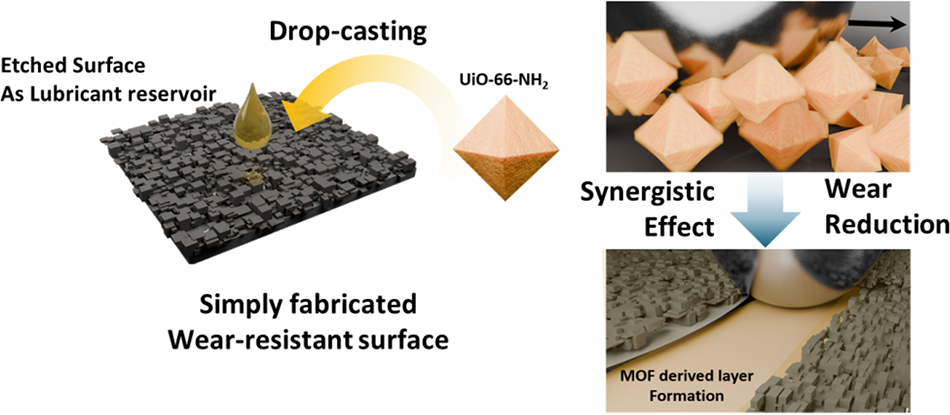
Paper: Synergy Between UiO-66-NH₂ and a Hierarchical Aluminum Reservoir for Durable, Self-Replenishing Dry Lubrication
Published: 3 November 2026
Journal: ACS Applied Materials & Interfaces
The researchers combined the metal–organic framework UiO-66-NH₂ with a hierarchical aluminium reservoir to create a solid-lubrication system designed to replenish protective material during sliding.
MOFs are attractive as solid lubricants because their chemistry and porous structures can be engineered. Their practical application is limited by production cost, mechanical fragility and difficulty maintaining material at the contact.
The reservoir concept aims to:
- Store lubricant particles beneath or within the surface
- Release material as the top layer wears
- Support repeated tribofilm formation
- Extend dry-sliding life
- Reduce the amount of MOF required pubmed.ncbi.nlm.nih.gov
Why It Matters
Self-replenishing solid lubrication could benefit conditions where liquid oils are unsuitable, including:
- Vacuum systems
- High-temperature mechanisms
- Dust-sensitive equipment
- Aerospace mechanisms
- Clean manufacturing
- Intermittently operated contacts
Important remaining questions include reservoir exhaustion, debris behavior, adhesion and performance under cyclic or impact loading.
Paper: https://doi.org/10.1021/acsami.6c18855
7.3 Ultrasonic Friction Reduction During Bolt Tightening
Paper: Application of Ultrasonic Friction Reduction Technology During the Bolt Tightening Process
Published online: 2 November 2026
Journal: Tribology Transactions
A large proportion of applied tightening torque is consumed by friction at the threads and beneath the bolt head or nut. Variability in these frictional losses causes uncertainty in the final preload.
The researchers applied ultrasonic vibration during tightening to dynamically reduce friction. The method reportedly:
- Reduced tightening friction
- Improved torque-to-preload conversion
- Reduced friction-related surface damage
- Improved tightening stability
- Avoided introducing an additional liquid lubricant
The friction-reduction effect ceased when ultrasonic excitation was removed, helping preserve the post-tightening friction condition. tandfonline.com
Why It Matters
The method could improve preload control in applications where liquid lubricants are undesirable because of:
- Cleanliness requirements
- High temperature
- Vacuum conditions
- Contamination risk
- Subsequent coating or joining processes
- Concerns about loosening
Further work should examine fatigue, self-loosening, repeated assembly and the effect on different thread coatings.
Paper: https://doi.org/10.1080/10402004.2026.2746243

7.4 Transient Mixed Lubrication of a Piston Ring–Cylinder Liner
Paper: Transient Thermo-Rheological Mixed-Lubrication Modelling of a Piston Ring–Cylinder Liner Conjunction Using an Accelerated Full-State Solver
Published: 3 November 2026
Journal: Proceedings of the Institution of Mechanical Engineers, Part J: Journal of Engineering Tribology
The study developed a transient mixed-lubrication model combining:
- Averaged Reynolds lubrication
- Roughness flow factors
- Asperity interaction
- Temperature-dependent lubricant behavior
- Shear-thinning rheology
- Engine-cycle operating changes
- An accelerated full-state numerical solver Volume 0, Number 0
Why It Matters
Piston-ring lubrication is strongly transient. Speed, load, temperature and sliding direction change throughout the cycle. Near dead centres, reduced entrainment can move the contact from hydrodynamic toward mixed or boundary lubrication.
A model that includes thermal and non-Newtonian effects can improve predictions of:
- Minimum film thickness
- Asperity load
- Frictional loss
- Oil consumption
- Ring and liner wear
- Lubricant-viscosity requirements
Experimental validation remains necessary because surface topography, oil availability and combustion products can substantially affect actual performance.
Publisher page: Journal of Engineering Tribology — Latest Articles
7.5 Dual-Ceramic Reinforcement Improves AA8011 Wear Resistance
Paper: Predicted Enhanced Wear Resistance and Mechanical Integrity in AA8011 Composites via Dual-Ceramic ZrB₂ and B₄C Reinforcement
Published: 4 November 2026
Journal: Scientific Reports
AA8011 aluminium composites containing 2–8 wt% combined zirconium diboride and boron carbide were manufactured through stir casting.
The study evaluated:
- Hardness
- Mechanical strength
- Coefficient of friction
- Dry-sliding wear
- Sliding-distance dependence
- Reinforcement concentration
- Microstructural integrity nature.com
Why It Matters
Ceramic reinforcement can improve aluminium’s load-bearing capacity and resist plastic deformation at asperity contacts. However, performance depends on:
- Particle distribution
- Matrix–particle bonding
- Porosity
- Particle fracture
- Counterface abrasion
- Mechanically mixed layer formation
- Reinforcement concentration
Excessive hard-particle content can increase brittleness or act as abrasive third bodies if particles detach.
Paper: https://doi.org/10.1038/s41598-026-79319-y
7.6 Fluid-Lubricated Piston–Cylinder Friction Fluctuation
Paper: Research on the Mechanism of Friction Fluctuation in Piston–Cylinder Kinematic Pair Under Fluid Lubrication
Accepted version posted: 6 November 2026
Journal: Tribology Transactions
The study investigates friction fluctuations in a fluid-lubricated piston–cylinder pair.
Potential sources of fluctuation in such contacts include:
- Film-thickness variation
- Reciprocating velocity changes
- Reversal at stroke ends
- Pressure fluctuations
- Surface roughness
- Piston misalignment
- Lubricant starvation
- Mixed-lubrication transitions
- Thermal viscosity variation
The paper is directly relevant to hydraulic machinery, reciprocating compressors and piston-based actuation systems. tandfonline.com
Why It Matters
Average coefficient of friction alone may hide short-duration contact events. Time-resolved force, displacement, pressure and film measurements are needed to distinguish genuine friction transitions from vibration or sensor-related fluctuations.
Journal page: Tribology Transactions — Latest Articles
8. Technology Outlook
| Technology area | Development | Opportunity | Principal limitation |
| Castrol ownership | Majority acquisition by Stonepeak | Increased flexibility and adjacent-market investment | Future technical strategy remains uncertain |
| Group II supply | European output fell sharply | Alternative U.S. and Asian sourcing | Source qualification and year-end surplus |
| Group III market | Record South Korean producer profits | Investment in premium base stocks | Limited short-term production flexibility |
| Cryo-MQL | Combined cooling and lubrication | Improved machining of difficult alloys | LN₂ lifecycle burden |
| MOF solid lubrication | Self-replenishing surface reservoir | Longer dry-sliding life | Material cost and reservoir exhaustion |
| Ultrasonic tightening | Temporary friction reduction | Better torque–preload conversion | Equipment integration and fatigue validation |
| Mixed-lubrication modelling | Thermal and shear-thinning effects included | Better piston-ring efficiency prediction | Dependence on realistic boundary conditions |
| Ceramic aluminium composites | Dual ZrB₂–B₄C reinforcement | Lightweight wear-resistant components | Particle pull-out and counterface abrasion |
9. Final Outlook
The 2–7 November period was defined by a widening difference between premium and conventional base-oil markets.
Group III remained constrained and highly profitable, while Group I and Group II supply became more comfortable as demand slowed and Asian cargoes reached Western markets. This divergence means that references to a general “base-oil shortage” are increasingly insufficient: availability depends on base-oil group, grade, region and formulation approval.
Stonepeak’s controlling investment in Castrol was the week’s most significant corporate development. It placed one of the world’s most recognized lubricant brands under a new ownership structure while retaining bp as a minority investor.
Research developments showed greater integration between tribology and manufacturing control. Cryogenic MQL combined thermal management with boundary lubrication; ultrasonic excitation temporarily modified friction during fastening; advanced models linked lubricant rheology with transient engine contacts; and self-replenishing surfaces aimed to extend dry-lubrication life.
The common engineering lesson is that friction and lubrication can increasingly be controlled in real time. However, these technologies must still demonstrate durability, repeatability, safety and economic value under realistic operating conditions.
References
- Stonepeak and Castrol. “Stonepeak Completes Acquisition of a 65% Controlling Interest in Castrol,” 2 November 2026.
https://www.castrol.com/en_au/australia/home/about-castrol/newsroom/stonepeak-acquisition.html - JobbersWorld. “Stonepeak Completes Castrol Acquisition; Former Shell CEO Named Chairman,” 2 November 2026.
https://jobbersworld.com/category/lubricant-news/ - Base Oil News. “Europe’s August Group II Base Oils Supply Falls to Two-Year Low,” 3 November 2026.
https://www.baseoilnews.com/amp/story/europe-mideast-gulf-africa/europe/europes-august-group-ii-base-oils-supply-falls-to-two-year-low - Base Oil News. “S-Oil’s Q3 Base Oils Profit Surges to Record High,” 4 November 2026.
https://www.baseoilnews.com/amp/story/company-news/s-oils-q3-base-oils-profit-surges-to-record-high - FUCHS SE. “FUCHS Reports Strong First Nine Months of 2026,” 30 October 2026; market analysis published 3 November 2026.
https://www.fuchs.com/us/en/company/news/press-releases/view/10399-FUCHS-reports-strong-first-nine-months-of-2026/ - Base Oil News. “FUCHS Q3 Profit Hits Record as Faster Pricing Offsets Costs,” 3 November 2026.
https://www.baseoilnews.com/amp/story/company-news/fuchs-q3-profit-hits-record-as-faster-pricing-offsets-costs-2026 - Base Oil News. “Base Oils and Lubricants: Weekly Global Market Review — 6 November 2026.”
https://www.baseoilnews.com/weekly-review/base-oils-and-lubricants-weekly-global-market-review/base-oils-and-lubricants-weekly-global-market-review-6-nov-26 - Base Oil News. “Global Base Oils Cargo Flows: Week to 6 November 2026.”
https://www.baseoilnews.com/amp/story/market-signals/cargo-flows/global-base-oils-cargo-flows-week-to-6-november-2026 - STLE. “Virtual Symposium: Future Transportation Propulsion,” posted 5 November 2026.
https://www.stle.org/ - Patel, D., Sivalingam, S., Singh, J., et al. “Sustainable Machining of Monel 400 Using Hybrid Cryogenic Lubrication and Multiobjective Optimization.” Scientific Reports (2026). DOI: 10.1038/s41598-026-79274-8.
https://doi.org/10.1038/s41598-026-79274-8 - Seo, D., Son, G., Kim, K., Kong, J. and Chung, J. “Synergy Between UiO-66-NH₂ and a Hierarchical Aluminum Reservoir for Durable, Self-Replenishing Dry Lubrication.” ACS Applied Materials & Interfaces (2026). DOI: 10.1021/acsami.6c18855.
https://doi.org/10.1021/acsami.6c18855 - Wang, H., Pei, N. and He, A. “Application of Ultrasonic Friction Reduction Technology During the Bolt Tightening Process.” Tribology Transactions (2026). DOI: 10.1080/10402004.2026.2746243.
https://doi.org/10.1080/10402004.2026.2746243 - Didouche, A.M. and Zidane, I. “Transient Thermo-Rheological Mixed-Lubrication Modelling of a Piston Ring–Cylinder Liner Conjunction Using an Accelerated Full-State Solver.” Proceedings of the Institution of Mechanical Engineers, Part J: Journal of Engineering Tribology (2026).
https://journals.sagepub.com/toc/pij/0/0 - Anusha, P., Kumar, R., Sandeep, V., et al. “Predicted Enhanced Wear Resistance and Mechanical Integrity in AA8011 Composites via Dual-Ceramic ZrB₂ and B₄C Reinforcement.” Scientific Reports (2026). DOI: 10.1038/s41598-026-79319-y.
https://doi.org/10.1038/s41598-026-79319-y - Yang, H., Chen, G., Zeng, Q., Guo, F. and Liang, P. “Research on the Mechanism of Friction Fluctuation in Piston–Cylinder Kinematic Pair Under Fluid Lubrication.” Tribology Transactions, accepted version posted 6 November 2026.
https://www.tandfonline.com/action/showAxaArticles?journalCode=utrb20
0 Comment