








TriboNet Weekly: Global Tribology, Lubrication & Surface Engineering Intelligence — Oct. 19–24, 2026
Key Takeaways
- Shell and ExxonMobil were reportedly exploring an approximately $8 billion sale of Infineum, one of the world’s largest lubricant- and fuel-additive suppliers.
- European Group III base-oil supply reportedly fell to a six-year low, while Asian cargo data showed weaker exports from several important supply centres.
- High crude-oil, feedstock, freight and insurance costs continued to place upward pressure on lubricant production and distribution.
- Lubrication Engineers acquired BioBlend, expanding its portfolio of bio-based and environmentally acceptable lubricants.
- FUCHS raised its 2026 EBIT outlook after reporting strong preliminary nine-month results.
- New studies covered AI-assisted lubricant-molecule design, continuous-load four-ball testing, timing-belt degradation, water-based hydraulic-fluid additives, biomedical bearing materials and journal-bearing failure analysis.
- TriboNet hosted an online event on artificial intelligence in tribology on 23 October.
1. Infineum’s Owners Explore a Potential $8 Billion Sale
Shell and ExxonMobil were reported to be exploring a sale of Infineum, their equally owned lubricant- and fuel-additive joint venture.

The reported sale process was at an early stage, with Bank of America appointed as an adviser. Reports placed the potential valuation at approximately $8 billion, but no transaction had been confirmed during the reporting period. reuters.com
Infineum is a major developer and supplier of additives used in:
- Passenger-car motor oils
- Heavy-duty diesel engine oils
- Automotive driveline fluids
- Marine lubricants
- Industrial lubricants
- Fuel formulations
- Electric-vehicle fluids
The company was established in 1999 and operates internationally, selling additive technologies in approximately 90 countries.
Why Tribologists Should Care

Lubricant additives determine much of a finished lubricant’s operational performance. A change in ownership of a major supplier could influence:
- Research and development priorities
- Additive-package availability
- Long-term supply agreements
- Regional manufacturing strategy
- Pricing and customer support
- EV-fluid and battery-fluid development
- Investment in new engine-oil specifications
The lubricant-additive industry is highly concentrated. Infineum competes primarily with Lubrizol, Afton Chemical and Chevron Oronite. Consolidation or a private-equity acquisition could therefore affect the wider competitive structure.
The sale remains a reported possibility—not a completed transaction.
Source: Reuters: Shell- and Exxon-backed Infineum weighs $8 billion sale


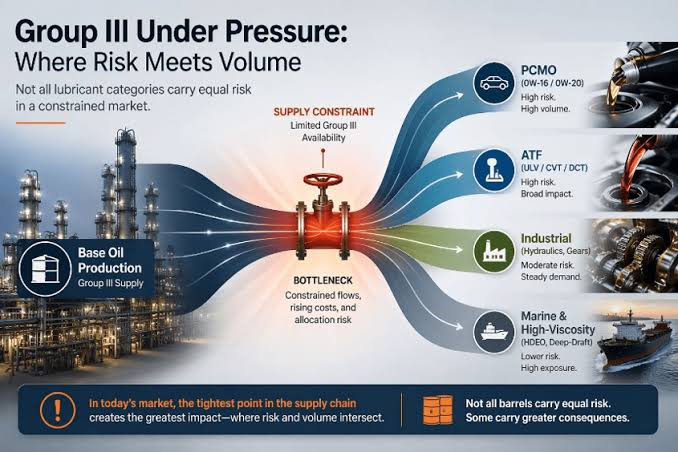
2. European Group III Base-Oil Supply Falls to a Six-Year Low
Market reporting on 20 October indicated that European Group III base-oil supply during August had fallen to its lowest level in six years.
Group III base stocks are critical to the formulation of:

- SAE 0W-20 and 0W-16 engine oils
- High-performance synthetic and semi-synthetic lubricants
- Long-drain passenger-car motor oils
- Fuel-efficient driveline fluids
- Low-viscosity industrial lubricants
The tight European position followed disruption to Middle Eastern production and shipping, constrained alternative supply and continuing growth in demand for lower-viscosity lubricants.
Base Oil News also reported several important trade developments during the week:
| Date | Market development |
| 19 October | South Korean base-oil exports to the United States and Europe remained high |
| 20 October | European Group III supply fell to a six-year low |
| 21 October | Saudi Arabian Red Sea base-oil exports declined in September |
| 22 October | Singapore’s base-oil exports declined during the month to 21 October |
| 22 October | China’s September base-oil imports fell below exports |
| 23 October | Weekly global base-oil cargo-flow review published |
These developments show redistribution of available supply rather than a uniform global shortage. South Korean exports remained important to Western markets, while lower exports from Singapore and Saudi Arabia added to regional uncertainty. baseoilnews.com
Tribology Impact
Changing the source of a base oil may affect more than product availability. Base stocks within the same API group and viscosity grade can differ in:
- Volatility
- Viscosity index
- Pour point
- Sulfur content
- Aromatic content
- Oxidation response
- Additive solubility
- Elastomer compatibility
- Boundary-film development
Blenders should therefore conduct formulation revalidation when changing base-stock sources, particularly for tightly optimized low-viscosity products.
Recommended checks include:
- Kinematic viscosity and viscosity index
- Noack volatility
- Cold-cranking and low-temperature pumping
- Oxidation stability
- Deposit and sludge formation
- Air release and foam behavior
- Seal compatibility
- Friction and wear performance
- Finished-product specification compliance
Source: Base Oil News — October 2026 market coverage

3. Elevated Crude and Freight Costs Increase Lubricant-Market Pressure
The Americas base-oil market entered the week with steep crude-oil and feedstock prices combined with tight supply fundamentals. Lubes’n’Greases reported these pressures in its 21 October Americas base-oil price assessment. lubesngreases.com
During the week, geopolitical risks affecting the Strait of Hormuz and regional energy infrastructure contributed to high crude-oil prices. On 21 October, Brent was reported at approximately $109.80 per barrel and West Texas Intermediate at approximately $98.72 per barrel during early European trading. barrons.com
Higher energy and transport costs affect lubricant suppliers through several channels:
- Increased base-stock acquisition cost
- Higher additive-manufacturing costs
- More expensive packaging materials
- Increased marine freight and insurance
- Greater road-distribution expenses
- Higher inventory-financing requirements
- Longer or less predictable replenishment cycles
Why Tribologists Should Care
Cost pressure can encourage reformulation, viscosity consolidation or extended use of existing lubricants. Each response carries a technical risk.
Extending lubricant life without supporting condition monitoring can allow:
- Oxidation products to accumulate
- Viscosity to increase
- Additives to become depleted
- Water and particles to reach damaging concentrations
- Varnish precursors to form
- Acid number to rise
- Wear-particle generation to accelerate
Lubricant drain intervals should therefore be based on oil condition and equipment condition—not solely on lubricant price or availability.
Sources:
4. Lubrication Engineers Acquires BioBlend Renewable Resources
Lubrication Engineers announced the acquisition of BioBlend Renewable Resources on 19 October.
BioBlend develops bio-based, hybrid and fully biodegradable lubricants for applications including:
- Mining equipment
- Marine machinery
- Dredging systems
- Drilling equipment
- Food-processing machinery
- Industrial hydraulic systems
- Fire-resistant hydraulic applications
The transaction expands Lubrication Engineers’ portfolio of sustainable and specialty industrial lubricants. It follows the company’s acquisitions of Royal Purple Industrial, SWEPCO and RSC Bio Solutions. jobbersworld.com
Technical Significance
Environmentally acceptable lubricants are especially important where leakage could release lubricant directly into soil or water. However, terms such as bio-based, biodegradable and environmentally acceptable should not be treated as interchangeable.
A bio-based lubricant may contain renewable raw material but may not necessarily meet a specified biodegradation or toxicity requirement. Conversely, a biodegradable lubricant may contain synthetic components.
Selection should consider:
- Biodegradation test method and result
- Aquatic toxicity
- Bioaccumulation potential
- Renewable-carbon content
- Oxidation resistance
- Hydrolytic stability
- Low-temperature performance
- Seal compatibility
- Water separation
- Wear and scuffing protection
- OEM approval
Tribology Impact
Bio-based esters often provide good lubricity because their polar molecules adsorb readily on metallic surfaces. However, the same polarity can produce competition with antiwear, corrosion-inhibitor or friction-modifier molecules.
Performance must be evaluated as a complete formulation rather than inferred from the base fluid alone.
Source: Lubrication Engineers Acquires BioBlend Renewable Resources

5. FUCHS Raises Its 2026 Earnings Outlook
FUCHS published preliminary results showing sales revenue of €3.126 billion for the first nine months of 2026, compared with €2.700 billion during the same period in 2025.
Preliminary EBIT increased from €326 million to €409 million, an increase of approximately 25%. The company raised its full-year 2026 EBIT forecast to around €500 million. www.fuchs.com
Industry Interpretation
The results indicate strong financial performance despite:
- Base-oil supply disruption
- Higher raw-material prices
- Elevated logistics expenses
- Changing automotive demand
- Increasing formulation complexity
- Regional economic uncertainty
However, reported sales growth should not automatically be interpreted as equivalent volume growth. Pricing, product mix, acquisitions and currency effects can also influence revenue.
Tribology Impact
A stronger financial position can support investment in:
- EV drivetrain fluids
- Thermal-management liquids
- Biodegradable lubricants
- Specialty metalworking fluids
- Condition-monitoring services
- Digital lubricant-management systems
- Regional manufacturing capacity
Primary source: FUCHS: Preliminary results for the first nine months of 2026

6. Research Watch: Papers Published During the Week
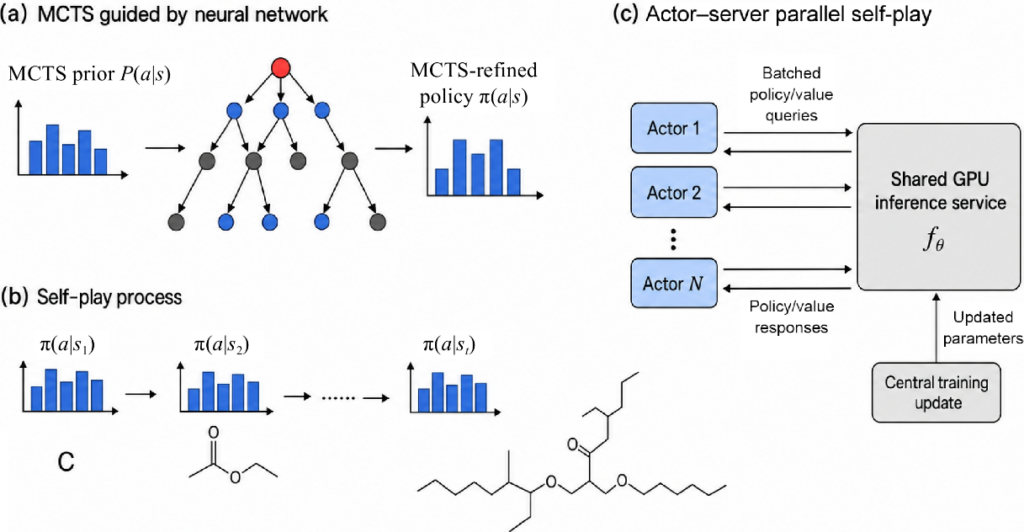
6.1 AI-Based Design of Lubricant Molecules
Paper: LubZero: An active molecular generation framework for multiobjective properties of lubricant molecules
Publication date: 20 October 2026
Journal: Friction
The researchers developed LubZero, a graph-based molecular-generation framework adapted from the AlphaZero algorithm. The system was designed to generate ester-lubricant molecular structures while optimizing multiple properties.
The approach addresses a major problem in lubricant development: candidate molecules must satisfy several objectives simultaneously, including:
- Suitable viscosity
- High viscosity index
- Low-temperature fluidity
- Thermal and oxidative stability
- Lubrication performance
- Safety-related properties
Conventional screening becomes inefficient because the possible chemical-design space is extremely large.
Why It Matters
The study illustrates how artificial intelligence can move lubricant development from screening known compounds toward generating candidate molecules with targeted combinations of properties.
The generated candidates would still require:
- Chemical-synthesis feasibility assessment
- Molecular-dynamics or quantum-chemical validation
- Physical-property measurements
- Tribometer testing
- Oxidation testing
- Toxicity and biodegradation assessment
Paper: https://doi.org/10.26599/FRICT.2026.9441293
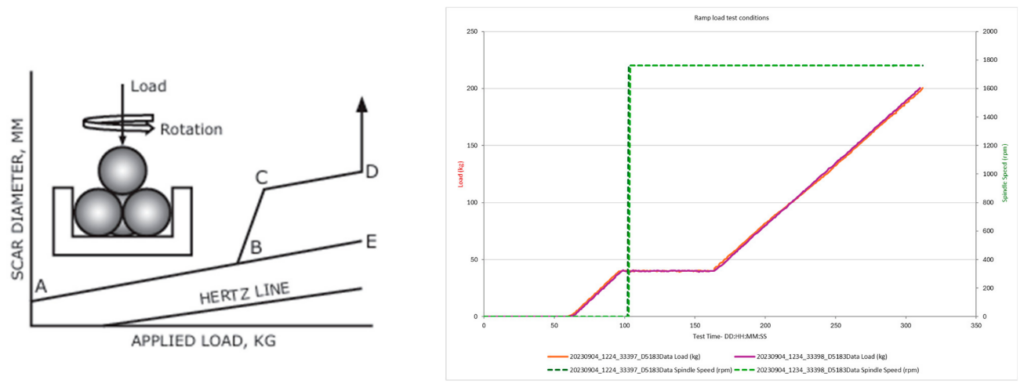
6.2 Continuous-Ramp Four-Ball Extreme-Pressure Testing
Paper: Continuous Ramp Load Four-Ball Testing with Controlled Force Application and Objective Detection of Extreme-Pressure Transitions—A Systematic Study
Publication date: 21 October 2026
Journal: Lubricants
Traditional four-ball extreme-pressure tests use a series of discrete load stages. This study examined continuous load application and the objective identification of extreme-pressure transitions using the recorded friction response.
The method continuously records:
- Normal load
- Friction force
- Rotational speed
- Lubricant-cup temperature
- Wear-related response
- Transition events during increasing load
The work is relevant to the development of ASTM WK100071, a proposed test method for measuring the extreme-pressure properties of greases using four-ball geometry and a constant load-ramp rate. mdpi.com
Why It Matters
Continuous loading can provide more detailed information about the onset of lubricant-film failure than discrete pass/fail stages. It may also reduce test time and improve the identification of:
- Initial film instability
- Scuffing transition
- Seizure onset
- Friction-response discontinuities
- Additive activation ranges
Interlaboratory validation will be important before continuous-ramp results can be compared directly with established four-ball standard tests.
Paper: https://doi.org/10.3390/lubricants14100404
6.3 Oil-Immersed Versus Dry-Running Timing Belts
Paper: Tribological Surface Degradation and Tooth-Profile Changes in Oil-Immersed and Dry-Running Timing Belts Under Real Operating Conditions
Publication date: 20 October 2026
Journal: Lubricants
The study compared surface degradation and tooth-profile changes in belt-in-oil and dry-running timing-belt systems under representative operating conditions.
The work focused on:
- Belt-to-pulley contact
- Tooth-profile geometry
- Elastomer degradation
- Lubricant–elastomer interaction
- Surface topography
- Wear progression
- Timing-belt durability
Oil immersion can reduce interfacial friction and temperature, but lubricant exposure may also alter the belt’s polymer matrix, reinforcement interface or surface layer.
Why It Matters
The performance of a belt-in-oil system cannot be predicted from the lubricant or belt material independently. It is controlled by the complete tribosystem:
- Lubricant chemistry
- Elastomer composition
- Additive compatibility
- Belt tension
- Pulley geometry
- Temperature
- Contamination
- Sliding and meshing conditions
Paper: https://doi.org/10.3390/lubricants14100402
6.4 Additives for Water-Based Hydraulic Fluids
Paper: Research Progress and Prospects for Lubricant Additives for Water-Based Hydraulic Fluids in Hydraulic Supports
Publication date: 19 October 2026
Journal: Lubricants
The review examines liquid and nanoparticle additives developed to improve the lubrication performance of water-based hydraulic fluids, particularly those used in hydraulic support systems.
Water-based fluids provide fire resistance and efficient heat transfer, but their low viscosity and limited boundary-lubrication capacity can increase wear.
The reviewed additive classes include:
- Water-soluble organic friction modifiers
- Corrosion inhibitors
- Surfactants
- Polymer additives
- Carbon-based nanomaterials
- Metal and metal-oxide nanoparticles
- Two-dimensional solid-lubricant particles
Why It Matters
A successful additive for a water-based hydraulic fluid must provide wear protection without creating:
- Sedimentation
- Filter blockage
- Foaming
- Corrosion
- Seal deterioration
- Microbial growth
- Poor long-term dispersion
The review identifies dispersion stability, surface-film formation and environmental compatibility as key future research requirements. mdpi.com
Paper: https://doi.org/10.3390/lubricants14100399
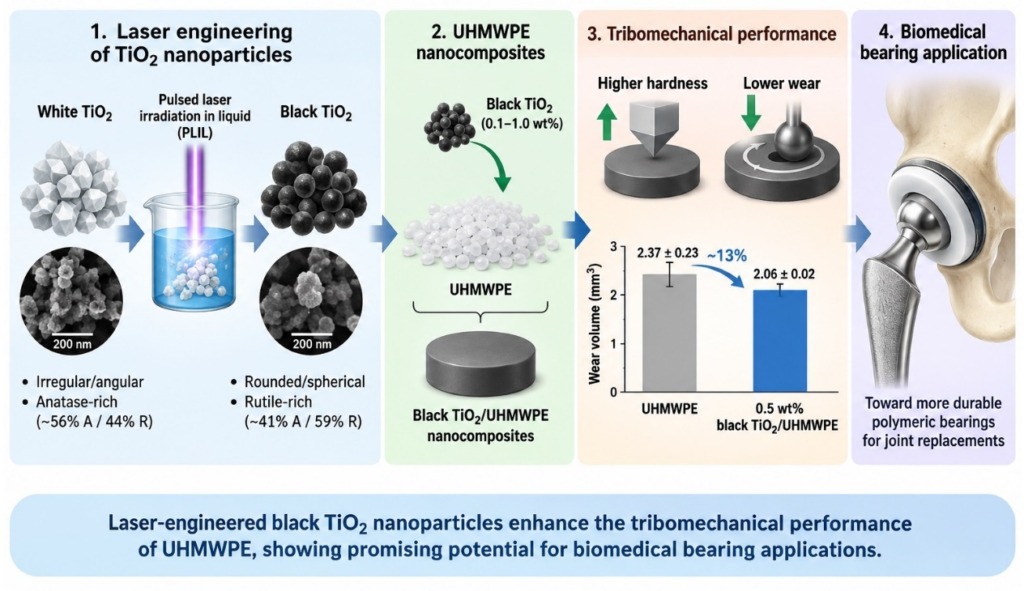
6.5 Laser-Engineered TiO₂/UHMWPE for Biomedical Bearings
Paper: Laser-Engineered Black TiO₂/UHMWPE Nanocomposites: Tribomechanical Response and Potential for Biomedical Bearing Applications
Publication date: 19 October 2026
Journal: Materials
The research investigated ultra-high-molecular-weight polyethylene containing laser-engineered black titanium-dioxide nanoparticles.
UHMWPE is widely used as a bearing material in joint replacements, but wear-particle generation remains a long-term concern. Nanoparticle modification may influence:
- Hardness
- Elastic response
- Friction
- Wear resistance
- Thermal behavior
- Transfer-film formation
- Biological functionality
Why It Matters
A reduction in laboratory wear does not alone demonstrate suitability for an implant. Biomedical bearing materials also require assessment of:
- Particle cytotoxicity
- Oxidative ageing
- Fatigue and delamination
- Creep
- Sterilization effects
- Protein-containing lubrication
- Counterface damage
- Long-duration wear
- Biological response to wear debris
Paper: https://doi.org/10.3390/ma19204384
6.6 Journal-Bearing Wear and Failure Analysis
Paper: Analysis of Journal-Bearing Wear Damage Caused by Abnormal Operating Conditions
Publication date: 19 October 2026
Journal: Applied Sciences
The study investigated journal-bearing wear as a system-level failure involving operating conditions, lubricant-film behavior and contact damage.
Journal bearings rely on hydrodynamic pressure to separate the shaft and bearing surface. Wear can accelerate when abnormal conditions reduce film thickness or disturb lubricant delivery.
Important failure drivers include:
- Insufficient lubricant supply
- Low operating speed during start-up or shutdown
- Excessive load
- Misalignment
- Elevated temperature
- Contamination
- Incorrect clearance
- Lubricant degradation
- Shaft vibration
Why It Matters
Journal-bearing failure should not automatically be attributed to an unsuitable lubricant. Damage patterns must be interpreted alongside operational data, alignment, clearance, temperature and oil condition.
A complete investigation should include:
- Wear-location mapping
- Surface profilometry
- Lubricant analysis
- Debris characterization
- Clearance measurement
- Shaft-alignment inspection
- Temperature and vibration history
- Hydrodynamic-film modelling
Paper: https://doi.org/10.3390/app162010351
7. AI in Tribology Takes Centre Stage
TriboNet hosted an online event titled “AI in Tribology” on 23 October 2026.
The timing aligned closely with emerging research such as LubZero, where AI was used for molecular lubricant design. AI applications in tribology now include:
- Lubricant formulation screening
- Wear-image classification
- Remaining-useful-life prediction
- Friction and wear modelling
- EHL film-thickness prediction
- Surface-topography analysis
- Fault diagnosis
- Digital twins
- Automated test-data interpretation TriboNet
Important Limitation
AI models are only as reliable as their training data and experimental definitions. Tribological datasets often suffer from:
- Small sample sizes
- Inconsistent test conditions
- Missing surface information
- Different counterbody materials
- Variable humidity and temperature
- Poor reporting of run-in behavior
- Inconsistent wear-volume calculations
- Limited external validation
AI should therefore complement physical understanding and controlled experiments rather than replace them.
Event page: TriboNet Events
8. Technology Outlook
| Development | Near-term opportunity | Technical risk |
| AI-generated lubricant molecules | Faster multi-property candidate screening | Predictions may not translate to synthesizable or tribologically stable molecules |
| Continuous-ramp four-ball testing | Faster and more objective EP-transition detection | Correlation with established standard methods requires validation |
| Belt-in-oil systems | Reduced friction, noise and package size | Lubricant–elastomer incompatibility |
| Water-based hydraulic fluids | Fire safety and improved cooling | Weak films, corrosion and additive instability |
| High-performance Group III substitution | Greater formulation flexibility | Different solvency, volatility and additive response |
| Bio-based lubricant consolidation | Wider availability of environmentally acceptable products | Oxidation, hydrolysis and seal compatibility |
| Biomedical nanocomposites | Improved wear resistance of polymer bearings | Long-term biological response to particles |
| AI-assisted condition monitoring | Earlier detection of abnormal wear | False predictions from incomplete or biased data |
9. Final Outlook
The week of 19–24 October demonstrated that tribology is being shaped simultaneously by corporate restructuring, supply-chain pressure and technical innovation.
The possible sale of Infineum could become a major event for the global lubricant-additive sector, but it remained preliminary at the end of the reporting period. Meanwhile, the fall in European Group III availability and continued disruption to international cargo flows reinforced the need for qualified alternative base stocks.
On the research side, two directions were especially visible. The first was data-driven design, represented by AI-generated lubricant molecules and increased interest in machine learning. The second was improved experimental realism, including continuous-load four-ball testing, operating-condition-based belt evaluation and system-level bearing-failure analysis.
For tribologists and lubricant developers, the principal message is that neither materials nor lubricants should be assessed in isolation. Reliable performance requires simultaneous consideration of chemistry, surfaces, operating conditions, environment, component design and supply variability.
References
- Reuters. “Shell- and Exxon-backed UK chemicals group weighs $8 billion sale,” 22 October 2026.
https://www.reuters.com/legal/transactional/shell-exxon-backed-uk-chemicals-group-weighs-8-billion-sale-ft-reports-2026-10-22/ - Financial Times. “Shell and Exxon’s $8bn UK chemicals unit put up for sale,” 22 October 2026.
https://www.ft.com/content/2d4876ae-c707-4df5-a3ae-ae3268343ef2 - JobbersWorld. “Infineum’s Potential Sale: What History Reveals and What Buyers Would Weigh,” 23 October 2026.
https://jobbersworld.com/2026/10/23/infineums-potential-sale-what-history-reveals-and-what-buyers-would-weigh/ - Base Oil News. “Europe’s August Group III Base Oils Supply Falls to Six-Year Low,” 20 October 2026.
https://www.baseoilnews.com/ - Base Oil News. “Saudi Arabia’s Red Sea Base Oils Exports Fall in September,” 21 October 2026.
https://www.baseoilnews.com/ - Base Oil News. “Singapore’s Base Oils Exports Fall in Month to 21 October,” 22 October 2026.
https://www.baseoilnews.com/ - Base Oil News. “China’s September Base Oils Imports Fall Below Exports,” 22 October 2026.
https://www.baseoilnews.com/ - Base Oil News. “Global Base Oils Cargo Flows: Week to 23 October,” 23 October 2026.
https://www.baseoilnews.com/ - Lubes’n’Greases. “Weekly Americas Base Oil Price Report,” 21 October 2026.
https://www.lubesngreases.com/category/base-stocks/other/base-oil-pricing-report/ - JobbersWorld. “Lubrication Engineers Acquires BioBlend Renewable Resources,” 19 October 2026.
https://jobbersworld.com/2026/10/19/lubrication-engineers-acquires-bioblend-renewable-resources/ - FUCHS SE. “Preliminary Results for the First Nine Months of 2026 Exceed Expectations and EBIT Forecast for 2026 Raised,” 19 October 2026.
https://www.fuchs.com/group/press/press-releases/ad-hoc-releases/news-detail/view/10393-FUCHS-SE-Preliminary-results-for-the-first-9-months-of-2026-exceed-expectations-and-EBIT-forecast-for-2026-raised/ - Bao, L., et al. “LubZero: An Active Molecular Generation Framework for Multiobjective Properties of Lubricant Molecules.” Friction, 2026. DOI: 10.26599/FRICT.2026.9441293.
https://doi.org/10.26599/FRICT.2026.9441293 - Drees, D., et al. “Continuous Ramp Load Four-Ball Testing with Controlled Force Application and Objective Detection of Extreme-Pressure Transitions—A Systematic Study.” Lubricants, 14(10), 404, 2026. DOI: 10.3390/lubricants14100404.
https://doi.org/10.3390/lubricants14100404 - Pálinkás, S., et al. “Tribological Surface Degradation and Tooth-Profile Changes in Oil-Immersed and Dry-Running Timing Belts Under Real Operating Conditions.” Lubricants, 14(10), 402, 2026. DOI: 10.3390/lubricants14100402.
https://doi.org/10.3390/lubricants14100402 - Hang, Z., et al. “Research Progress and Prospects for Lubricant Additives for Water-Based Hydraulic Fluids in Hydraulic Supports.” Lubricants, 14(10), 399, 2026. DOI: 10.3390/lubricants14100399.
https://doi.org/10.3390/lubricants14100399 - Negrin-González, J., et al. “Laser-Engineered Black TiO₂/UHMWPE Nanocomposites: Tribomechanical Response and Potential for Biomedical Bearing Applications.” Materials, 19(20), 4384, 2026. DOI: 10.3390/ma19204384.
https://doi.org/10.3390/ma19204384 - Gu, M.W., et al. “Analysis of Journal-Bearing Wear Damage Caused by Abnormal Operating Conditions.” Applied Sciences, 16(20), 10351, 2026. DOI: 10.3390/app162010351.
https://doi.org/10.3390/app162010351
0 Comment