






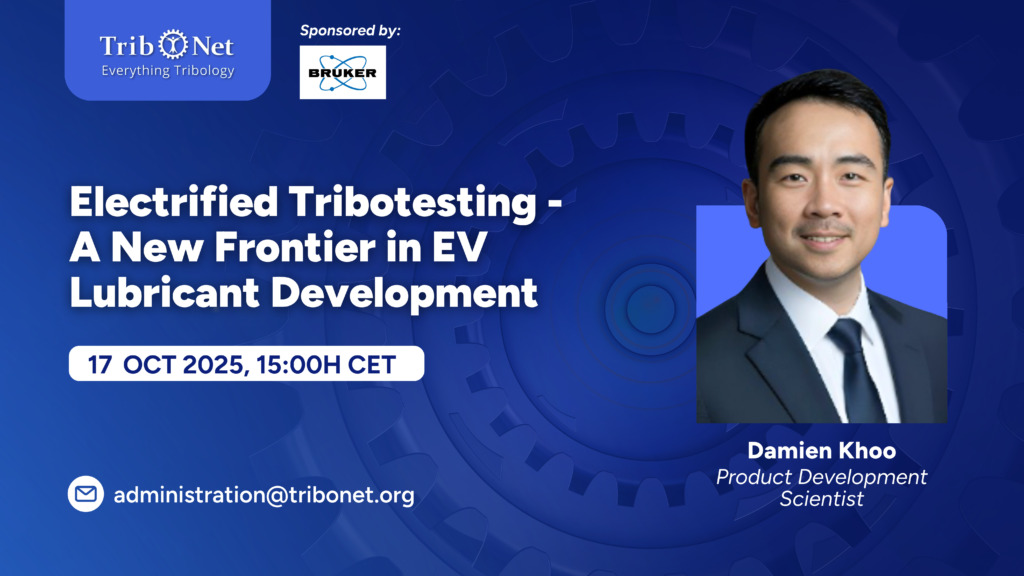
Electrified Tribotesting – A New Frontier in EV Lubricant Development
Introduction
As the shift toward electric vehicles (EVs) accelerates, engineering challenges are becoming increasingly complex across many domains. One of the most critical areas affected is tribology — the science of friction, wear, and lubrication in moving systems In a recent TriboNet webinar, Dr. Damien Khoo explored this complexity from a unique and advanced perspective. He is a Senior Staff Scientist in tribology product development at Bruker Nano Inc. His presentation offered a deep look into one of the field’s most innovative topics: electrified tribotesting for EV powertrains.
In this article, we’ll explore the key insights from his session and their implications for the EV industry. We’ll also discuss why integrating electrical effects into tribological testing is vital for modern EV systems. Additionally, we’ll connect these findings with relevant TriboNet research and highlight possible next steps for future work. These directions will be especially relevant for researchers, lubricant formulators, and drivetrain engineers seeking to advance the field.
Materials available for download
- Optimizing Lubricant Formulations for EVs: A Comprehensive Tribotesting Approach Application Note AN1024-Optimizing Lubricant App Note-BRUKER
- UMT TriboLab Tribometer and Mechanical Tester: UMT TriboLab Mechanical Tester and Tribometer Brochure-BRUKER
- Link to Bruker Tribometer and TriboTester
Why Electrified Tribology Matters
Traditional tribology has largely focused on mechanical, thermal and fluid‐film interactions in moving contacts (e.g., bearings, gears, sliding surfaces). But EV and hybrid electric vehicle (HEV) systems bring new, interwoven factors: high speeds, high voltages, stray currents, new materials and lubricants developed for purely electrical power-train environments. For instance, one prior TriboNet article, “Lubricants in Electric vehicles”, outlines how EV fluids must address not only thermal and mechanical demands but also electrical properties like dielectric strength and copper corrosion. (tribonet.org)

Dr. Khoo emphasised that in an electrified powertrain, components may carry or be exposed to electrical currents or potentials, which in turn can influence lubrication film behaviour, wear mechanisms, discharge damage and surface chemistry. Conventional tribometer tests that ignore electrical stresses risk missing critical degradation pathways.
In short: to ensure durability, efficiency and reliability of EV drivetrains, test methods must evolve. Incorporating electrical current (DC and/or AC) as a test variable is a core step in that evolution.
Key Insights from Dr. Khoo’s Webinar
Here are the major lessons from the webinar:
Adapting conventional tribometer methods
- – Dr. Khoo discussed how standard test rigs (e.g., pin-on-disc, four-ball) are being adapted for electrified testing: integrating electrical current/voltage paths, isolating components electrically, and controlling combined mechanical + electrical stresses.
- – The challenge lies in avoiding unintended current pathways (e.g., through test rig frame or instrumentation) — isolation of the test sample, careful wiring and electrical insulation are essential.

Integration of electrical current into tribological tests
- – Tests can be run in constant current or constant voltage mode, under direct current (DC) or alternating current (AC) conditions.
- – By doing so, researchers can replicate real-world EV conditions where bearings, gears or fluid films might see stray potentials, micro-discharges or current flows.
Case studies: electrified pin-on-disc, four-ball methods
- – Dr. Khoo showed how such modified rigs allow examination of phenomena like electrical discharge damage (ED), lubricant film breakdown under current, copper corrosion and cavitation under stray current conditions.
- – He emphasised that just purely mechanical wear testing is insufficient when electrical stress is in play — the interaction matters.

Tribological challenges in EV systems
- – Key issues addressed included stray currents (for instance, through bearings of electric motors), cavitation from electrical effects, and copper corrosion induced by electric potentials interacting with lubricants.
- – By measuring friction, wear and thermal response under electrical load, lubricant developers can optimise chemistries for the unique demands of EVs (higher speeds, lower viscosity, electrical insulation or conduction as required).
Next steps and future research
- – Dr. Khoo concluded with an emphasis on expanding the range of test rigs and conditions (different components, wider voltage/current regimes, both AC and DC) and applying the methods across more lubricant formulations and EV components.
- – The goal: develop next-generation lubricants and test protocols that anticipate the electrified environment of tomorrow’s EV powertrains.
Practical Implications for Engineers and Lubricant Developers
What do the insights from Dr. Khoo’s webinar mean in practice for engineers working in EV systems and lubricant formulators? Below are several actionable take-aways:

- – Designing test rigs: When building tribometer rigs for EV fluids, ensure electrical isolation of non-test components, plan for current/voltage control (both DC and AC), and replicate realistic mechanical loads (speeds, contacts) combined with electrical loading.
- – Lubricant formulation criteria: Typical EV lubricant requirements now include not just low-viscosity fluid, thermal stability and compatibility with elastomers/polymers, but also dielectric strength/electrical impedance properties, resistance to electrical discharge damage, and copper corrosion mitigation. The webinar’s content reinforces that electrical stresses will remain a real risk in EV drivetrains.
- – Component testing strategy: Rather than relying only on mechanical wear/fatigue tests, plan for “electrified” tribology tests (mechanical + electrical) early in the development process of EV components (bearings, gears, motor housings). This helps identify failure modes that would otherwise be missed.
- – Data interpretation: When analysing results, be aware that introducing current/voltage changes wear tracks, film stability, friction coefficient evolution and thermal behaviour. As seen in other studies (for example, one using a modified MTM rig) the application of voltage significantly affected film thickness and wear scar size. (PCS Instruments)
- – Future readiness: As electrified powertrains evolve (higher voltages, faster switching, more integrated electronics) the conditions for lubrication and tribological health will become more demanding. The webinar emphasises staying ahead of the curve by implementing advanced testing protocols now.
Challenges & Considerations
Of course, this emerging field is not without its obstacles. Some of the key considerations include:
- – Cost and complexity: Electrified tribometer setups require more complex instrumentation (voltage/current control, isolation, safety measures) and are more expensive. Dr. Khoo noted the necessity of avoiding unintended current paths (which could damage electronics) and ensuring reliable data.
- – Standardisation: At present there is no widely agreed-upon standard for ‘electrified’ tribotesting of EV fluids or components. This means that results from different labs may not always be directly comparable. The webinar highlighted the need for wider adoption and method harmonisation.
- – Interpretation of results: The interplay of mechanical, thermal and electrical stresses is complex. It can be difficult to de-couple which factor of wear or film breakdown is due to mechanical load vs due to electrical stress vs due to thermal input. Robust test design and data analysis are required.
- – Scaling to real systems: Laboratory tribometer tests (pin-on-disc, four-ball) remain simplified geometries compared to full EV gearboxes or motor bearings. Translating bench-scale findings to full-scale drivetrain performance remains a challenge. The webinar noted that further work is needed to apply these methods to a “wider range of EV components and conditions”.
Future Outlook: Where is This Headed?
Looking ahead, the field of electrified tribology for EVs is poised for significant growth. Some trends to watch:
- – More specialised test rigs: Just as conventional tribometers matured over decades, we can expect rigs built specifically to integrate mechanical, thermal and electrical stresses at high speeds and under real-life contact geometries (e.g., block-on-ring, ball-on-flat, full gearbox rigs). The webinar pointed this direction.
- – Advanced lubricant chemistries: Lubricants developed for EVs will increasingly incorporate additives and base fluids that are optimised for electrical stress resilience (e.g., better dielectric breakdown strength, better resistance to electric discharge damage, enhanced film formation under stray currents). The baseline TriboNet article “Lubricants in Electric vehicles” touches on this trend. (tribonet.org)
- – Integration with simulation and diagnostics: As wear and film breakdown mechanisms under electrical stress become better understood, predictive modelling and diagnostic capabilities (for example, sensing stray currents in bearings, diagnosing electric discharge damage) will become more common.
- – Standardisation and industry adoption: As more labs adopt electrified tribological testing, we can expect the development of industry‐standards and best practice guidelines (for test conditions, reporting, analysis) to ensure comparability and accelerate lubricant/component qualification.
- – Cross-discipline collaboration: This space sits at the intersection of tribology, electrical engineering (high-voltage systems, stray currents), materials science (surfaces, coatings, corrosion), and lubricant chemistry. Progress will increasingly depend on collaborative research across these domains.
Conclusion
The webinar by Dr. Damien Khoo marks an important step in advancing tribology for the electrified mobility era. It presented practical approaches to integrate electrical stresses into tribological testing in a controlled and measurable way. Through these demonstrations, the session revealed how electrical effects influence lubricant film behaviour, friction, wear, and corrosion. This discussion highlighted both the urgency and the potential of adopting “electrified tribotesting” in modern research.
For engineers, researchers, and lubricant formulators working in the EV field, the message was clear and timely. Now is the moment to adjust test rigs and refine lubricant design criteria for new performance demands. Preparing for the combined mechanical, thermal, and electrical conditions of future drivetrains is no longer optional.
Keywords
electric vehicle tribology, electrified tribotesting, EV lubricants, tribometer electrification, stray currents bearings, lubrication film stability, copper corrosion EV fluids, four-ball electrified test, AC DC current tribology, advanced EV fluids, drivetrain lubrication EV.
0 Comment