






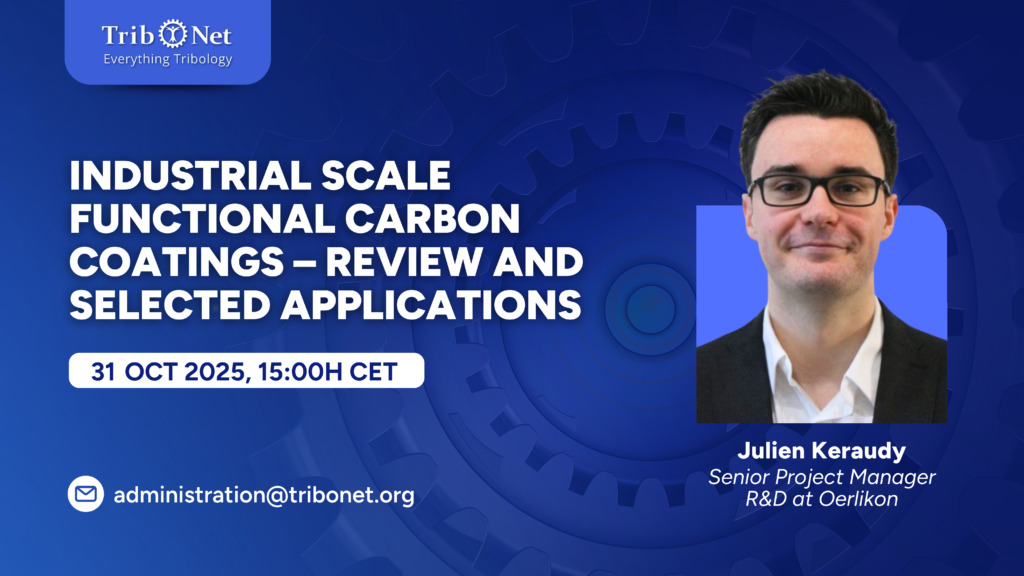
Industrial Scale Functional Carbon Coatings
Introduction
The TriboNet webinar titled “Industrial Scale Functional Carbon Coatings – Review and Selected Applications” offered a deep dive into how advanced coating technologies are transforming tribological performance across industries. The session, held on October 31, 2025, featured Dr. Julien Keraudy, Senior Project Manager in R&D at Oerlikon Service Solutions, based in Balzers, Liechtenstein.
With over 12 years of academic and industrial experience, Dr. Keraudy focuses on developing advanced surface engineering solutions. He specializes in physical vapor deposition (PVD) and plasma-enhanced chemical vapor deposition (PCVD) for high-performance industrial applications. His presentation showed how diamond-like carbon (DLC) coatings, when applied on an industrial scale, deliver exceptional wear resistance and reduced friction. These coatings also extend operating limits, improving reliability and efficiency in demanding mechanical systems.

“Our R&D philosophy is customer-centric,” Dr. Keraudy emphasized. “We develop tailor-made coating solutions that provide measurable value and keep our clients ahead of their industry.”
Oerlikon’s Global Surface Technology Network
Oerlikon, a Swiss company with over 12,000 employees and an annual turnover exceeding CHF 2.4 billion, is a global leader in surface engineering and coating solutions. Its extensive R&D network operates across 21 countries in Europe, 11 in Asia, and 5 in the Americas, supporting customers in automotive, aerospace, medical, and semiconductor sectors. The company’s integrated approach—covering coating materials, equipment manufacturing, and surface treatment services—enables complete control over the coating process chain. This holistic structure ensures quality consistency and global reliability, vital for scaling high-performance coatings to industrial levels.
For readers seeking more background on PVD technology, TriboNet provides a comprehensive guide on Physical Vapor Deposition (PVD) and its importance in tribological surface engineering.
Understanding DLC Coatings and Their Tribological Significance
Dr. Keraudy explained that DLC coatings represent a broad family of carbon-based films with both sp² and sp³ atomic bonds. These coatings combine low friction, high hardness, and strong chemical stability, making them essential for modern tribological applications. DLC coatings usually range from 0.5 to 4 micrometers thick and are applied using PVD or PCVD deposition methods. By adjusting bonding structures, doping elements like tungsten or silicon, and multilayer architectures, engineers can fine-tune coating performance.
One key example presented was the comparison between Balinit C and Balinit DLC coatings. Balinit C, which is tungsten-doped, delivers faster running-in and a lower friction coefficient. In contrast, Balinit DLC, a hydrogenated coating, provides higher hardness and improved durability under extended use. This balance of friction and wear resistance helps engineers select the most suitable coating for each operational need.

To understand how friction and wear mechanisms are analyzed, readers can refer to Coefficient of Friction (CoF).
Engineering Coating Architecture for Performance
A central aspect of Oerlikon’s innovation is the development of multi-layered coating architectures that enhance durability and performance.
DLC layers often include adhesion-promoting interlayers such as chromium nitride (CrN) or titanium nitride (TiN) to reduce residual stress. These interlayers also improve bonding strength between the coating and the underlying metal substrate.
For instance, the Balinit C Star and Balinit DLC Star coatings use a CrN base layer to increase load-bearing capacity. This structure also enhances fatigue resistance, allowing components to perform reliably under demanding operating conditions. The Balinit CarboStar coating, produced using Oerlikon’s proprietary S³p® (Scalable Pulsed Power Plasma) technology, provides a dense, smooth, hydrogen-free carbon layer. This coating exhibits exceptional stability and performance in extreme load environments.

The presentation also highlighted the benefits of filtered plasma arc (FPA) systems in modern coating processes. This advanced technology significantly reduces surface roughness, a major challenge in conventional cathodic arc deposition. As a result, it improves coating uniformity, enhances mechanical precision, and ensures consistent quality in high-performance applications.
Expanding Tribological Frontiers Across Industries
Dr. Keraudy illustrated several industrial applications where DLC coatings have become indispensable, supported by both internal laboratory testing and joint research collaborations.

1. General Engineering and Gearing Systems
In high-load gears, DLC coatings such as Balinit C significantly improve scuffing and pitting resistance. Comparative tests performed with Germany’s FZG Institute showed that coated gears endured higher torque cycles and frictional loads than uncoated ones—particularly under limited lubrication conditions.
2. Bearings and Wind Turbines
To combat fatigue in wind turbine bearings, Oerlikon developed Balinit DLC Classic, a dual-layer architecture combining tungsten carbide (WC-C) and amorphous hydrogenated carbon (a-C:H). The coating dramatically extended bearing lifespan by reducing stress concentrations and surface fatigue.
3. Mechanical Seals and Pumps
In water pump mechanical seals, the application of hydrogen-free DLC coatings minimized dry-run friction and prevented heat buildup that could damage polymeric O-rings. Testing in Oerlikon’s application lab confirmed that using the Milubia hydrogen-free coating further reduced friction and improved long-term durability.
4. Automotive and Motorsport Components
From piston pins to camshafts, Balinit CarboStar demonstrated exceptional resilience under contact pressures exceeding 1,400 MPa during engine bench tests, completing 1,500 km without measurable wear. This performance highlights DLC’s relevance to both energy efficiency and sustainability in next-generation mobility.
5. Medical Devices
In the medical field, Oerlikon’s Balimed C coating offers biocompatibility, anti-glare, and autoclave resistance, improving the lifespan and hygiene of surgical tools and dental implants. Tests show that coated dental screws achieve higher clamping force at fixed torque, minimizing risk of breakage during surgery.
6. Semiconductor Manufacturing
DLC coatings also protect critical components such as electrostatic chucks and lapping carriers used in wafer production. By reducing wear and particle generation, coatings like Balinit Hard Carbon enhance process reliability and extend service intervals—an advantage for semiconductor fabs operating under strict contamination control standards.
Readers interested in the broader industrial implications can explore TriboNet’s resource on Diamond-Like Carbon (DLC) Coatings and their use across engineering sectors.
Addressing Technical Questions
The Q&A session highlighted several key tribological considerations:
- – Hydrogen Content: The hydrogenated Balinit DLC coatings typically contain 15–25% hydrogen, depending on the process parameters.
- – Hydrogen-Free Assurance: Non-hydrogenated coatings are grown using inert gases only, confirmed through analytical tools such as ERDA and ERBS.
- – Temperature Resistance: DLC coatings generally operate up to 400°C, while hydrogen-free variants like Balinit Hard Carbon can endure up to 500°C.
- – Limitations: While DLC performs in both lubricated and dry environments, it is less suited for applications excee=e nitride coatings become more stable.
These discussions underscored that material selection must be case-specific, influenced by temperature, load, lubrication, and environmental conditions.
Toward a Sustainable Tribological Future
Dr. Keraudy concluded by emphasizing that DLC coatings are not merely protective layers, but integral design elements that redefine performance and reliability. By reducing friction and wear, they enable energy savings, extended maintenance intervals, and reduced lubricant dependency—key factors supporting sustainability in manufacturing and mobility.
“With a deep understanding of tribological systems,” he said, “we can tailor coatings to deliver the right solution for every environment. This is how surface engineering contributes to a sustainable economy.”
For those looking to expand their understanding of sustainability in tribology, TriboNet’s article on Green Tribology provides further insights into how coating technologies support eco-efficient engineering.
Conclusion
The TriboNet webinar by Dr. Julien Keraudy highlighted decades of R&D that transformed carbon-based coatings into industrial-scale innovations. Using advanced PVD and PCVD techniques, Oerlikon’s DLC coatings show how tribology and surface science work together for real-world progress. These coatings deliver measurable improvements in performance, reliability, and long-term sustainability across various engineering applications.
From wind turbines to surgical instruments and semiconductor components, the message remained clear and compelling. Functional carbon coatings are defining the next generation of high-performance and energy-efficient engineering surfaces.
Keywords
DLC coatings, industrial coatings, carbon coatings, tribology, PVD, PCVD, surface engineering, Oerlikon, friction and wear
0 Comment