







Tribological challenges and their solutions in electrified powertrains
Introduction
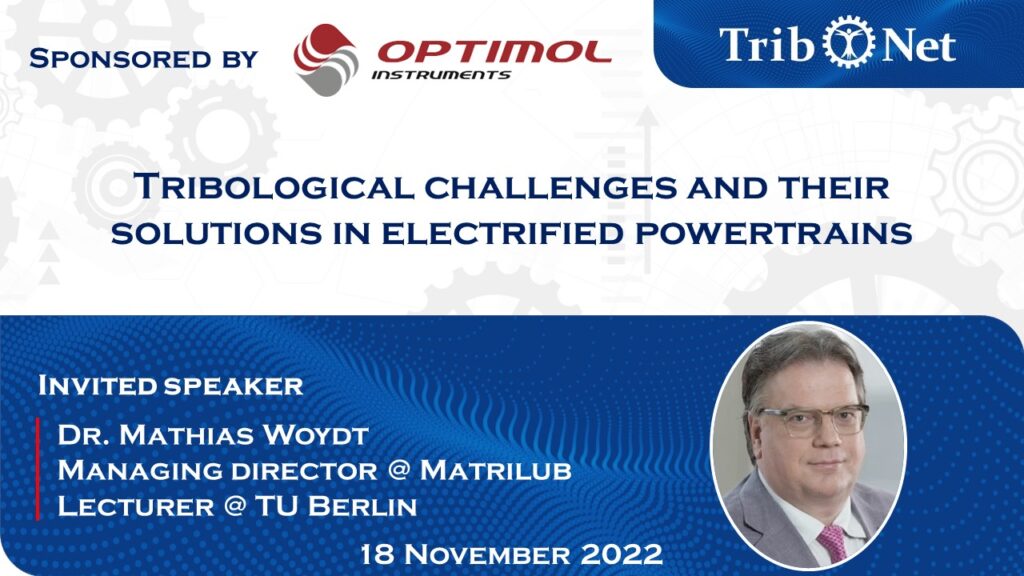
The rapid adoption of electric vehicles (EVs) and renewable energy systems such as wind turbines is creating new challenges in the field of tribology. Traditional lubricants and testing methods, developed for internal combustion engines, are no longer sufficient. In a recent TriboNet Webinar, Dr. Mathias Woydt, managing partner of Optimal Instruments Germany and vice president of the German Society for Tribology, shared his expert insights into how electrification is transforming lubrication science and why new testing methodologies are urgently needed.
The New Demands of Electrification
Electrified systems introduce requirements far beyond friction and wear:
Electrical conductivity – A lubricant must perform under high voltages (400–1000V) without causing failures such as pitting or washboarding.

Heat transfer – Effective cooling of components like hairpin windings is essential for motor longevity.
Material compatibility – Coatings and polymers face unique fretting risks not captured by conventional tests.
As Dr. Woydt emphasized, “The electrical contact resistance has nothing to do with the frictional properties, the anti-wear properties, or the extreme pressure properties. That’s why we have to look in the future also on what happens in the driver contact itself.”
Why Traditional Testing Falls Short
Current lubricant standards (ASTM, DIN) were never designed for EV applications. Tests that measure friction and wear alone ignore critical electrical properties. Dr. Woydt presented data showing that two greases with similar mechanical performance had vastly different impedance behavior across temperatures — proof that mechanical performance and electrical stability are decoupled.
For reliable EV lubricants, the tribo-film’s electrical properties must remain stable across the full range of operating conditions. Standardized combined mechanical + electrical testing will be essential for next-generation lubricants.
👉 Related: Introduction to Tribology
| Lubrication Basics
Failure Mechanisms in Electrified Systems
Dr. Woydt highlighted several critical risks:
Washboarding and pitting in bearing raceways caused by electrical discharges.
Fretting wear on polymer-coated motor windings, where friction data fails to detect coating failure.
Voltage-induced degradation, accelerating surface damage as systems move toward 800V+ architectures.
These insights align with broader research in tribo-corrosion and advanced coating design, reinforcing the need for tribology + electrical diagnostics.
👉 Related: Wear Mechanisms
| Surface & Adhesion

Future Directions
The presentation also pointed to emerging trends:
New DIN 51819-1 draft standard for testing electrical properties of lubricants.
Novel lubricant formulations, including additives like graphene, designed to balance mechanical and electrical demands.
Integrated high-voltage test rigs simulating real EV conditions to accelerate failure analysis.
As Dr. Woydt concluded: “The consequence is really that the formulation will change and have to change due to the criteria of electrical systems.”
Conclusion
Electrification is reshaping tribology. Lubricants can no longer be evaluated solely by their friction and wear performance. Instead, their electrical properties, stability across temperature, and compatibility with new materials must take center stage. By adopting new combined test methods, tribologists and engineers can ensure the reliability of future EVs and wind turbines.
0 Comment