







DLC Coatings for Friction and Wear: What Engineers Should Measure Before Choosing a Coating
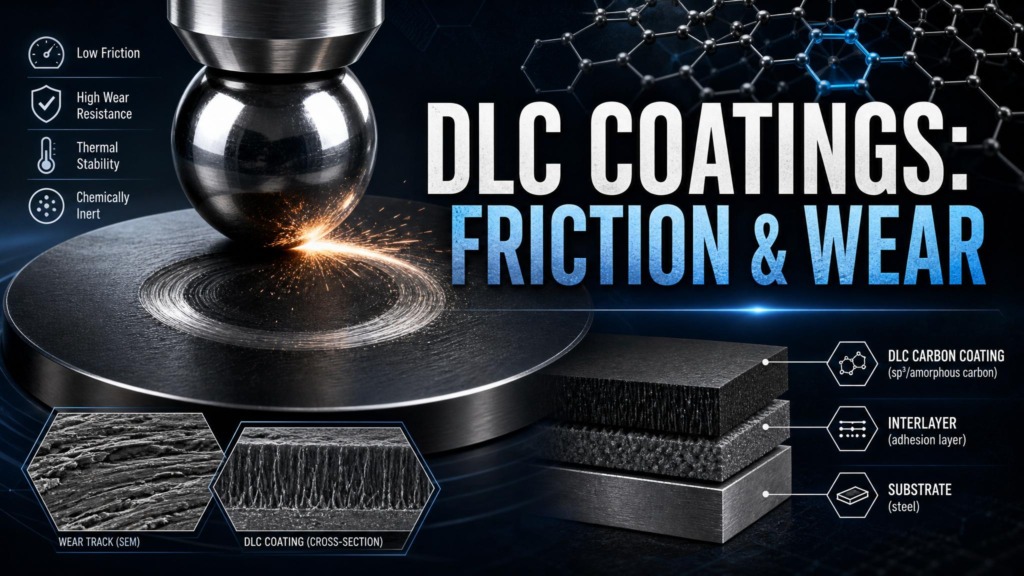
By Aydar Akchurin
DLC coatings are often described as low-friction, wear-resistant carbon films. That is true in many applications, but it is not enough for engineering selection. Diamond-like carbon is a family of coatings, not one universal material. Hydrogen content, sp2/sp3 bonding, dopants, interlayers, thickness, hardness, residual stress, roughness and counterface chemistry can all change friction and wear behavior.
This guide explains what engineers should measure before choosing a DLC coating for friction and wear applications.
TL;DR: Before choosing a DLC coating, define the contact system and measure more than average COF. Check substrate hardness, surface roughness, coating thickness, adhesion, residual stress, counterface material, lubrication, temperature, humidity, contact pressure, wear scar morphology and coating-through failure. DLC selection should be based on the full tribological system, not on a generic “low-friction” label.
- DLC is a coating family, not a single performance value.
- Friction depends strongly on environment, lubricant and counterface.
- Wear testing must confirm whether the coating survives or wears through.
- Adhesion and load support are as important as hardness.
- Report COF curves, wear volume, scar images and failure mode together.
Why DLC coating selection is not one-size-fits-all
Diamond-like carbon coatings are carbon-based thin films that combine varying amounts of diamond-like sp3 bonding and graphite-like sp2 bonding. Some DLC coatings are hydrogenated; others are hydrogen-free. Some are doped with elements such as tungsten, silicon or metals. Many use interlayers to improve adhesion and manage stress.
This variety is useful because engineers can tune coating behavior. It also means that a friction coefficient or wear rate from one DLC system cannot be automatically transferred to another application.
Further learning: TriboNet has a recorded webinar article on Industrial Scale Functional Carbon Coatings, including industrial DLC applications. The future webinar program also lists A Predictive Framework for Friction and Wear of DLC Coatings Using Literature Data on May 29, 2026.
Start with the contact, not the coating brochure
The first selection step is to define what the coating must survive. Important questions include:

- Is the contact sliding, rolling, rolling/sliding, oscillating, fretting or impact-loaded?
- What are the normal load, contact pressure, speed, temperature and duty cycle?
- Will the contact run dry, lubricated, humid, vacuum, fuel-exposed or chemically aggressive?
- What is the counterface material, hardness, roughness and coating state?
- Is low friction, low wear, scuffing resistance, corrosion protection or fatigue life the main goal?
- Is the substrate hard and stiff enough to support the coating?
- What is the allowable wear depth before function is lost?
A DLC coating can fail not because the carbon film is “bad,” but because the substrate deforms, the interlayer delaminates, the counterface is too rough, the contact overheats, or the environment prevents a stable low-friction surface from forming.
Key DLC coating properties to measure
| Measurement | Why it matters | Common method or evidence |
|---|---|---|
| Coating thickness | Defines wear allowance and stress state | Calotest, cross-section, profilometry step |
| Hardness / modulus | Affects load support and contact stress | Nanoindentation with thin-film care |
| Adhesion | Delamination can dominate failure | Scratch test, Rockwell indentation, application-specific loading |
| Surface roughness | Controls running-in, counterface wear and contact stress | 2D/3D profilometry, AFM, optical methods |
| Hydrogen / bonding structure | Affects friction, thermal stability and environment response | Raman, ERDA, XPS or supplier data |
| Residual stress | High stress can cause cracking or adhesion problems | Curvature method, supplier qualification |
| Counterface compatibility | Friction and transfer depend on the pair | Tribology test with actual or representative counterface |
| Thermal stability | Some DLC systems graphitize, oxidize or degrade at high temperature | High-temperature exposure and tribology testing |
What to measure in friction and wear tests
A DLC friction test should not end with one average coefficient of friction. At minimum, report:
- full COF curve, including running-in and any sudden transitions;
- average COF in a defined analysis window;
- wear volume or depth of coating and counterface;
- whether the coating wore through to the substrate;
- wear scar microscopy and, when needed, cross-section or Raman/EDS evidence;
- counterface transfer film or damage;
- repeat count and scatter;
- environment, humidity, temperature and lubricant condition.
Coating-through failure is especially important. A test may show low friction for most of its duration and then rise sharply when the coating fails. Reporting only the average may hide the critical lifetime limit.
DLC in dry vs lubricated contacts
DLC can perform well in dry sliding, but its behavior depends heavily on humidity, temperature, counterface chemistry and film composition. Some DLC systems need a specific environment to achieve low friction; others are designed for vacuum, fuel, oil or high-load applications.

In lubricated contacts, DLC interacts with base oil and additives. Additive chemistry developed for steel surfaces may not react the same way on DLC. Some additives can improve protection; others may be less effective or even harmful depending on the system. That is why testing the actual lubricant and counterface combination is important.
Common mistakes when specifying DLC
- Using generic COF values: supplier data may not match your load, speed, humidity, lubricant or counterface.
- Ignoring substrate support: a hard coating on a soft substrate can crack or delaminate under load.
- Skipping surface preparation: rough substrates can create coating defects and abrasive peaks.
- Testing only the coated part: the counterface may wear, transfer or become the limiting surface.
- Confusing screening with qualification: a pin-on-disk result is useful, but not always enough for gears, bearings, seals or engine parts.
- Not checking temperature: thermal limits differ between DLC types and environments.
DLC coating selection checklist
- Define the target failure mode: friction, wear, scuffing, fatigue, corrosion or debris.
- Specify contact geometry, load, pressure, speed, temperature and duty cycle.
- Measure substrate hardness, roughness and dimensional tolerance before coating.
- Choose DLC type, interlayer and thickness based on load support and environment.
- Test the actual counterface and lubricant where possible.
- Report COF curve, not only one average number.
- Measure wear on both coating and counterface.
- Inspect for coating-through, cracking, delamination and transfer film.
- Repeat tests and report scatter.
- Confirm performance after running-in, temperature exposure or lubricant aging if relevant.
FAQ
What are DLC coatings used for?
DLC coatings are used to reduce friction, improve wear resistance, protect surfaces and extend component life in applications such as automotive parts, bearings, gears, pumps, seals, medical tools and precision mechanisms.
Do DLC coatings always reduce friction?
No. DLC can reduce friction in many systems, but performance depends on coating type, humidity, temperature, lubricant, counterface, roughness and load.
What should be measured before choosing a DLC coating?
Measure or specify substrate hardness, roughness, coating thickness, adhesion, hardness, counterface material, environment, lubrication, contact pressure, wear volume and failure mode.
Can DLC coatings work with lubricants?
Yes, many DLC coatings work in lubricated contacts, but lubricant additives may interact differently with DLC than with steel. Application-specific testing is recommended.
How does DLC coating fail?
Common failure modes include wear-through, cracking, delamination, abrasive damage, counterface wear, thermal degradation and loss of a protective transfer film.
Is thicker DLC always better?
No. Thickness must balance wear allowance, residual stress, adhesion, geometry and load support. Too much thickness can create stress or dimensional problems.
Takeaway
DLC coatings can be powerful tribological tools, but they must be selected and tested as part of a system. The right question is not “What is the COF of DLC?” but “Which DLC architecture works with this substrate, counterface, lubricant, load, temperature and lifetime target?”

Engineers who measure the coating, the substrate, the counterface and the wear mechanism before qualification will make better DLC decisions than teams relying on generic low-friction claims.
0 Comment