








FKM vs Viton vs FPM: naming, standards and grade selection for seal specification
1. Three names, one polymer family – and why the confusion is expensive
Procurement documents routinely mix three names for the same material family. FKM is the designation used by ASTM D1418 for fluoroelastomer rubbers [1]. FPM is the equivalent designation under ISO 1629, and it remains the common form in European drawings and DIN-referenced specifications [2]. Viton is not a standard designation at all: it is a registered trademark of The Chemours Company, inherited from the DuPont heritage of the product line, and it refers specifically to Chemours-manufactured fluoroelastomer grades [3].
The three names therefore sit on different levels: two standardized class names (FKM, FPM) and one commercial brand (Viton). In practice they are used interchangeably in RFQs, which creates two recurring failure modes. The first is commercial: a drawing that calls out “Viton” where any FKM was intended excludes functionally equivalent compounds from other manufacturers at quotation stage, or the opposite – a vendor substitutes the cheapest generic FKM where the specification silently relied on a specific branded grade’s properties. The second is technical: “FKM” on a drawing says almost nothing about which grade family is meant, and the differences between those families (next section) decide whether a seal survives in fuel, steam or low-temperature service. A specification that only says FKM is roughly as informative as one that only says “steel”.
A note on scope: statements about the FKM class, its designation standards and grade families in this article are generic material classification; the Viton trademark and its grade nomenclature are identified as Chemours brand-specific terms wherever they appear.
2. The grade families inside “FKM”
Within the FKM class, suppliers distinguish a handful of grade families by fluorine content and cure chemistry. The families below follow the widely used naming convention popularized by the Viton line (A, B, F, G-series), but equivalent families exist across other manufacturers’ portfolios, which is precisely why a brand-neutral family description is useful in a specification [3][4].

Type A (approximately 66% fluorine, dipolymer). The general-purpose family: hot-air and engine-compartment service, many mineral-oil based fluids. Its weaknesses are hot water and steam, where bisphenol-cured dipolymer FKMs de-vulcanize over time, and aggressive fuels.
Type B (approximately 68% fluorine, terpolymer). Improved resistance to engine oils and some alkaline and steam-exposed duties relative to Type A; a common middle choice where oil additives rule out Type A.
Type F (approximately 70% fluorine, terpolymer). The fuel-oriented family: improved resistance to fuel aromatic components and, critically, to sour gas and amine corrosion inhibitors found in oilfield and gas service. Standard-cure Type F compounds trade away some low-temperature flexibility.
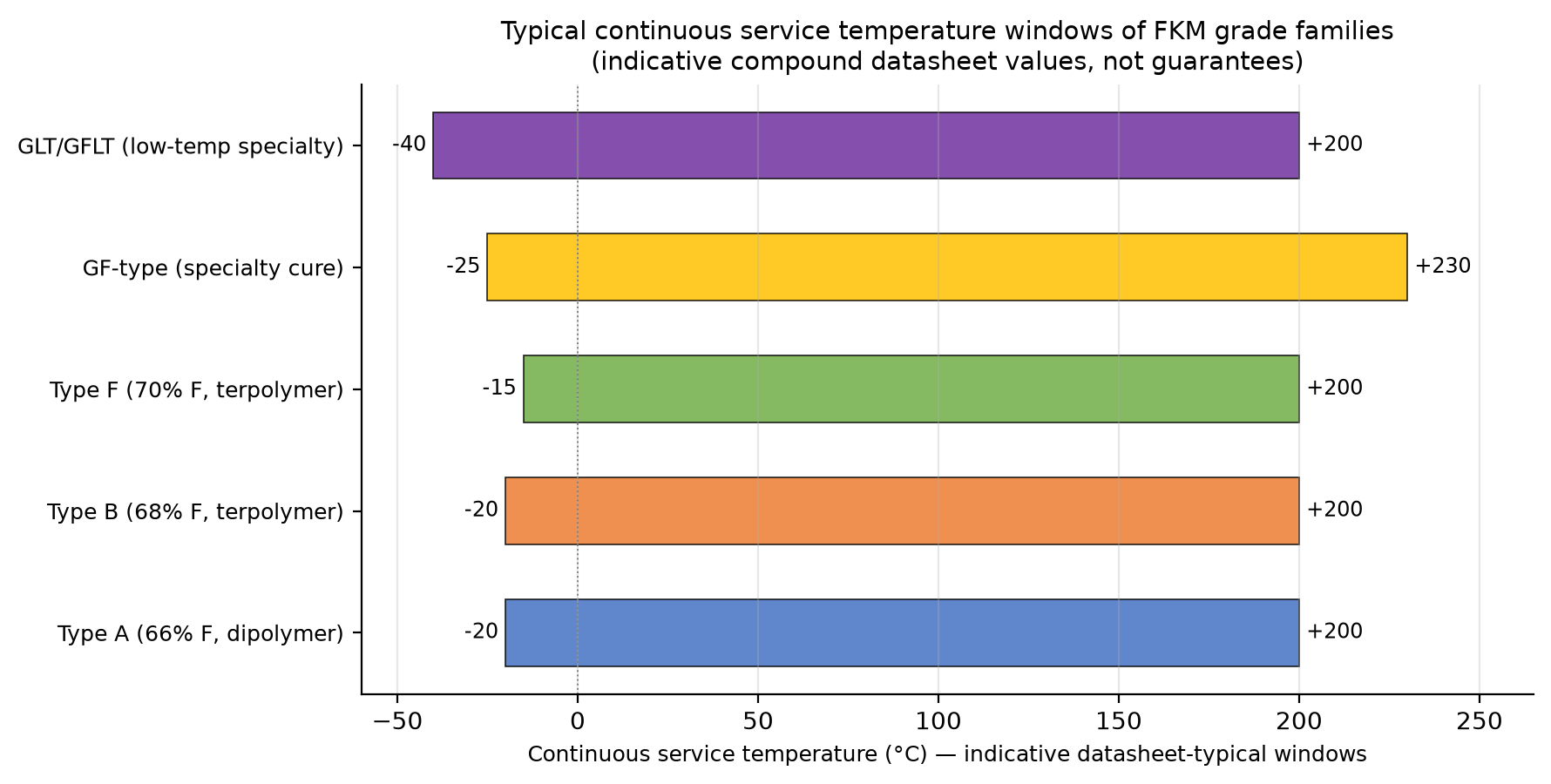
GF/GLT-type specialty families. The G-prefix denotes specialty cures and polymerization: GF-type compounds pair fuel and chemical resistance with improved low-temperature behavior, and GLT/GFLT-type grades extend the glass transition downward – typical continuous service windows reach roughly -40 degC against about -20 degC for a standard Type A, at a meaningful cost premium [3][4]. Figure 1 compares the typical datasheet windows.

Two cross-cutting notes. First, cure system matters as much as fluorine content for water/steam and amine service; peroxide-cured grades dominate the demanding end. Second, post-cure practice influences final compound properties; compression set values quoted for a post-cured slab do not transfer unmodified to a press-cured, post-cure-free production part.
3. A practical selection map: media first, temperature second, cost last
Media. Map the fluid before the grade. Mineral oils and silicone oils: any FKM family can be evaluated, Type A is the cost baseline. Fuels and aromatic-containing fluids: Type F or better. Sour gas / amine inhibitors: Type F or GF-type with peroxide cure. Hot water and steam: standard FKMs are weak; peroxide-cured specialty grades or a switch of polymer class entirely (EPDM for water/steam duties) is the honest engineering answer. Skydrol-type phosphate-ester fluids: no FKM is appropriate; the answer is EPDM. This “polymer class before grade family” step eliminates most bad selections before any datasheet comparison starts.
Temperature. Continuous windows in Figure 1 are datasheet-typical: standard families serve roughly -20 degC to +200 degC continuous with excursions to +230 degC, low-temperature specialties reach -40 degC. Two traps: dynamic low-temperature sealing begins to fail well above the quoted brittle point as the compound hardens (TR-10 is the better screening value), and frictional heating in a reciprocating seal can push the sealing interface 20-30 degC above bulk fluid temperature, so a comfortable bulk-temperature reading can still exceed the grade window at the lip.
Cost. The price ladder runs Type A < Type B < Type F < specialty GLT/GFLT-type, and the premium for the low-temperature specialty families is substantial – commonly a multiple of the Type A price for the same part. The economical specification is therefore the family that covers the duty with margin, not the best family on the datasheet. Cost pressure is also where the substitution question of the next section arises.
4. Substituting a named-brand grade with a generic equivalent
When a drawing names a specific branded grade (for example a Viton GFLT-type compound) and procurement wants a generic equivalent, the substitution is safe only if the comparison is made family-to-family, not name-to-name. The working checklist:
- Same ASTM D1418 class (FKM) is the entry ticket, nothing more. It does not by itself authorize substitution.
- Match the family: fluorine content class (66/68/70%), cure system (bisphenol vs peroxide), and specialty designation (GFLT-type low-temperature, GF-type fuel service).
- Compare the application-relevant datasheet lines: TR-10 for low-temperature service, compression set at the actual operating temperature, volume swell in the actual fluid, and hardness. Values at 23 degC in IRM 903 oil are marketing tables, not selection data.
- Require test coupons on the actual compound, not a family datasheet, for safety-relevant or high-temperature duties.
- Document the equivalence decision. A substitution note on the drawing prevents the next buyer from silently reverting to – or from – the branded callout.
Done this way, brand-to-generic substitution is routine and safe; done by name only, it is how “equivalent FKM” parts end up as field failures in fuel or low-temperature service.
5. Summary
FKM and FPM are two standards’ names for one polymer class; Viton is one manufacturer’s brand inside that class. Specifications should say “FKM, Type X family, peroxide/bisphenol cure” with the duty conditions – and name brands only where a specific branded compound is genuinely required. Grade selection is media first, temperature second, cost last, and substitutions are family-to-family with application-relevant data. That is the whole game; the rest is datasheet reading discipline.
References
[1] ASTM D1418, Standard Terminology Relating to Rubber and Rubber Latices – Abbreviations for Rubbers and Rubber Latices (FKM designation). ASTM International.
[2] ISO 1629, Rubber and latices – Nomenclature (FPM designation). International Organization for Standardization.
[3] The Chemours Company, Viton fluoroelastomer technical information and grade selection guides (Viton is a registered trademark of The Chemours Company; grade families A/B/F and G-series naming). chemours.com.
[4] Parker Hannifin, Parker O-Ring Handbook, ORD 5700 – elastomer selection, fluid compatibility and temperature limits of FKM compounds. parker.com.
Disclosure note
This article was prepared by the engineering team at O-Ring Supply Co., a commercial supplier of O-rings and seals (https://oringsupplyco.com). It is contributed to TriboNet for editorial review under the site’s contribution policy; no payment or link terms are requested. Statements about the Viton trademark and Chemours grade nomenclature are brand identification in the trademark-owner’s own public usage; all other material statements are generic polymer classification intended to be brand-neutral.
0 Comment