






Can we formulate lubricants using AI?
Introduction
The selection of the right lubricant is crucial for ensuring optimal friction, lubrication, and wear performance in engineering systems. However, due to the diverse compositions of lubricants, identifying the most suitable formulation can be challenging. Artificial Neural Networks (ANNs) provide a solution by analyzing feedback data on lubricant properties and their tribological performance. Lubricant effectiveness depends on its base oil and additives, with viscosity being a key parameter influenced by pressure, temperature, and shear rate. Predicting viscosity under real-world conditions is complex, particularly when accounting for additive performance in boundary and mixed lubrication regimes. By leveraging AI, researchers and engineers can focus on successful formulations, streamlining the lubricant design process and enhancing performance [1].
Lubricant regimes and lubricant performance
AI and ML are being developed to predict lubrication regimes in tribosystems by analyzing key parameters such as speed, load, temperature, and surface roughness. Understanding lubrication regimes helps determine contact conditions, friction, and wear characteristics, improving AI-driven maintenance and material selection. There are three main lubrication regimes: boundary lubrication, responsible for 70% of wear due to asperity contact; full-film (elasto-)hydrodynamic lubrication, which minimizes friction but is difficult to maintain; and mixed lubrication, where both lubricant film and asperity contact coexist. These regimes are particularly important in sliding bearings, which are prone to failure under severe conditions. By using friction, heat, and vibration sensors, AI (especially ANN) can predict bearing performance and detect potential failures, enhancing reliability and efficiency in engineering systems.
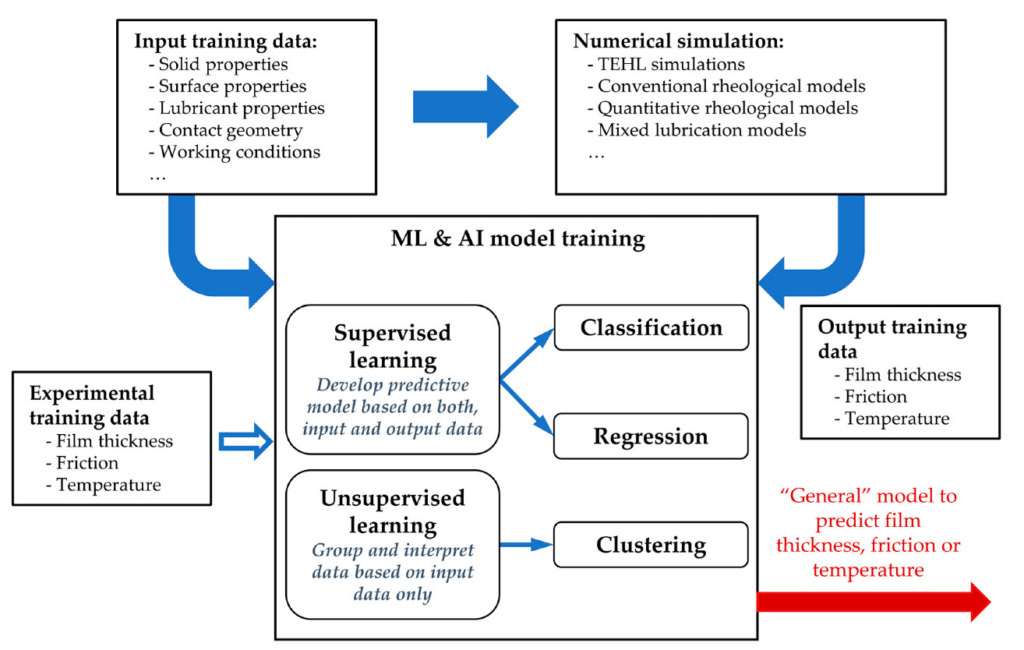
Figure-1 Schematic showing the main steps and parameters associated with the training process of ML/AI models to predict the lubrication performance from experimental and simulation datasets [2]
Enhancing lubricant performance using AI
AI and ML algorithms analyze lubricant compositions, operating conditions, and surface treatments to determine the most efficient combinations for reducing friction and wear. These data-driven approaches help engineers iteratively improve lubrication system designs, leading to enhanced performance, decreased friction, and lower energy consumption. Further AI and ML can study lubricant degradation processes, such as oxidation, thermal breakdown, and contamination, to predict their lifespan. By modelling degradation rates under different conditions, researchers can develop predictive maintenance strategies, reducing the risk of equipment failure due to deteriorated lubricants.
Lubricant selection using AI
ML models are trained on lubricant properties and performance data that can simulate lubricant behavior under various operating conditions, including temperature, pressure, velocity, and surface roughness. These simulations help engineers anticipate potential issues in lubrication regimes and optimize formulations accordingly. Further this knowledge can help in AI customised lubricants based on the extensive lubrication data to identify optimal lubricant selections for specific applications. By using previous experimental data, engineers can make informed decisions about lubricant composition, ensuring optimal rheology, thermal stability, and anti-wear properties for extended equipment life. There are also Physics-Informed Neural Networks (PINNs) for Lubrication Studies which integrates AI with fundamental physics equations (e.g., Reynolds equation) to model lubrication dynamics accurately. These models improve hydrodynamic lubrication simulations, predict pressure and cavitation effects, and enhance the precision of lubrication studies without requiring extensive training data, making them a valuable tool in tribology research.
Conclusion
The integration of AI and ML in tribology significantly enhances lubricant selection and optimization by using data-driven decision-making, performance prediction, and formulation improvements. By adapting to environmental and operational variables, AI-driven approaches continuously refine lubrication strategies based on real-world feedback, leading to improved efficiency, reduced wear, and extended equipment lifespan.
References
0 Comment