







TriboNet Weekly: Global Tribology, Lubrication & Surface Engineering Intelligence | Sep 7–Oct 5, 2026

7 September–5 October 2026
Weekly Key Takeaways
- The global oil market remained highly sensitive to logistics, freight cost and geopolitical risk. By 5 October, Brent was around the low-US$100/bbl range, while WTI remained around US$90/bbl.
- Lubricant-market pressure continued, although retail motor-oil prices showed signs of stabilising after sharp increases earlier in 2026.
- JobbersWorld reported that retail motor-oil prices were still around 25.3% above February levels, showing that lubricant-cost pressure remains structurally elevated.
- India’s crude-import pattern shifted during September, with Gulf crude imports increasing sharply as refiners adjusted sourcing under geopolitical and logistics uncertainty.
- The 8th World Tribology Congress, held in Rio de Janeiro from 20–25 September, became the major global tribology event of the period.
- Research momentum remained strong in active interface design, including textured TiN coatings, gel lubricants with MOF additives, self-healing epoxy coatings and adaptive self-lubricating materials.
- Testing and instrumentation discussions continued to move toward realistic operating conditions, including electrified contacts, high-speed lubricant behaviour, complex motion and net-zero energy systems.
- The key message for tribologists is that future lubrication reliability depends on both microscopic contact control and macroscopic supply-chain resilience.
1. Global Oil Market
Market Snapshot

| Factor | Weekly status | Tribology/lubricant impact |
| Brent crude | Around low-US$100/bbl by 5 Oct | ↑ Feedstock and transport uncertainty |
| WTI crude | Around US$90/bbl by 5 Oct | ↑ North American formulation-cost pressure |
| Middle East exports | Recovering, but logistically strained | ↑ Freight and insurance sensitivity |
| Tanker movement | Cost and route pressure remained high | ↑ Base-oil and additive-delivery risk |
| Refining access | Refined-product bottlenecks reported | ↑ Finished-lubricant vulnerability |
| India crude imports | Gulf imports rose strongly in September | ↑ Regional supply-chain adjustment |
Oil markets remained volatile through September and early October. By 5 October, crude oil was reported around US$90/bbl for WTI, while Brent was around US$102/bbl. Prices remained significantly above the previous year’s level, keeping pressure on energy-intensive manufacturing and lubricant supply chains.
The most important development was that oil-market stress was not only about crude supply. Reuters highlighted that logistics, tanker availability, insurance, refinery access and transport disruption had become major cost drivers, even when some Middle East export volumes recovered.
Why Tribologists Should Care
Daily crude-price movements do not translate directly into finished-lubricant price changes. However, prolonged instability affects:

- refinery operating decisions,
- base-oil availability,
- synthetic hydrocarbon feedstocks,
- additive manufacturing,
- energy-intensive processing,
- packaging and transportation,
- finished-lubricant pricing.
The pressure becomes particularly important for high-performance formulations requiring Group III base oils, PAOs, esters or specialised additive packages.
Tribology Impact
The relevant industrial pathway is:
geopolitical disruption → crude volatility → refinery economics → base-oil availability → formulation cost → finished-lubricant price

Further reading: Trading Economics—Crude Oil
Further reading: Reuters—Oil’s new problem is logistics

2. Lubricant Pricing Remains Elevated Despite Stabilisation
Retail motor-oil prices showed signs of stabilisation by late September, but at a much higher level than earlier in the year.

JobbersWorld reported that most observed motor-oil product families remained unchanged from August to late September. However, the overall basket was still approximately 25.3% above February levels.
Lubricant Industry Implication
This suggests that the sharpest lubricant-price acceleration may have slowed, but the market has not returned to earlier cost conditions.
Pressure remains around:
- base-stock sourcing,
- additive-package cost,
- packaging,
- freight,
- private-label pricing,
- high-VI base oils,
- low-viscosity automotive oils,
- extended-drain industrial lubricants.
Engineering Message
The lubricant market is moving from short-term price shock into a more persistent cost-management phase. Lubricant users may increasingly need to balance:
performance specification + supply reliability + price sensitivity
This matters especially for fleets, industrial plants, EV drivetrains, high-load machinery and high-temperature systems where lubricant substitution can influence film formation, friction, wear and component life.
Further reading: JobbersWorld—Lubricant News
3. India and Asian Crude Supply Shifts
India’s crude-import pattern shifted strongly during September. Gulf oil imports reportedly increased sharply, while Russian crude imports declined from earlier highs.
The Financial Express reported that India’s West Asian crude imports increased to approximately 2.10 million barrels per day in September, with higher supplies from Iraq, Saudi Arabia, the UAE and Kuwait.
Why It Matters
For Asian lubricant and refining markets, crude sourcing affects:
- refinery operating economics,
- base-oil production planning,
- regional fuel and lubricant pricing,
- marine lubricant demand,
- transport and insurance cost,
- supply-chain risk management.
Lubricant Industry Implication
Changing crude slates can influence refinery output and downstream economics. For the lubricant sector, this can affect not only fuel pricing but also availability and cost of suitable feedstocks for base-oil production.
Tribology Impact
The key lesson is that lubricant supply security depends on the entire chain:
crude source → shipping route → refinery configuration → base-oil output → blending → distribution → end-use reliability
Further reading: Financial Express—India’s Gulf oil imports surge
4. World Tribology Congress 2026 Places Net-Zero Tribology in Focus
The major tribology event of this period was the 8th World Tribology Congress, held in Rio de Janeiro from 20–25 September 2026.
The official WTC programme included scientific sessions, plenary lectures, keynote presentations and invited talks across cutting-edge tribology disciplines. The event brought together academic and industrial specialists working on friction, wear, lubrication, surface engineering, modelling, materials and sustainability.
Key Themes
| Theme | Why it matters |
| Net-zero tribology | Lower friction, improved efficiency and longer service life |
| Electrified contacts | EV bearings, e-mobility fluids and current-induced damage |
| Surface engineering | Coatings, textures, tribolayers and functional interfaces |
| Lubricant formulation | Low-viscosity oils, sustainable additives and EV fluids |
| Testing and instrumentation | More realistic contact, speed, load and temperature conditions |
| AI and modelling | Faster material and lubricant screening |
PCS Instruments also highlighted WTC discussions around high-speed lubricant behaviour, electrified contacts, formulation development and complex motion testing.
TriboNet Takeaway
WTC 2026 reinforced that tribology is no longer only a component-level science. It is becoming central to energy efficiency, electrification, sustainable manufacturing and system reliability.
Further reading: WTC 2026 Programme

5. Testing and Instrumentation: Moving Toward Real Operating Conditions
A clear theme from industry-facing WTC communication was the growing need for tribological testing that better reproduces real operating contacts.
Traditional tribology tests often simplify load, speed, temperature, motion and lubrication conditions. Modern applications increasingly involve:
- transient loading,
- mixed sliding and rolling,
- electrified surfaces,
- high-speed contacts,
- thin lubricant films,
- chemically active interfaces,
- thermal cycling,
- complex motion paths.
Tribology Significance
The field is moving away from simple friction/wear ranking and toward application-specific simulation of real engineering systems.
Industrial Applications
This is increasingly relevant to:
- electric vehicles,
- wind turbines,
- aerospace systems,
- bearings and gears,
- medical implants,
- manufacturing tools,
- hydrogen systems,
- robotics and precision motion systems.
Engineering Message
The important question is shifting from:
Which material has the lowest friction?
toward:
Which surface-lubricant-contact system remains reliable under realistic operating conditions?
6. Research Highlights: Friction, Wear, Lubrication and Surface Engineering
Recent tribology research during this period continued to focus strongly on engineered interfaces, where coatings, additives, surface texture and responsive materials are designed to actively control friction and wear.
6.1 TiN Coatings and Groove Orientation
A September 2026 article in Friction examined how groove orientation affects the tribological behaviour of TiN coatings. The study moved from unidirectional to orthogonal groove designs, showing that surface texture geometry can significantly influence contact mechanics, debris movement and friction response Friction journal.
Tribology impact:
This supports the growing idea that coating performance is not only controlled by hardness or chemistry, but also by surface architecture. Groove orientation can be used as a design variable for controlling wear debris, lubricant retention and sliding stability.
6.2 Supramolecular Gel Lubricants with MOF Additives
Another September 2026 study reported supramolecular composite gel lubricants containing polymer-brush-grafted MOF additives for friction and wear reduction Friction journal.
Why it matters:
Gel lubricants are becoming attractive for applications where conventional oils may leak, degrade or fail to remain inside the contact. MOF-based additives provide a tunable route for improving load support, interfacial film formation and lubricant durability.
Tribology impact:
This direction is useful for precision machinery, soft contacts, biomedical devices and sealed systems where long-term lubricant retention is important.
6.3 Self-Healing and Lubricating Epoxy Coatings
Research published in September 2026 also explored active-passive PANI microcapsule@MXene networks in epoxy coatings for tribocorrosion protection and on-demand lubrication Friction journal.
Why it matters:
Tribocorrosion remains a major challenge in marine, biomedical, energy and chemical-processing environments. A coating that can respond to damage by releasing protective or lubricating components offers a more intelligent protection strategy than passive barrier coatings alone.
Tribology impact:
This work reflects a wider movement toward smart tribological coatings that combine corrosion resistance, wear protection and lubrication in one material system.
6.4 Biomimetic Self-Lubricating Materials
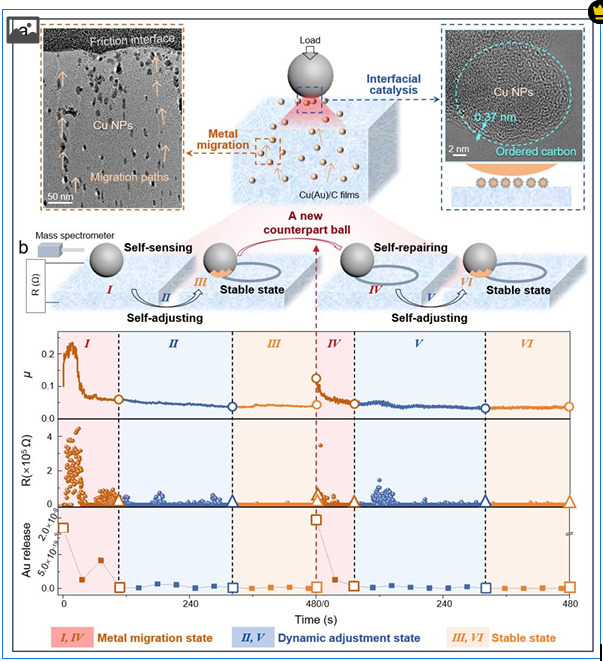
A 2026 preprint reported a biomimetic feedback-loop system for sustaining self-lubrication and wear resistance. The material used frictional heating as a trigger for soft metal nanoparticle migration, promoting formation of low-friction carbon nanostructures and achieving ultra-low friction around 0.04 under high vacuum conditions arXiv.
Why it matters:
This is a strong example of tribology moving toward adaptive materials. Instead of simply resisting wear, the material responds to frictional conditions and adjusts the interface.
Tribology impact:
Such self-regulating surfaces may be highly relevant for aerospace, vacuum systems, micro-mechanisms and other systems where liquid lubrication is difficult.
Research Trend Summary
| Research Direction | Key Message | Application Relevance |
| Textured TiN coatings | Geometry controls contact and debris behaviour | Cutting tools, forming, sliding components |
| MOF-gel lubricants | Additive architecture improves lubrication stability | Precision systems, soft contacts, sealed devices |
| Self-healing epoxy coatings | Coatings can combine lubrication and corrosion protection | Marine, biomedical, chemical equipment |
| Biomimetic self-lubrication | Friction itself can activate protective mechanisms | Aerospace, vacuum, MEMS/NEMS |
| WTC 2026 themes | Net-zero, electrification and realistic testing are central | EVs, wind, manufacturing, energy systems |
Overall Research Outlook
The research message from this period is clear: modern tribology is moving from passive material selection toward active interface design. The strongest developments are not simply harder coatings or lower-viscosity lubricants, but systems that can retain lubricant, form protective films, respond to damage, manage debris and adapt to changing contact conditions.
7. Research Highlight: MOF-Based Gel Lubricants
Another September 2026 study reported supramolecular composite gel lubricants containing polymer-brush-grafted MOF additives for enhanced friction and wear reduction.
Gel lubricants are attractive where conventional oils may leak, migrate or fail to remain in the contact. MOF-based additives offer a tunable route for improving load support, interfacial film formation and lubricant durability.
Why It Matters
Gel lubricants may be useful for:
- precision machinery,
- sealed systems,
- soft contacts,
- biomedical devices,
- robotics,
- slow-speed mechanisms,
- contacts requiring long-term lubricant retention.
Tribology Impact
The operating pathway can be represented as:
gel network → additive retention → interfacial film formation → reduced friction → improved wear resistance
TriboNet Takeaway
Lubricant design is moving beyond base oil plus additive chemistry. Structure, retention and controlled release are becoming equally important.
Further reading: Friction journal
8. Research Highlight: Self-Healing Tribocorrosion Coatings
Research published in September 2026 also explored active-passive PANI microcapsule@MXene networks in epoxy coatings for tribocorrosion protection and on-demand lubrication.
Tribocorrosion remains a major challenge in systems where mechanical wear and chemical/electrochemical degradation occur together.
Application Relevance
This type of coating is relevant to:
- marine components,
- biomedical implants,
- chemical-processing equipment,
- energy systems,
- offshore structures,
- pumps and valves,
- wet sliding contacts.
Tribology Significance
A coating that can respond to damage by releasing protective or lubricating components offers a more intelligent strategy than passive barrier coatings alone.
Engineering Message
The development reflects a wider movement toward smart tribological coatings that combine:
wear protection + corrosion resistance + lubrication + damage response
Further reading: Friction journal
9. Research Highlight: Biomimetic Self-Lubricating Materials
A 2026 preprint reported a biomimetic feedback-loop system for sustaining self-lubrication and wear resistance. The material used frictional heating as a trigger for soft metal nanoparticle migration, promoting the formation of low-friction carbon nanostructures.
The reported system achieved ultra-low friction around 0.04 under high-vacuum conditions.
Why It Matters
This is a strong example of tribology moving toward adaptive materials. Instead of simply resisting wear, the material responds to frictional conditions and adjusts the interface.
Potential Applications
- aerospace mechanisms,
- vacuum systems,
- micro-mechanisms,
- MEMS/NEMS,
- dry-running contacts,
- high-reliability sliding systems.
Tribology Impact
The adaptive pathway can be represented as:
high friction → frictional heating → nanoparticle migration → low-shear carbon formation → reduced friction
TriboNet Takeaway
Self-regulating surfaces may become important where conventional liquid lubrication is difficult, especially in vacuum, space and miniaturised systems.
Further reading: arXiv—Biomimetic feedback loop for self-lubrication
10. Technology Outlook
| Technology | Maturity | Current momentum |
| Predictive lubrication | High | ★★★★★ |
| Plasma and coating engineering | High | ★★★★★ |
| Electrified-contact testing | Medium–High | ★★★★★ |
| Hydrogen tribology | Medium–High | ★★★★★ |
| Smart/self-healing coatings | Medium | ★★★★☆ |
| MOF-based lubricant additives | Emerging–Medium | ★★★★☆ |
| Gel lubricants | Medium | ★★★★☆ |
| Biomimetic self-lubrication | Emerging | ★★★★☆ |
| AI-assisted lubricant/material design | Medium | ★★★★★ |
| Tribofilm-centred design | Medium–High | ★★★★★ |
11. Events & Conferences Watch
44th Polish Tribology Conference
8–11 September 2026 — Gdańsk, Poland
The conference brought together work on friction, wear, lubrication, machine elements, surface engineering and tribological testing.
Tribology in Industry — TriboNet Webinar
11 September 2026 — Online
Kuldeep Mistry discussed the application of tribological principles within industry, highlighting the importance of translating tribology from laboratory testing into practical reliability and engineering decision-making.
8th World Tribology Congress
20–25 September 2026 — Rio de Janeiro, Brazil
The World Tribology Congress brought together academic and industrial specialists across:
- friction and wear,
- lubrication,
- surface engineering,
- computational tribology,
- biotribology,
- nanotribology,
- machine elements,
- sustainable and net-zero technologies.
The programme included plenary lectures, keynote presentations, technical sessions, exhibitions and international networking.
Further reading: WTC 2026 Programme
12. Final Tribology Outlook
The period from 7 September to 5 October 2026 showed how tribology sits at the centre of both engineering performance and industrial resilience. Oil and lubricant markets remained exposed to geopolitical and logistics uncertainty, while research and conference activity pushed the field toward net-zero energy, electrified machinery, smart coatings, advanced lubricants and more realistic testing.
The key message for the tribology community is clear:
Future progress will depend not only on reducing friction and wear at the contact, but also on designing reliable, sustainable and economically resilient lubrication systems across the full engineering value chain.
References / Further Reading
- Trading Economics. Crude Oil – Price, Chart, Historical Data, News.
https://tradingeconomics.com/commodity/crude-oil - Reuters. Oil’s new problem isn’t supply. It’s logistics.
https://www.reuters.com/commentary/reuters-open-interest/oils-new-problem-isnt-supply-its-logistics-2026-10-05/ - JobbersWorld. Lubricant News: Retail Motor-Oil Prices Stabilize After Sharp 2026 Increases.
https://jobbersworld.com/category/lubricant-news/ - Financial Express. India’s Gulf oil imports surge despite Hormuz risk as ship-to-ship transfers rise.
https://www.financialexpress.com/world-news/indias-gulf-oil-imports-surge-despite-hormuz-risk-as-ship-to-ship-transfers-rise/4353343/ - WTC 2026. Program at a Glance: 8th World Tribology Congress.
https://www.wtc2026.org/program/detailed/at-glance.php - PCS Instruments. What Does Tribology Need Next? Hear from the PCS WTC Team.
https://pcs-instruments.com/articles/what-does-tribology-need-next-hear-from-the-pcs-wtc-team/ - Friction Journal. Recent research articles in friction, lubrication and wear.
https://www.sciopen.com/journal/2223-7690 - Kang, F. et al. 2026. A biomimetic feedback loop for sustaining self-lubrication and wear resistance. arXiv.
https://arxiv.org/abs/2603.15181
0 Comment