







Surface-Topography Challenge
Introduction
The World Surface Topography Challenge brought together scientists and engineers from around the world to answer one important question: how can we better measure and understand surface roughness to improve performance in real applications?
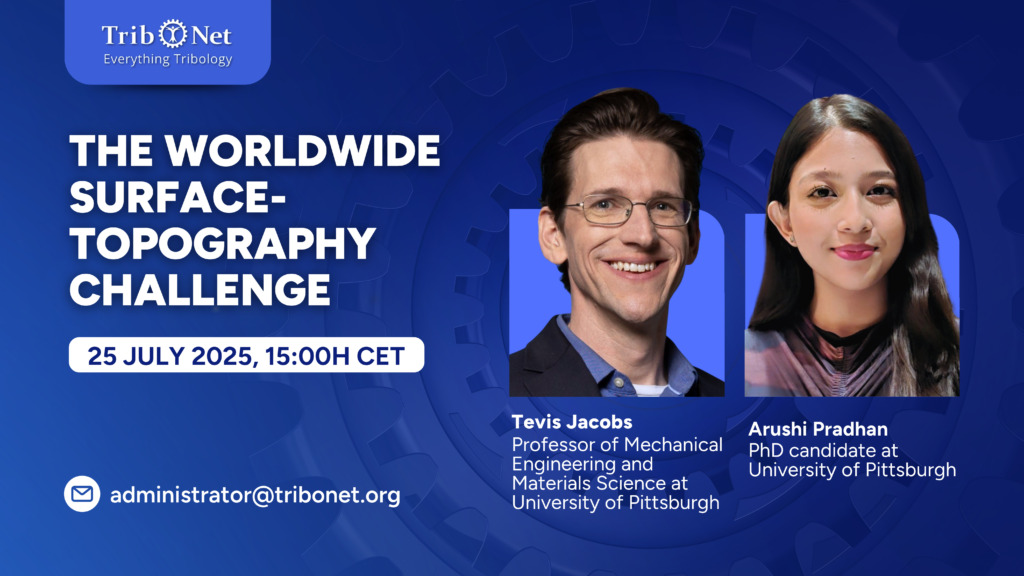
In a recent international webinar, Professor Tevis Jacobs and Dr. Arushi Pradhan presented the major insights from this global initiative. Their findings revealed not only the complexity of surface topography but also the need for a more unified and accurate approach to measuring it.
What Is the World Surface Topography Challenge?
The challenge began in 2022 during the Gordon Research Conference in Tribology. Its main goal was to improve how researchers measure and interpret surface texture, a crucial property that determines how materials interact with each other—whether in biomedical implants, lubricated mechanical parts, or coating technologies.

Over 150 participants from 20 countries joined the initiative. Each participant analyzed identical surface samples that included both smooth and rough textures, but they used different instruments such as AFM (Atomic Force Microscopy), white light interferometry, stylus profilometry, and confocal microscopy.
The wide variety of tools and methods created a rich dataset, allowing researchers to directly compare how different techniques influence surface roughness measurements.
Key Lessons from the Challenge
1. One Technique Is Not Enough
One of the clearest findings was that no single measurement technique can fully describe a surface. Each method has its own strengths and limitations, and using only one can easily lead to misleading results.
For instance, while optical methods can capture a large area quickly, they may miss fine-scale details. Meanwhile, atomic force microscopy provides nanometer-level precision but only over small regions. Combining these methods gives a more complete and reliable view of the surface.

This takeaway is especially valuable for industries where precision is everything—like aerospace engineering and medical device manufacturing—where even microscopic differences in roughness can affect performance or safety.
2. Resolution and Calibration Matter

Another important point was resolution correction. Many measurement instruments have resolution limits that can distort data if left uncorrected.
Professor Jacobs emphasized that surface topography data must always be adjusted to account for these limitations. Without correction, two researchers could measure the same surface but report drastically different results simply because their instruments had different sensitivity levels.

This insight encourages laboratories to regularly calibrate and verify their equipment and to be transparent about instrument settings and parameters used during testing.
3. Go Beyond a Single Number
Perhaps the most memorable message from the challenge came directly from Professor Jacobs:
“A single number cannot describe a surface; the entire curve is what defines topography.”
In other words, reporting surface roughness as just one number—like Ra (average roughness) or RMS height—is not enough. Surfaces behave differently depending on the scale of observation. A texture that appears smooth under one magnification may look rough and uneven under another.
The challenge encouraged participants to use scale-dependent parameters and surface spectra, which can more accurately describe how a surface behaves across multiple size ranges. This perspective shift represents a major step toward more realistic and reliable surface metrology.
Why Surface Roughness Measurement Matters
Surface roughness is not just a laboratory concern—it directly affects how materials perform in the real world. From how oil spreads on a bearing surface to how cells attach to a titanium implant, surface texture governs physical, mechanical, and even biological behavior. However, inconsistent measurement techniques have led to confusion across scientific fields. For example, studies on bone tissue engineering often report conflicting results about how roughness influences cell growth, mainly because each used a different method to measure it.
During the challenge, researchers found that the reported RMS height values of identical samples differed by as much as six orders of magnitude, depending on the technique used. This massive variation underlines the urgent need for standardized measurement practices and data correction protocols. If measurement consistency can be improved, it could open the door to more accurate predictions of wear, adhesion, and friction—core principles in tribology and materials science.
For readers who want to explore more about how roughness measurement techniques evolve, you can refer to related studies such as Surface Roughness Measurement and Surface Roughness which dive deeper into specific methods and applications.
A New Era for Surface Science
The World Surface Topography Challenge marked a turning point in how the scientific community views surface measurement. Instead of treating it as a simple task of “getting one number,” the challenge demonstrated that understanding the entire surface spectrum is key to unlocking meaningful insights.
Moreover, the project highlighted the value of collaboration across borders and disciplines. Physicists, materials engineers, and biologists all benefited from the shared data, which revealed how diverse perspectives can lead to better, more standardized approaches. This kind of collaborative research is essential for solving real-world problems—such as improving battery interfaces in electric vehicles, enhancing lubrication in micro-mechanical systems, and designing biocompatible surfaces for implants.
Moving Forward: What Comes Next
Following the success of the World Surface Topography Challenge, the organizers plan to expand the initiative with new samples, measurement methods, and data-sharing platforms. The goal is to create a global database of surface roughness data where researchers can compare their results, learn from others, and refine their methods. Such a resource would make it easier to benchmark instruments, establish common calibration standards, and ultimately make surface metrology more reliable worldwide.
As surface measurement continues to evolve, it will play an even bigger role in emerging technologies—like nanomanufacturing, wear-resistant coatings, and 3D-printed materials—where understanding texture at the micro- and nanoscale can define the difference between success and failure.
Conclusion
The World Surface Topography Challenge has not only exposed the limitations of current surface measurement methods, but also provided a roadmap for improvement. By encouraging the use of multiple techniques, resolution correction, and scale-aware analysis, this initiative is setting new standards for surface science. Whether you’re in tribology, materials science, or biomedical research, these insights can help you better understand—and control—how surfaces behave in the real world.
Contact
For further information, you can contact the organizers at:
🔗 https://contact.engineering/challenge
📧 E-mail: [email protected]
Keywords
surface roughness, surface topography, surface measurement, tribology, materials science, World Surface Topography Challenge, roughness analysis, surface texture, resolution correction, surface metrology
0 Comment