








Friction and Wear of Elastomer Seals: A Practical Guide for Machine Builders
By the engineering team at O-Ring Supply Co.
Elastomer seal friction and wear affect positioning accuracy, actuator efficiency, heat generation, leakage, and service life. Yet seal selection is often reduced to hardness, temperature range, and chemical compatibility. For a dynamic seal, the useful engineering question is broader: how will the compound, lubricant, counterface texture, geometry, pressure, temperature, and motion interact over the full duty cycle?
Why seal friction is a system property
The friction of a reciprocating elastomer seal can include adhesion and shearing at real contact areas, deformation losses within the viscoelastic material, and viscous shear in the lubricant film. The balance changes with speed, pressure, temperature, dwell time, surface texture, lubricant supply, and seal design. A single coefficient of friction from a simplified material test therefore cannot describe every operating point.
Low-speed motion deserves special attention. During dwell, lubricant can be displaced from the interface and adhesion can increase. On restart, breakaway friction may be much higher than steady sliding friction. If friction decreases with increasing velocity over part of the operating range, the interaction with drive-system compliance can produce stick-slip. The critical velocity is application-specific; it should be measured under representative conditions rather than inferred from a universal threshold.
Reading a Stribeck-style seal-friction curve
A Stribeck-style curve is a useful conceptual map for the transition from boundary-dominated contact through mixed lubrication toward greater fluid-film contribution. Real seal curves do not always follow the textbook shape, and their axes cannot be transferred directly between compounds, geometries, and fluids.
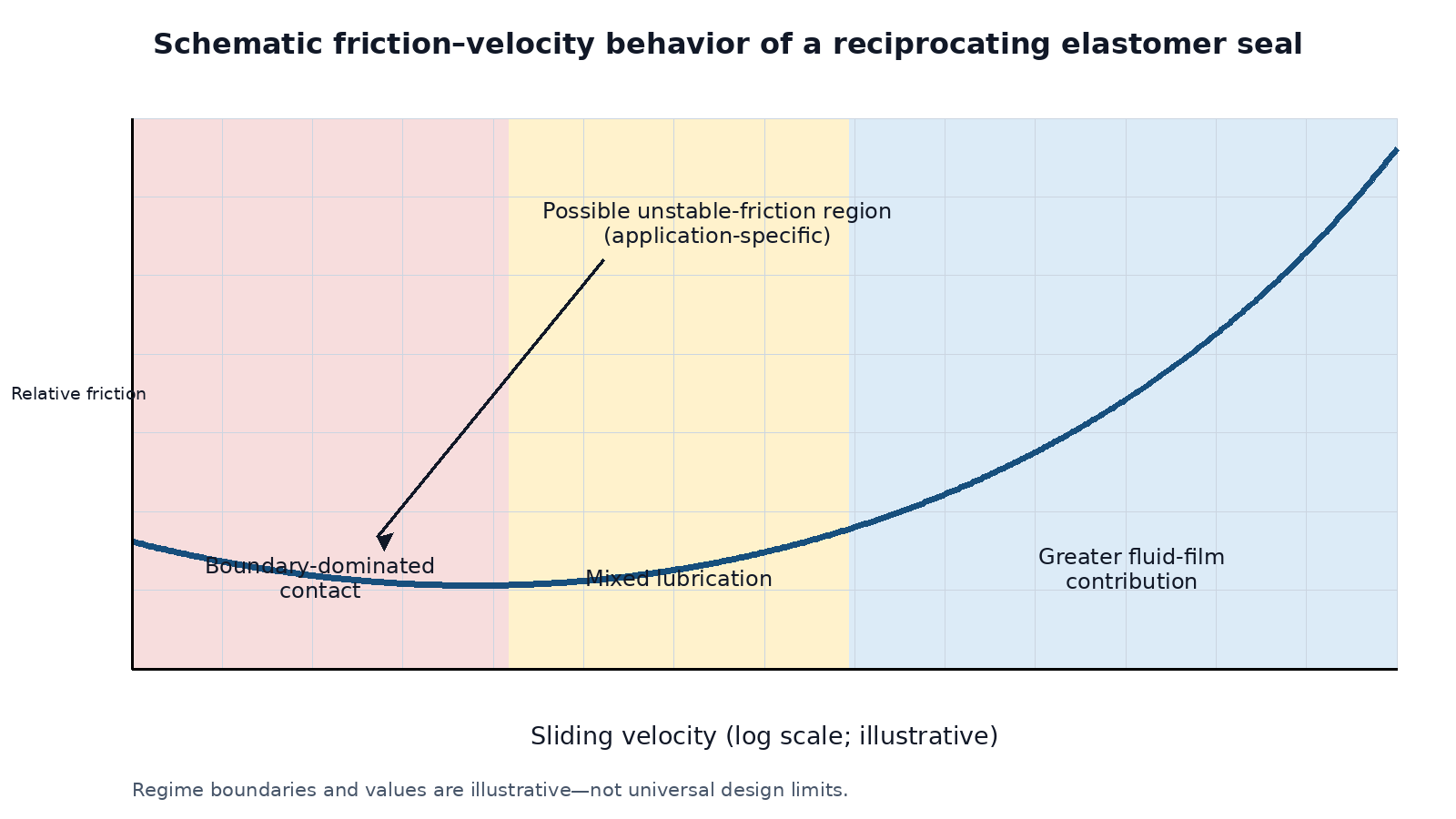
Validate the actual breakaway and running-friction curve for the intended seal, lubricant, counterface, pressure, and temperature.
Counterface texture: more than an Ra value
The counterface is part of the sealing system. A surface that is too rough can abrade the elastomer, disturb the lubricant film, and create leakage paths. A surface that is extremely smooth may provide insufficient lubricant retention for some seal-lubricant combinations. The acceptable window depends on the seal design and supplier specification.
Ra alone does not fully describe a functional sealing surface. Peak height, valley structure, material ratio, waviness, defects, and texture direction can all matter. Rotary sealing surfaces also require control of lead because directional machining marks can pump fluid. For reciprocating seals, the manufacturing process and texture direction should follow the seal supplier’s application-specific guidance rather than a generic rule.

For a broader treatment, see TriboNet’s guide to surface roughness interpretation in tribology.
Common elastomer wear mechanisms
Abrasive wear occurs when hard asperities or particles remove material. Adhesive damage can leave glossy streaks, transfer, or local tearing after strong interfacial contact. Fatigue damage develops through repeated deformation and can produce cracks or surface spalling. Thermal or chemical degradation can accelerate each mechanism by changing the polymer network and reducing surface strength.
Failure analysis should begin with the removed seal, counterface, lubricant, and operating history. A cut or nick may point to installation damage. Extrusion at a clearance gap calls for a review of pressure, clearance, temperature, and backup-ring design. Glazing, hardening, swelling, softening, or cracking may indicate temperature or fluid incompatibility. Different evidence calls for different corrective action.
Material selection for friction and wear
NBR, FKM, EPDM, polyurethane, silicone, and PTFE-based sealing materials occupy different chemical, thermal, mechanical, and tribological envelopes. No family is universally “low friction” or “wear resistant” because formulation, hardness, fillers, geometry, lubrication, and surface condition strongly influence behavior.

- NBR: widely used with many mineral-oil systems; grade selection must match temperature and fluid chemistry.
- FKM: often selected for high-temperature and chemically demanding service, but many grades have poorer low-temperature flexibility than NBR.
- EPDM: useful in many water, steam, and glycol duties but generally unsuitable for mineral oils unless a specific formulation is approved.
- Polyurethane: valued in many hydraulic applications for mechanical strength and abrasion resistance, subject to fluid and temperature compatibility.
- PTFE-based seals: can reduce friction and stick-slip, but sealing force, leakage control, creep, counterface requirements, and energizer design still need attention.
Fillers and internal lubricants can change friction, wear, extrusion resistance, compression set, and fluid response simultaneously. Compare complete compounds and tested seal designsânot polymer-family labels alone.
Lubrication, dwell, and running-in
Lubrication affects breakaway friction, running friction, heat generation, and wear. A new seal and counterface can pass through a running-in period as high spots change and a transfer or boundary film develops. Acceptance testing should therefore define whether results are taken on a fresh interface, after a controlled running-in sequence, or at a stabilized condition.
Grease and elastomer compatibility must cover more than base-fluid compatibility. Thickeners, additives, temperature, time, and volume change can all matter. Confirm compatibility with the seal and lubricant suppliers, then validate it under representative exposure and motion.
Installation and groove geometry
Installation damage often masquerades as premature wear. Sharp edges, inadequate lead-in chamfers, twisting, contamination, incorrect tools, or dry assembly can damage a seal before service begins. Groove dimensions, squeeze, stretch, clearance, and thermal volume expansion should be checked against the selected seal manufacturer’s design limits. There is no single gland-fill limit that is correct for every seal type and duty.

For preliminary geometry checks, TriboNet’s Dynamic O-Ring Piston and Rod Seal Calculator can help structure the inputs; final dimensions should still be confirmed against the manufacturer’s data and applicable standards.
Practical checklist for machine builders
- Specify the seal compound, geometry, squeeze, pressure, temperature, fluid, stroke, speed, and dwell time.
- Use the supplier’s counterface specification and record more than Ra when texture is critical.
- Measure breakaway friction separately from stabilized running friction.
- Evaluate friction, leakage, temperature, and wear together.
- Inspect both the failed seal and counterface before changing materials.
- Confirm fluid and grease compatibility with the exact compound.
- Protect seals from sharp edges and contamination during assembly.
- Define and document running-in before acceptance testing.
Frequently asked questions
Is a smoother counterface always better for an elastomer seal?
No. Excessive roughness can accelerate wear and leakage, while an extremely smooth surface may not retain enough lubricant in some applications. Follow the seal supplier’s specification and consider texture direction and functional parameters beyond Ra.
Why is breakaway friction higher after a seal has been stationary?
Dwell can allow lubricant squeeze-out and greater adhesive contact. Temperature, pressure, fluid, surface texture, compound, and dwell duration all influence the peak.
Can a low-friction seal still fail?
Yes. Friction, leakage, wear, extrusion resistance, chemical compatibility, and service life must be evaluated together. Optimizing one result can degrade another.
How should stick-slip be evaluated?
Measure friction and motion stability over the actual low-speed range using representative pressure, temperature, lubricant, counterface, seal geometry, and drive-system compliance. Avoid relying on a universal speed threshold.
References and further reading
- Stribeck curve and lubrication regimes, TriboNet Tribology Glossary.
- Stick-slip phenomenon in friction, TriboNet.
- Wear mechanisms, TriboNet Tribology Glossary.
- The evolution of rotary lip seals, TriboNet.
- Parker O-Ring Handbook, ORD 5700, Parker Hannifin.
About the author and disclosure
This article was prepared by the engineering team at O-Ring Supply Co., a commercial supplier of O-rings and engineered elastomer seals in FKM, NBR, EPDM, silicone, and PTFE materials. The contributor states that the article is original and that the rights to the submitted diagram are held by the author. The company link in this disclosure is the article’s single promotional link.
0 Comment